Markets II: Rates, FX and Credit · Markets
16FX Swaps, Forwards and the Cross-Currency Basis
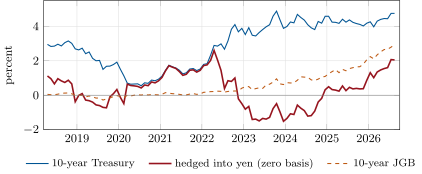
At the end of August 2026 a ten-year US Treasury yielded 4.75% and a ten-year Japanese government bond 2.94%. A Japanese insurer that buys the Treasury earns 1.81 percentage points more, but it owes its policyholders yen, and a fall of the dollar would wipe that out many times over, so it hedges: it sells the dollars forward, three months at a time. With the dollar overnight rate at 3.68% and the yen’s under 1%, each roll of the hedge costs about 2.70 percentage points a year, more than the extra yield, before the market charges anything extra for lending dollars. The hedged Treasury yields about 2.05%, less than the Japanese bond. This chapter is about the instruments that set that cost: the outright forward, the FX swap that is the most traded instrument in foreign exchange, the parity that links them to interest rates, and the basis by which that parity has failed since 2007.
16.1 Outright forwards and forward points
Definition 16.1 (Outright forward, forward points)
An outright forward is an agreement to exchange two currencies at a rate fixed today, for value on a date after spot. Its forward points are expressed in pips of the pair: the market quotes forwards as points added to the spot rate.
A forward is priced by an argument that uses nothing but deposits. Borrow one unit of the base currency for the period at its rate , sell it spot for units of the quote currency, and lend those at the quote currency’s rate : at maturity you owe of the base and own of the quote, where are the accrual fractions in each currency’s day count. The forward that makes the round trip worth nothing is the covered-parity forward.
Definition 16.2 (Covered interest parity)
Covered interest parity (CIP) is the relation
between spot, forward and the two currencies’ money-market rates over the same period.
The currency with the higher interest rate trades at a forward discount: its forward buys less of the other than its spot does, and the lower yield of the other currency is made up by the gain in the exchange rate. USDJPY is quoted in yen per dollar; with dollar rates above yen rates, its forward points are negative.
Example 16.3 (Three-month USDJPY)
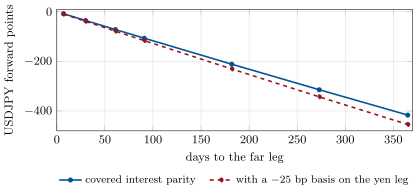
With USDJPY at 156.87, a dollar rate of 3.68% (actual/360) and a yen rate of 0.977% (actual/365), the 91-day forward by Equation 16.1 is 155.8028: forward points of pips of 0.01 yen. A basis of basis points on the yen leg, as defined below, lowers it to 155.7059, pips. The one-day tom-next points are .
16.2 FX swaps and short-dated rolls
Definition 16.4 (FX swap, tom-next)
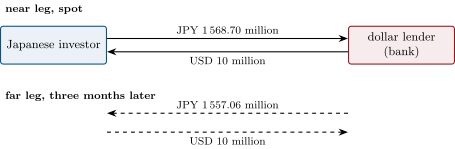
An FX swap is a pair of opposite exchanges of the same amount of one currency: a near leg, usually at spot, and a far leg at a forward date, the two rates differing by the forward points. Tom-next is the one-day swap from the next business day (tomorrow) to the day after (next), with which positions are rolled from one spot date to the next.
An FX swap is a collateralised loan. The party that buys dollars at the near leg and sells them back at the far leg has borrowed dollars and lent the other currency for the period, each loan secured by the other; the forward points are the interest differential. It is by far the largest FX instrument: USD 4 trillion a day in April 2025, 42% of all FX turnover, mostly for seven days or less (Chapter 14). Banks use it to fund their dollar assets, investors to hedge their foreign holdings, and a trader who holds a spot position rolls it every day with a tom-next swap, paying or earning the day’s points: this is the carry of an FX position.
16.3 Covered interest parity
Before 2007 CIP held within transaction costs, because any gap was a riskless profit for a bank: if dollars were cheaper to borrow through FX swaps than in the money market, a bank would borrow them through swaps and lend them in cash, and its trades would close the gap. Economists at the BIS called it “the closest thing to a physical law in international finance”. The same economists documented, in 2016, that it had been systematically violated since the financial crisis of 2007–2008.
Proposition 16.5 (Forward points by tenor)
Under CIP with flat rates, the forward points of a pair grow almost in proportion to the tenor, for short tenors, and a basis on the quote leg adds approximately .
Proof. Expand Equation 16.1 to first order in : . With in place of the term appears. ∎
16.4 The cross-currency basis
Definition 16.6 (Cross-currency basis swap, cross-currency basis)
A cross-currency basis swap exchanges notionals in two currencies at the start at the spot rate, exchanges floating interest in each currency during its life, one leg with a spread, and re-exchanges the same notionals at maturity. The spread is the cross-currency basis , quoted on the non-dollar leg; for short tenors it is measured from FX swaps as the gap between the yen (or euro) rate implied by forward points and the cash rate:
A negative basis on the yen means that lending yen and borrowing dollars through swaps earns less than the yen money-market rate: dollars are dearer through swaps than in cash. Since 2007 the basis against the dollar has been negative for most currencies, notably the euro and the yen, and positive for a few, such as the Australian dollar. The BIS explanation combines demand and limits. Demand: investors such as Japanese insurers hedge large dollar holdings by borrowing dollars in swaps, and companies that issue bonds in euros and swap the proceeds into dollars add to it. Limits: the banks that would arbitrage the gap now pay for the balance sheet the trade uses, in capital and leverage ratios, and do so only for a spread. Since 2014 the basis has jumped at quarter ends, with repo rates, when banks shrink their balance sheets for their reports.
For the investor of the hook the basis is a direct cost. Rolling a three-month hedge of a dollar bond costs, a year, approximately the dollar rate minus the yen rate plus the yen basis taken with its sign reversed:
As of September 2026 — The inputs of the hook
Ten-year Treasury 4.75% and SOFR 3.68% on 31 August 2026; Japanese call-money rate 0.977% and ten-year JGB 2.94% as August 2026 averages; USDJPY 156.87 on 18 September 2026 (Federal Reserve H.10). Overnight rates stand in for three-month rates, and no official series of the basis is used: its levels in this chapter are illustrative.
Figure 16.3 shows the consequence. When the Federal Reserve’s rates were far above Japan’s, from late 2018 to early 2020 and again from November 2022, the hedged Treasury yielded less than the Japanese bond even before any basis: in 57 of the 101 months shown. The investor then chooses between a lower hedged yield, an unhedged position that bets on the yen, or staying at home.
16.5 Dollar funding stress
Non-US banks hold large dollar assets funded partly through FX swaps. When dollar funding dries up, as in 2008 and March 2020, the basis widens sharply, and the central bank that issues the dollar lends it to other central banks, which lend it on to their banks. The Federal Reserve first set up such swap lines on 12 December 2007, with the ECB for up to USD 20 billion and the Swiss National Bank for USD 4 billion; on 13 October 2008 the lines with the Bank of England, the ECB and the SNB were increased “to accommodate whatever quantity of U.S. dollar funding is demanded”. In March 2020 the standing lines with five central banks were cut in price to the dollar OIS rate plus 25 basis points on 15 March, and temporary lines with nine more were opened on 19 March (Figure 16.4).
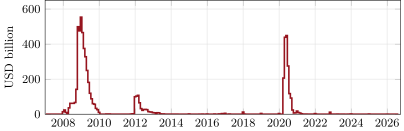
The swap lines cap the basis in a crisis, since a bank with access to its central bank’s dollar auctions will not pay much more than their rate. They do not remove it in normal times, when the drivers are hedging demand and the price of balance sheet.
16.6 Tutorial: forward points and the implied basis
Goal. Compute forward points from two money-market rates, back out the basis implied by market points, and compute a hedged yield. End state: Example 16.3, Figures 16.2 and 16.3 and the numbers of the weekend problem.
The forward and the basis, by Equation 16.1 and its inverse.
def forward(spot: float, r_quote: float, r_base: float, days: int, basis_quote: float = 0.0,
            basis_base: float = 0.0, dc_quote: int = 360, dc_base: int = 360) -> float:
    """Outright forward by covered interest parity, with a basis on either leg."""
    return spot * (1.0 + (r_quote + basis_quote) * days / dc_quote) / (1.0 + (r_base + basis_base) * days / dc_base)


def points(fwd: float, spot: float, pip: float) -> float:
    """Forward points: F - S in pips."""
    return (fwd - spot) / pip


def implied_rate_quote(spot: float, fwd: float, r_base: float, days: int, dc_quote: int = 360,
                       dc_base: int = 360) -> float:
    """The quote currency's rate implied by the swap: (F/S)(1 + r_base t) - 1, annualised."""
    return ((fwd / spot) * (1.0 + r_base * days / dc_base) - 1.0) * dc_quote / days


def basis_on_quote(spot: float, fwd: float, r_quote: float, r_base: float, days: int, dc_quote: int = 360,
                   dc_base: int = 360) -> float:
    """Cross-currency basis on the quote currency implied by market spot and forward."""
    return implied_rate_quote(spot, fwd, r_base, days, dc_quote, dc_base) - r_quote
Listing 16.1. Forward by covered parity, forward points, implied rate and basis. code/firm/fxfwd/firm_fxfwd.py The hedge, by Equation 16.2.
def hedge_cost(r_usd: float, r_other: float, basis_other: float) -> float:
    """Annualised cost, to a holder of dollar assets funded in another currency, of rolling a short-dated
    FX hedge: the dollar rate less the other currency's rate plus its basis."""
    return r_usd - (r_other + basis_other)


def hedged_yield(y_usd: float, r_usd: float, r_other: float, basis_other: float) -> float:
    """Yield of a dollar bond hedged back into the other currency with rolling short-dated swaps."""
    return y_usd - hedge_cost(r_usd, r_other, basis_other)
Listing 16.2. Hedge cost and hedged yield. code/firm/fxfwd/firm_fxfwd.py - Run
fxfwd_demo.three_month(),fxfwd_demo.hedged_now()andfig_fxfwd.py.
What to change next. Replace the overnight rates by term rates of the hedge’s tenor, and compare the hedged yield from rolling three-month swaps with that from a one-year forward.
16.7 Build: the forward and basis calculator
Purpose. The miniature firm quotes forwards and swaps to clients, funds dollar positions through swaps, and hedges investors’ currency exposure: it needs forwards from curves, the basis from market points, and hedged yields.
Interface. forward(spot, r_quote, r_base, days, basis_quote, basis_base, dc_quote, dc_base); points(fwd, spot, pip); implied_rate_quote; basis_on_quote; fx_swap_legs; hedge_cost; hedged_yield.
Rules. Simple money-market rates with each currency’s day count; basis on the non-dollar leg; forward points in the pair’s pips.
Acceptance tests. code/firm/fxfwd/tests/: CIP forward and its inverse; the basis recovered from a forward built with it; FX swap legs that net to the interest differential; the hedged yield lower with a negative basis.
Stretch. Forward curves from full discount curves in each currency (Section 9.7); broken dates; a cross-currency basis swap priced on two curves with the basis as a spread.
Sources and further reading
- C. Borio, R. McCauley, P. McGuire and V. Sushko, “Covered interest parity lost: understanding the cross-currency basis”, BIS Quarterly Review, September 2016.
- Bank for International Settlements, Triennial Central Bank Survey 2025.
- Federal Reserve, press releases of 12 December 2007, 13 October 2008, 15 and 19 March 2020; H.4.1 and H.10 releases.
- FRED series DGS10, SOFR, IRSTCI01JPM156N, IRLTLT01JPM156N and SWPT.
16.8 Exercises
Exercise 16.1 ★
EURUSD is 1.1464, the euro rate 2.00% and the dollar rate 3.68%, both actual/360. Give the 90-day forward and its points.
Solution
Solution of Exercise 16.1.
: pips. The euro, with the lower rate, trades at a forward premium.
Exercise 16.2 ★
Why does the currency with the higher interest rate trade at a forward discount?
Solution
Solution of Exercise 16.2.
Otherwise there would be a riskless profit: borrow the low-rate currency, convert it spot, lend at the high rate and sell the proceeds forward. For this to earn nothing, the forward must give back less of the low-rate currency per unit of the high-rate one than spot did: the high-rate currency’s forward discount offsets its interest advantage.
Exercise 16.3 ★
In the swap of Figure 16.1, who has borrowed which currency, and what is the yen cost of the dollars?
Solution
Solution of Exercise 16.3.
The investor has borrowed USD 10 million and lent JPY 1 568.70 million for three months, each loan the collateral of the other. It receives back JPY 1 557.06 million: the JPY 11.64 million difference is the cost of the dollars, the dollar interest less the yen interest, plus the basis.
Exercise 16.4 ★★
The market’s three-month USDJPY forward is 155.7059 with the rates of Example 16.3. What basis does it imply, and what does its sign mean?
Solution
Solution of Exercise 16.4.
basis points: lending yen and borrowing dollars through the swap earns the yen rate less 0.25%. Dollars are dearer through the swap than in cash, the usual sign since 2007.
Exercise 16.5 ★★
A trader long USD 100 million against yen rolls the position with tom-next. Using the tom-next points of Example 16.3, what does one roll earn or cost, in yen?
Solution
Solution of Exercise 16.5.
Long dollars, the trader sells them for the near date and buys them back for the next at 1.18 pips (0.0118 yen) lower: it earns about JPY 1.18 million a day, the carry of holding the higher-yielding currency.
Exercise 16.6 ★★
Why do quarter ends move the basis, and why did the swap lines of March 2020 narrow it?
Solution
Solution of Exercise 16.6.
At quarter ends banks shrink their balance sheets for their reports and regulatory ratios, so arbitrage capacity falls and those needing dollars through swaps pay more: the basis widens. In March 2020 swap lines let central banks lend dollars to their banks at the OIS rate plus 25 basis points; no bank with access needed to pay much more than that in swaps, so the basis narrowed.
Exercise 16.7 ★★★
Coding. With hedged_series, find the first month in the data when the zero-basis hedged Treasury yielded less than the JGB, and count such months.
Solution
Solution of Exercise 16.7.
December 2018; 57 of the 101 months in the data.
Exercise 16.8 ★★★
Find the flaw. “The basis is negative, so a bank can borrow dollars in the money market, lend them through FX swaps and lock in a riskless profit; this will close the basis within days.” Correct it.
Solution
Solution of Exercise 16.8.
The trade uses balance sheet: the bank lends dollars and holds yen assets, which count in its leverage and capital ratios, and at quarter ends cost more still. It will do the trade only if the basis pays for that; the basis is the price of balance sheet, not a free profit, and hedging demand keeps it open.
16.9 Problem: The Hedged Yield
Problem 16.1
Weekend problem — what a Treasury yields to a yen investor
A Japanese life insurer considers buying ten-year Treasuries at 4.75% on 31 August 2026 and hedging them into yen with rolling three-month FX swaps. Dollar rates are 3.68%, yen rates 0.977%, USDJPY 156.87; the ten-year JGB yields 2.94%.
Part I — The hedge.
- Give the three-month forward with no basis, and its points.
- Give the annualised cost of the hedge with no basis.
- Give the hedged yield with no basis.
- Give it with a basis of and basis points.
- Compare each with the JGB.
Part II — The mechanics.
- What does the insurer do at each roll?
- What happens to the hedge’s cash flows if the dollar falls 10% in a quarter?
- Why does the insurer need yen liquidity, and when?
- How does a one-year forward hedge differ from rolling three-month swaps?
- What would make the hedge cheaper?
Part III — The alternatives.
- What does the insurer earn unhedged, and what does it risk?
- What break-even does the dollar need, over a year, for the unhedged position to beat the JGB?
- Why might it hedge only half?
- Why do such flows widen the basis?
- Who takes the other side of its FX swaps?
Part IV — Judgement.
- When did hedged Treasuries last beat JGBs in the data, and why then?
- How would a cut of 100 basis points by the Federal Reserve change the answer?
- Why is the basis the insurer pays not a free lunch for the bank that lends the dollars?
- State the named result: the hedged yield of the Treasury for the insurer.
- In one sentence: what does a hedged investor in foreign bonds earn?
Solution
Solution of Problem 16.1.
1. 155.8028, pips. 2. percentage points a year. 3. . 4. 1.80% and 1.55%. 5. All below the JGB’s 2.94%, by 0.89, 1.14 and 1.39 points. 6. It closes the maturing swap, paying or receiving yen for the change in the dollar’s value since the last roll, and opens a new three-month swap at the new spot and points. 7. The swap gains in yen what the bonds lose: the insurer receives about 10% of the hedged notional in yen at the roll, offsetting the fall in the yen value of its dollar bonds. 8. When the dollar rises, the hedge loses and the insurer must pay yen at the roll while the gain on the bonds is unrealised; it needs cash for that. 9. It fixes the cost for a year and avoids three rolls, but at the one-year points and basis, and settles the whole year’s revaluation at once. 10. Lower dollar rates, higher yen rates, or a narrower basis. 11. 4.75% plus or minus the change in the dollar, which in a bad year can be many times the 1.81-point advantage. 12. The dollar must not fall by more than about 1.81% over the year against the yen for the unhedged Treasury to match the JGB. 13. To trade some yield against some currency risk, within its limits, and to reduce its need for rolling cash. 14. They are one-way demand to borrow dollars through swaps; the banks that supply them charge for balance sheet. 15. Banks, and through them investors with dollars to lend, such as money funds lending in repo, and at times central-bank swap lines. 16. In October 2022, just before the Federal Reserve’s rates had risen far enough above Japan’s to push the zero-basis hedged yield below the JGB’s. 17. It lowers the dollar rate and the hedge cost by 1 point: the hedged yield rises to about 3.05% with no basis, above the JGB’s 2.94%, if bond yields do not move. 18. Because it uses the bank’s balance sheet, which is costly; the basis pays for it, and at quarter ends the bank may not lend at all. 19. Named result: the hedged yield of the ten-year Treasury for the insurer was about 2.05% with no basis, 1.80% with a basis-point basis, against 2.94% on the JGB. 20. The foreign yield less the short-rate differential and the basis: the hedge takes back what the higher rates give.
16.10 Interview questions
Interview question 16.1 ★ trader, researcher
Derive the forward exchange rate from spot and interest rates.
Solution
Solution of Interview question 16.1.
Borrow one unit of the base currency at , sell it spot for , lend the proceeds at , and agree today to buy back the base at : no initial cost, no risk, so , that is .
What the interviewer is looking for: the replication argument and the day counts.
Interview question 16.2 ★ bank, trader
What is an FX swap, and why is it the most traded FX instrument?
Solution
Solution of Interview question 16.2.
A spot exchange and its reversal at a forward date: a collateralised loan of one currency against another. Banks fund foreign-currency assets with it, investors roll currency hedges with it, dealers manage positions and liquidity with it, and most of it is very short-dated, so it is traded again and again.
What the interviewer is looking for: the loan interpretation and the uses.
Interview question 16.3 ★★ researcher, trader
Why has covered interest parity failed since 2008?
Solution
Solution of Interview question 16.3.
First, in 2008 and in the euro crisis, banks’ credit and funding strains stopped arbitrage. Since 2014, strong one-way hedging demand to borrow dollars through swaps (investors, issuers swapping foreign bonds, banks) has met limits to arbitrage: regulation makes balance sheet costly, especially at quarter ends, so the gap persists at the price of balance sheet.
What the interviewer is looking for: demand plus limits to arbitrage, not a single cause.
Interview question 16.4 ★★ trader
How would you hedge a portfolio of euro bonds for a dollar investor, and what does the hedge earn or cost?
Solution
Solution of Interview question 16.4.
Sell euros forward against dollars for the portfolio’s value, rolling one- or three-month FX swaps and adjusting the notional as the value changes. The hedge earns the dollar rate less the euro rate, plus or minus the basis: with dollar rates higher, a dollar investor gains from hedging euro bonds, and the negative euro basis adds to that gain. Rebalancing and cash flows at each roll are the operational costs.
What the interviewer is looking for: the sign of the carry and the role of the basis.
Interview question 16.5 ★★ bank
What happens in the FX swap market at a quarter end, and what would a bank do about it?
Solution
Solution of Interview question 16.5.
Swaps that span the quarter end become dearer: banks that report on that date shrink the balance sheet they lend, so implied dollar rates and the basis jump. A bank with spare balance sheet lends into the spike; one that needs dollars funds ahead of time, before the turn is priced.
What the interviewer is looking for: the balance-sheet mechanism and a pre-funding response.
Interview question 16.6 ★★★ developer, researcher
Design a service that publishes forward points for fifty pairs and all standard tenors, and the implied basis, from rate curves and market points.
Solution
Solution of Interview question 16.6.
For each currency, a discount or money-market curve refreshed from its sources; for each pair, spot and market points by tenor. Compute CIP points from the curves with the right day counts and spot dates, and the implied basis from market points; interpolate broken dates on the basis, not on the points; flag stale inputs and outliers; publish with timestamps; test against hand-computed cases and round trips between points and basis.
What the interviewer is looking for: conventions per currency, interpolation on the basis, and checks.