Markets II: Rates, FX and Credit · Markets
13The Rates Options Market
On 11 June 2014 the European Central Bank cut the rate it pays on deposits to , and over the next five years to . German ten-year yields were below zero in 38 months between mid-2016 and early 2022. For the options market this was not a curiosity but a breakdown. The model long standard for these options, Black’s, assumes that a rate moves in proportion to its level, and a rate of that rises to has moved 100%; below zero the model has no answer at all. The market switched to quoting in the units a rates trader thinks in, basis points of movement, with a model written in 1900 by a French doctoral student. This chapter explains the options traded on interest rates, caps, floors and swaptions, the normal volatility in which they are quoted, and the structural flows, from callable bonds and mortgages, that set their prices.
13.1 Caps and floors
Definition 13.1 (Caplet, cap, floor)
A caplet with strike on a floating rate for a period of length pays at the end of the period, where is the rate fixed for that period. A cap is a strip of caplets on consecutive periods; a floor is the same strip of floorlets, each paying .
A borrower who pays a floating rate buys a cap to limit what it can pay; a lender, or an investor in floating-rate notes, buys a floor. Buying a cap and selling a floor is a collar, often struck so that the two premiums cancel. Each caplet is an option on one forward rate, so a cap is priced as a sum of single-period options with one volatility per period, or one flat volatility quoted for the whole cap.
Example 13.2 (A cap and a zero-cost collar)
On a flat 4% curve, a five-year cap at 4.5% on USD 100 million of an annual rate, with the first period already fixed, has four caplets fixing in one to four years. At a normal volatility of 100 basis points a year they are worth USD 182 874, 310 339, 401 400 and 470 709: USD 1.37 million in all, 137 basis points of notional. A floor at 3.5% is worth exactly the same, since the forward sits halfway between the strikes and the normal model is symmetric: the borrower who buys the cap and sells the floor pays nothing and keeps its rate between 3.5% and 4.5%.
13.2 Swaptions
Definition 13.3 (Swaption, payer, receiver; callable bond)
A swaption is an option to enter an interest-rate swap at a fixed rate on a future date. A payer swaption gives the right to pay fixed; a receiver swaption the right to receive fixed. At expiry a payer is worth , where is the par rate of the underlying swap then and its annuity. A callable bond is a bond its issuer may repay early, at a set price on set dates.
Swaptions are named by expiry and tenor: a 1y10y is a one-year option on a ten-year swap. A payer is a bet on higher rates, a receiver on lower rates; the pair struck at the forward, the straddle, is a bet on how much rates move, in either direction (Figure 13.1). The annuity turns a rate difference into money: pricing uses the forward swap rate and the forward annuity, and in that measure the swap rate is a martingale, so the swaption is priced like an option on a single rate.
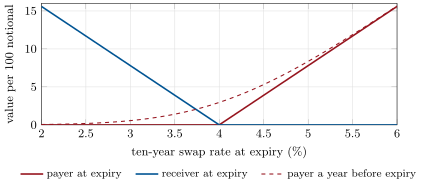
Callable bonds are one natural source of swaption supply. An issuer that sells a ten-year bond callable in three years holds the right to stop paying its coupon from year three, which is a receiver swaption: when rates fall, it calls the bond and refinances. Issuers that fund at a floating rate swap the bond with a dealer and sell that right to the dealer inside the swap, which the dealer can cancel on the call date; the dealer is then long a receiver swaption, and long volatility, and sells swaptions to other investors to lay the risk off (Figure 13.2). The weekend problem does this trade.

Mortgages run the other way. The holder of a mortgage-backed security is short the borrowers’ refinancing option (Chapter 12), and some hedge that negative convexity by buying swaptions. Issuers of callable debt are natural sellers of volatility, mortgage investors natural buyers, and dealers stand between them.
13.3 Normal volatility
Definition 13.4 (Bachelier model, normal volatility)
The Bachelier model, published by Louis Bachelier in 1900, assumes that the forward rate follows : it moves by normally distributed amounts, independent of its level, and can go negative. Its parameter , in basis points a year, is the normal volatility; the implied normal volatility of an option is the at which the model reproduces its price.
Proposition 13.5 (The Bachelier price)
In the Bachelier model a payer with strike and expiry , on a forward rate with annuity , is worth
and a receiver is the payer less . At the money each is worth , so a straddle costs .
Proof. is normal with mean and standard deviation . With , , using . Put–call parity gives the receiver, and the at-the-money value. ∎
A trader converts the annual normal volatility into a daily one to compare it with what rates actually do: 95 basis points a year is basis points a business day. If the ten-year rate moves more than six basis points a day on average over the option’s life, a delta-hedged straddle bought at 95 makes money; less, and it loses. Quoting in normal volatility makes this comparison immediate, and it remains the usual convention for rates options now that rates are positive again.
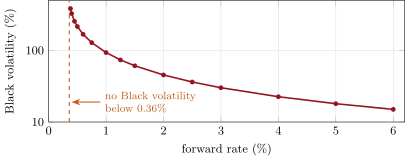
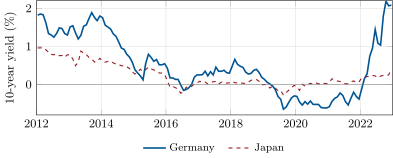
The lognormal, Black, quote is still used and must be converted. At the money, ; away from it the models’ smiles differ. Near zero the conversion explodes (Figure 13.3): 90 basis points of normal volatility is a Black volatility of 22.5% at a 4% forward, 93% at 1% and 215% at 0.5%, and below a forward of about 0.36% no Black volatility at all reproduces the price, because a Black call can never be worth more than the forward. When euro and yen rates spent years near and below zero (Figure 13.4), Black quotes stopped carrying information and the normal quote took over.
Example 13.6 (A straddle)
On a flat 4% curve the 1y10y forward annuity is 7.80. At 95 basis points of normal volatility, a straddle on USD 100 million costs of notional, USD 5.91 million. Divided by the annuity it is 75.8 basis points: the ten-year rate must end more than about 76 basis points away from 4% for the straddle held to expiry to pay for itself.
13.4 The volatility cube and who trades it
Definition 13.7 (Volatility cube)
The volatility cube of a currency is the set of implied volatilities of its swaptions by expiry, tenor of the underlying swap and strike. Its at-the-money face, expiry by tenor, is the swaption matrix; the strike dimension is the smile.
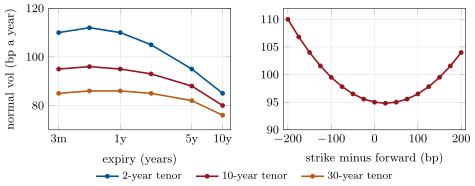
A rates options desk quotes and risk-manages the whole cube. Its at-the-money matrix has a term structure in each direction (Figure 13.5): short expiries on short tenors move with the next central-bank decisions, long expiries on long tenors with the slow flows of callable issuance and mortgage hedging. The smile, which a model such as SABR (One Quant Book 6) interpolates, prices the tails; for rates it is usually higher on both sides of the money, and asymmetric.
The flows that shape the cube can be large and one-sided. In Taiwan, a law of May 2014 let life insurers hold locally issued foreign-currency bonds outside their cap on overseas assets; every dollar bond sold there in the following months was callable by its issuer, with maturities of twenty or thirty years, and three in four paid no coupon. Each such issue, swapped by its issuer, leaves a dealer long a long-dated receiver swaption that it must sell on: a steady supply of long-dated volatility, from the balance sheets of one country’s insurers.
As of September 2026 — The market’s size
Over-the-counter derivatives notional outstanding was USD 846 trillion at the end of June 2025, 16% more than a year earlier, 79% of it in interest-rate derivatives; their gross market value was USD 21.8 trillion (BIS statistics published 8 December 2025). Swaptions, caps and floors are a part of the interest-rate total; the BIS breaks options out in its detailed tables.
13.5 Tutorial: normal and lognormal quotes
Goal. Price caps and swaptions in the Bachelier and Black models, convert quotes between them, find where the conversion fails, and price a straddle and a callable bond’s option from a cube slice. End state: Figures 13.1 and 13.3, Examples 13.2 and 13.6 and the numbers of the weekend problem.
The two pricers and the vega of Proposition 13.5.
def bachelier(f: float, k: float, t: float, vol: float, annuity: float = 1.0, payer: bool = True) -> float:
    """Normal model: F_T = F + vol * W_T."""
    s = vol * math.sqrt(t)
    if s <= 0.0:
        return annuity * max(f - k if payer else k - f, 0.0)
    d = (f - k) / s
    call = (f - k) * _cdf(d) + s * _pdf(d)
    return annuity * (call if payer else call - (f - k))


def black(f: float, k: float, t: float, vol: float, annuity: float = 1.0, payer: bool = True) -> float:
    """Lognormal model: needs F > 0 and K > 0."""
    if f <= 0.0 or k <= 0.0:
        raise ValueError("Black's model needs a positive forward and strike")
    s = vol * math.sqrt(t)
    d1 = math.log(f / k) / s + 0.5 * s
    call = f * _cdf(d1) - k * _cdf(d1 - s)
    return annuity * (call if payer else call - (f - k))


def normal_vega(f: float, k: float, t: float, vol: float, annuity: float = 1.0) -> float:
    """Price change per unit of normal volatility (same for payer and receiver)."""
    s = vol * math.sqrt(t)
    return annuity * math.sqrt(t) * _pdf((f - k) / s)
Listing 13.1. Bachelier and Black prices, normal vega. code/firm/normalvol/firm_normalvol.py Implied volatility and conversion, by bisection, refusing a price that no volatility reproduces.
def implied(price: float, f: float, k: float, t: float, annuity: float = 1.0, payer: bool = True,
            model: str = "normal", lo: float = 1e-8, hi: float = 20.0) -> float:
    """Implied volatility by bisection (prices increase with volatility in both models). Raises
    ValueError when no volatility in (lo, hi) reproduces the price: a Black call is worth less than
    the forward times the annuity, whatever the volatility."""
    pricer = bachelier if model == "normal" else black
    if not pricer(f, k, t, lo, annuity, payer) <= price <= pricer(f, k, t, hi, annuity, payer):
        raise ValueError("no volatility reproduces this price")
    for _ in range(200):
        mid = 0.5 * (lo + hi)
        if pricer(f, k, t, mid, annuity, payer) < price:
            lo = mid
        else:
            hi = mid
    return 0.5 * (lo + hi)


def normal_to_black(f: float, k: float, t: float, vol_n: float) -> float:
    return implied(bachelier(f, k, t, vol_n), f, k, t, model="black")


def black_to_normal(f: float, k: float, t: float, vol_b: float) -> float:
    return implied(black(f, k, t, vol_b), f, k, t, model="normal")
Listing 13.2. Implied volatility and quote conversion. code/firm/normalvol/firm_normalvol.py - Run
swaption_demo.straddle_1y10y(),swaption_demo.cap(),swaption_demo.callable_swap()andfig_swaptions.py.
What to change next. Convert the smile of Figure 13.5 into Black volatilities at a 4% and at a 1% forward, and compare the shapes; then shift the curve down 3.5 points and repeat.
13.6 Build: the normal-volatility pricer
Purpose. The miniature firm quotes caps, floors and swaptions in normal volatility, receives Black quotes from some counterparties and must convert them, and hedges vega from structured trades.
Interface. bachelier(f, k, t, vol, annuity, payer); black(…); normal_vega; implied(price, f, k, t, annuity, payer, model); normal_to_black; black_to_normal; atm_straddle(t, vol, annuity); bp_per_day(vol).
Rules. Rates and volatilities as decimals; Black refuses a non-positive forward or strike; implied volatility by bisection between explicit bounds, raising an error when the price is outside the model’s range.
Acceptance tests. code/firm/normalvol/tests/: put–call parity in both models, including negative rates; the at-the-money closed form; vega against a finite difference; implied-volatility and conversion round trips; the refusal at a 0.25% forward.
Stretch. Shifted Black; SABR in its normal form (One Quant Book 6); Bermudan swaptions by a lattice (One Quant Book 6); a cube interpolator by expiry and tenor.
Sources and further reading
- L. Bachelier, “Théorie de la spéculation”, Annales scientifiques de l’École Normale Supérieure, 1900.
- European Central Bank, key ECB interest rates; OECD long-term interest rates via FRED.
- F. Le Floc’h, “Explicit rational formulae for Bachelier (normal) implied volatility”, arXiv 2605.18343, 2026.
- Bloomberg, “Goldman leads Wall Street tapping Taiwan cash pile”, 10 September 2014 (via Insurance Journal).
- Bank for International Settlements, OTC derivatives statistics at end-June 2025.
13.7 Exercises
Exercise 13.1 ★
Express a normal volatility of 95 basis points a year in basis points a business day, and a daily volatility of 7 basis points as an annual one.
Solution
Solution of Exercise 13.1.
basis points a day; basis points a year.
Exercise 13.2 ★
A company has a floating-rate loan. Which does it buy to protect itself, a payer or a receiver swaption, a cap or a floor? And a pension fund that fears lower rates?
Solution
Solution of Exercise 13.2.
The company fears higher rates: it buys a cap on its loan’s rate, or a payer swaption if it wants the right to fix its rate later. The pension fund fears lower rates: it buys a receiver swaption, or a floor on floating income.
Exercise 13.3 ★
Why can the Black model not price an option on a rate of , and why did the market choose normal volatility rather than another fix?
Solution
Solution of Exercise 13.3.
Black models the rate as lognormal, always positive; a negative forward or strike has no logarithm. Normal volatility handles any sign without a free parameter, is quoted in the basis points traders already think in, and its daily equivalent compares directly with realised moves; a shifted lognormal model works too, but its quotes depend on the shift, which must be agreed.
Exercise 13.4 ★★
Give the price of the 1y10y at-the-money payer on USD 100 million at 95 basis points, and the straddle’s break-even move.
Solution
Solution of Exercise 13.4.
Half the straddle: of notional, USD 2.96 million. The straddle’s break-even is 75.8 basis points either way.
Exercise 13.5 ★★
Give the Black volatilities equivalent to 90 basis points of normal volatility, one year at the money, at forwards of 6%, 2% and 0.4%.
Solution
Solution of Exercise 13.5.
15.0%, 45.4% and 326.7%.
Exercise 13.6 ★★
In Example 13.2, why is the floor at 3.5% worth exactly the cap at 4.5%? Would it still be so in Black’s model?
Solution
Solution of Exercise 13.6.
In the normal model the rate at fixing is symmetric around the forward, 4%, so the chance and size of ending 50 basis points above are the same as 50 below: caplet and floorlet have equal values period by period. In Black’s model the distribution of the rate is skewed to the right, and at the same Black volatility the floor at 3.5% would be worth less than the cap at 4.5%.
Exercise 13.7 ★★★
Coding. Find the forward below which no Black volatility reproduces the one-year at-the-money price at 90 basis points of normal volatility, and check it against .
Solution
Solution of Exercise 13.7.
0.359%: the at-the-money normal price per unit annuity is , and a Black call is worth less than the forward, so no Black volatility reproduces it below that forward.
Exercise 13.8 ★★★
Find the flaw. “Swaption volatility is 20% in one currency and 60% in another: the second is three times riskier.” Correct it.
Solution
Solution of Exercise 13.8.
Lognormal volatility is a percentage of the rate’s level. At 20% on a 5% rate the market expects moves of about 100 basis points a year; at 60% on a 1% rate, about 60. In basis points, the units in which a position gains or loses, the second currency is the calmer one. Compare normal volatilities.
13.8 Problem: The Callable Issuer
Problem 13.1
Weekend problem — the vega a bank takes on from one callable bond
A bank issues USD 500 million of ten-year bonds with a 4.5% annual coupon, callable at par once, in three years. It swaps them with a dealer into floating: the dealer pays 4.5% fixed and receives floating for ten years, and may cancel the swap in three years, when the bank would call the bond. The curve is flat at 4%; the 3y7y normal volatility is 100 basis points.
Part I — The option.
- What option does the bank hold through its bond, and why?
- What option does the dealer hold through its swap?
- Give the forward swap rate and the forward annuity of the 3y7y swap.
- Is the option in or out of the money, and by how much?
- Give its value on USD 500 million, in dollars and in basis points of notional.
Part II — The dealer’s risk.
- Give its vega per basis point of normal volatility.
- Give its delta per basis point of the forward swap rate, and its sign.
- How much does the dealer lose if volatility falls 2 basis points?
- Give the vega of USD 100 million of at-the-money 3y7y straddles.
- What notional of straddles must the dealer sell to lay off the vega?
Part III — The bank.
- How does the bank get paid for the option it sells?
- Express the option’s value as a running spread over the ten years.
- When will the bank call the bond, and what happens to the swap?
- Why does the bank prefer this to a plain bond and a plain swap?
- What happens to the dealer’s hedge if rates fall to 3.5% the next day?
Part IV — The market.
- What happens to long-dated swaption volatility when many issuers do this?
- Who buys the volatility the dealers sell?
- Why is a real callable bond, callable every year, harder to hedge?
- State the named result: the vega the dealer acquires, and the straddles it sells.
- In one sentence: where does the supply of long-dated volatility come from?
Solution
Solution of Problem 13.1.
1. A receiver swaption, 3y7y struck at 4.5%: calling the bond in three years stops its 4.5% payments for seven years, which is worth having exactly when the seven-year rate is below 4.5%. 2. Cancelling a swap in which it pays 4.5% is the same as then entering one in which it receives 4.5%: a receiver swaption on the same terms. 3. 4.00%; annuity 5.336. 4. In the money by 50 basis points: a receiver struck at 4.5% on a 4% forward. 5. USD 25.87 million, 517 basis points of notional. 6. USD 176 826 per basis point of normal volatility. 7. per basis point: the receiver gains when rates fall. 8. USD 353 651. 9. USD 73 740. 10. About USD 240 million ( million). 11. In the swap’s terms: the dealer charges it a lower floating spread, or pays it an upfront amount, for the cancellation right. 12. 63.8 basis points a year: USD 25.87 million over the ten-year annuity of 8.11 on USD 500 million. 13. When refinancing for seven years costs it less than 4.5%, roughly when the seven-year rate plus its credit spread is below the coupon; the dealer cancels the swap on the same day, and the bank is left with neither. 14. Investors in the callable are paid for the option in a higher coupon; the bank sells the same option to the dealer and pays floating like any other issuer. If the dealer pays more for the option than the investors charged, the bank’s floating cost is lower than on a plain bond swapped plainly; it also reaches investors who want the extra coupon. 15. The receiver moves deeper into the money: its value rises to USD 34.76 million, its delta grows, its vega falls to USD 156 048; the dealer must rebalance both its delta and its vega hedges. 16. Dealers sell the volatility they acquire, pushing long-dated volatility down, most in the expiries and tenors of the calls. 17. Investors who need options: mortgage investors hedging negative convexity, insurers and pension funds hedging guarantees, and speculators who think volatility cheap. 18. Callable every year, it is a Bermudan swaption: the bank will call on the best date, which depends on the whole future curve; the value and the hedge need a model of the cube’s dynamics, and the hedge is a strip of European swaptions whose weights change with the market. 19. Named result: the callable’s vega is USD 176 826 per basis point of normal volatility, which the dealer lays off by selling about USD 240 million of 3y7y at-the-money straddles. 20. From issuers of callable debt, who sell the option in their bonds to dealers, who sell it on.
13.9 Interview questions
Interview question 13.1 ★ trader, researcher
What is the difference between normal and lognormal volatility, and when does it matter?
Solution
Solution of Interview question 13.1.
Lognormal volatility measures moves in proportion to the rate’s level; normal volatility in basis points, independent of the level. They agree at the money up to a factor of the forward. It matters when rates are low or negative, where lognormal quotes explode or do not exist, for smiles, which the two models shape differently, and for hedging: the delta of an option differs between the models.
What the interviewer is looking for: units, the low-rate breakdown, and the model dependence of the smile and the delta.
Interview question 13.2 ★ trader, bank
Explain a payer and a receiver swaption, and who buys each.
Solution
Solution of Interview question 13.2.
A payer is the right to enter a swap paying fixed at the strike, valuable if rates rise; a receiver the right to receive fixed. Borrowers planning to fix their debt, and investors hedging rate rises, buy payers; investors hedging falling rates, mortgage investors hedging prepayments and pension funds buy receivers; callable issuers, through their dealers, sell receivers.
What the interviewer is looking for: payoffs, and the natural buyers and sellers.
Interview question 13.3 ★★ researcher
Derive the price of an at-the-money option in the Bachelier model.
Solution
Solution of Interview question 13.3.
With and , the payer is worth , since . The straddle is twice that, about .
What the interviewer is looking for: the one-line derivation and the rule of thumb.
Interview question 13.4 ★★ trader
You are long a delta-hedged 1y10y straddle at 95 basis points. How do you know, day by day, whether you are making money?
Solution
Solution of Interview question 13.4.
Each day the hedged straddle earns roughly its gamma times the squared move over two, and pays its time decay; the two balance when the day’s move equals the implied daily volatility, 95 over , about 6 basis points. Days with larger moves make money, smaller lose; compare the realised daily moves, weighted by gamma, with six.
What the interviewer is looking for: gamma against theta, and the daily break-even move.
Interview question 13.5 ★★ bank, trader
Why does callable issuance lower long-dated swaption volatility, and mortgage hedging raise it?
Solution
Solution of Interview question 13.5.
Callable issuers sell their call options to dealers inside swaps; dealers sell the volatility on, concentrated in long expiries and tenors, which pushes their volatility down. Mortgage investors are short prepayment options and hedge by buying swaptions, or by trading dynamically in the direction of moves, which raises realised and implied volatility.
What the interviewer is looking for: the two structural flows and their opposite signs.
Interview question 13.6 ★★★ developer, researcher
Implied normal volatility must be computed for a million options a second. How would you do it, and how would you test it?
Solution
Solution of Interview question 13.6.
Use a closed-form or rational approximation of the inverse Bachelier function (accurate to near machine precision, as published for this purpose) rather than a root finder, vectorised over options; handle the edge cases (prices at or below intrinsic value, zero time, deep wings) explicitly. Test by round trips on a grid of moneyness and maturities, against a slow bisection reference, on random inputs, and on the edge cases; benchmark throughput on production-like batches.
What the interviewer is looking for: an explicit inverse, edge cases, and round-trip testing.