সব বই

পেশাদার

1 Markets I: The Ecosystem and Exchange-Traded Marketsবাজার অনলাইন 2 Markets II: Rates, FX and Creditবাজার অনলাইন 3 Markets III: Commodities, Energy and Cryptoবাজার অনলাইন 4 Quantitative Methodsপদ্ধতি অনলাইন 5 Derivatives and Volatilityডেরিভেটিভস অনলাইন 6 Rates, Credit, XVA and Riskসুদহার, ঋণ ও ঝুঁকি অনলাইন 7 Research Craft: Predictors, Backtests, Measurement, Portfoliosগবেষণা অনলাইন 8 Strategies I: Equities and Futuresকৌশল অনলাইন 9 Strategies II: Volatility, Relative Value, Macro and the Bank Desksকৌশল অনলাইন 10 Microstructure and Executionএক্সিকিউশন অনলাইন 11 Market Making and High-Frequency Tradingমার্কেট মেকিং অনলাইন 12 Machine Learning for Marketsমেশিন লার্নিং অনলাইন 13 Low-Latency Softwareপ্রযুক্তি অনলাইন 14 Networks, Hardware and Trading Infrastructureপ্রযুক্তি অনলাইন 15 Research, Data and Risk Platformsপ্রযুক্তি অনলাইন 16 The Desk and the Firmপ্রতিষ্ঠান অনলাইন 17 The Industry: Firms, Roles and Careersক্যারিয়ার অনলাইন 18 Interviews I: Maths, Probability and Speedক্যারিয়ার অনলাইন 19 Interviews II: Markets, Trading Games and the Final Roundক্যারিয়ার অনলাইন 20 Interviews III: Codeক্যারিয়ার অনলাইন
অ্যাপ পরিচিতি Coach সাইন ইন পড়া শুরু করো

বইগুলো এখনো বাংলা ভাষায় পাওয়া যায় না — ইংরেজি সংস্করণ দেখানো হচ্ছে।

Biology · পরিভাষা

Carbohydrates, lipids, proteins, nucleic acids কী?

অন্য নাম: carbohydrate · lipid · protein · amino acid · nucleic acid

Definition 1.10 High School Biology · অধ্যায় 1 — The Chemical Makeup of Living Things

Organic molecules belong to four families.

  • Carbohydrates (sugars) contain carbon, hydrogen and oxygen only. The simple sugars are single units, such as glucose C6H12O6\mathrm{C_6H_{12}O_6}; the complex carbohydrates are chains of hundreds or thousands of glucose units — starch and cellulose in plants, glycogen in animals.
  • Lipids (fats and oils) also contain only C, H and O, but with much less oxygen, and they do not dissolve in water. The commonest are the triglycerides, each made of one glycerol molecule joined to three long fatty-acid chains.
  • Proteins are chains of amino acids: twenty kinds of amino acid, all containing nitrogen, linked in a precise order into chains of fifty to several thousand units that fold into a definite shape.
  • Nucleic acids (DNA and RNA) are chains of nucleotides, containing phosphorus as well as C, H, O and N; they store and transmit genetic information, and are the subject of Chapter 3.
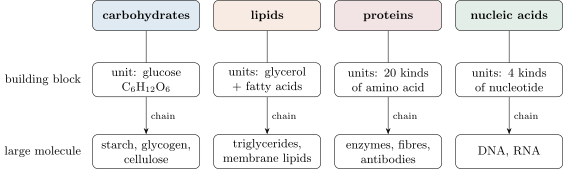
The four families of organic molecules. Each large molecule is a chain of small building blocks; the identity of the block, and the way the chain is arranged, decide what the molecule does.
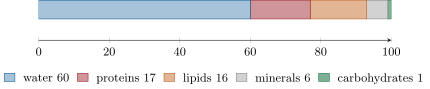
Composition of an adult human body by mass, in per cent. The figures vary with age and build (a lean athlete carries less lipid, a newborn more water), but water always dominates and free carbohydrate is never more than about 1%.

উদাহরণ

Example 1.11 (Reading a food label)

A label on wholemeal bread reads, per 100 g100\,\mathrm{g}: carbohydrates 41 g41\,\mathrm{g} (of which sugars 3 g3\,\mathrm{g}), fat 3 g3\,\mathrm{g}, protein 9 g9\,\mathrm{g}, fibre 7 g7\,\mathrm{g}, salt 1.1 g1.1\,\mathrm{g}. The rest — about 39 g39\,\mathrm{g} — is water. "Carbohydrates" here is mostly starch, "sugars" the simple ones, "fibre" is cellulose (a carbohydrate we cannot digest), "fat" the lipids, "salt" a mineral salt. A label is a chemical analysis, rounded.

Example 1.15 (Analysing a potato)

A raw potato slice: cobalt chloride paper turns pink (water); iodine turns blue-black at once (starch, abundant); Fehling’s gives only a faint orange tinge (little free sugar); biuret gives a pale violet (some protein, about 2% of the fresh mass); no translucent spot (almost no lipid). Drying leaves 22% of the mass; burning that leaves 1% of ash. The potato is a starch store wrapped in water — exactly what a plant needs to survive the winter underground.

প্রসঙ্গসহ পড়ো →