 Coach
CoachA carcinogen is an agent that raises the risk of cancer. Most are mutagens: the ultraviolet of sunlight (skin cancers), the tars of tobacco smoke (lung, mouth, bladder), ionising radiation, asbestos fibres, alcohol, some moulds. Some act otherwise: certain viruses carry genes that jam the cell’s brakes — human papillomaviruses cause nearly all cancers of the cervix, hepatitis viruses many cancers of the liver — and chronic inflammation or hormones that keep a tissue dividing raise the number of divisions in which mutations can occur.
Examples
Example 17.7 (Tobacco)
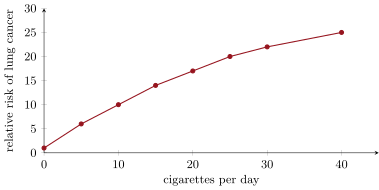
Smoke carries some seventy carcinogens; benzopyrene, once activated by the cells’ own enzymes, attaches to guanines and causes substitutions at those positions. The p53 gene of a smoker’s lung tumour typically carries exactly such a substitution, at one of a few positions where benzopyrene binds most readily — the mutagen leaves its signature in the sequence. Lung cancer was a rarity before cigarettes; smoking causes nine cases in ten, and stopping halves the risk within ten years, because the cells that carried the early steps are gradually replaced.