High School Biology · Grades 10–12
17Genome Damage and Cancer
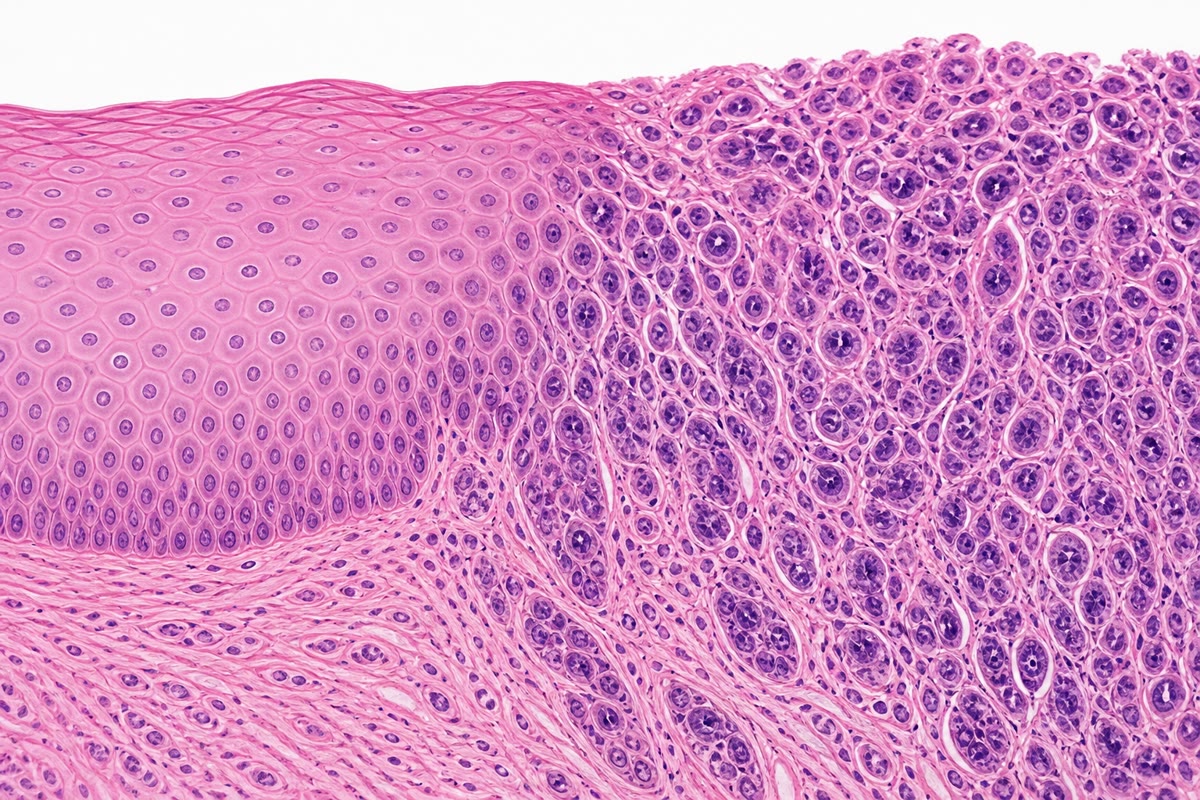
Under the microscope, a slice of healthy gut lining is a picture of order: cells in neat layers, each with a modest nucleus, dividing at the bottom of the layer and dying at the top, in step. A few millimetres away, in the same slice, a patch of cells has broken ranks: crowded, oddly shaped, with huge dark nuclei, dividing anywhere and pushing into the tissue beneath. Every cell of the patch descends from one cell that, some years earlier, acquired a mutation letting it divide when it should not have — and then, over the years, a few more. This chapter is about how the controls of the cell cycle fail, what damages them, and what can be done before and after.
17.1 Dividing when one should not
Definition 17.1 (Cancer)
A cancer is a population of cells that divide without the controls that limit the division of normal cells, and that invade the surrounding tissues. It begins with one cell whose DNA has accumulated mutations in the genes controlling the cell cycle; the cell’s descendants form a tumour. A tumour that stays confined is benign; one whose cells invade neighbouring tissue and travel through the blood or lymph to found new tumours elsewhere (metastases) is malignant.
Proposition 17.2 (Cancer is a disease of the genome)
The cells of a tumour carry mutations that its owner’s other cells do not: somatic mutations, arisen in one cell and inherited by its descendants. The tumour is a clone, and it evolves — cells that divide faster or survive better take over, and later mutations add the ability to invade and to spread.
Evidence. Sequencing the DNA of tumour cells beside that of the patient’s normal cells finds thousands of differences, all present in the tumour, none in the healthy tissue; the same few genes are found mutated in tumour after tumour. Every tumour cell of a woman carries the same one of her two X chromosomes switched off — the signature of descent from a single cell. And mutagens are carcinogens: the agents that raise the mutation rate (Chapter 13) raise the cancer rate, with a delay of decades. ∎
17.2 Accelerators and brakes
Proposition 17.3 (Two kinds of gene control the cycle)
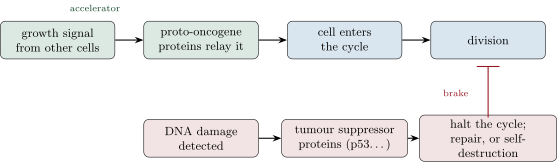
The decision of a cell to divide is taken by proteins that act like the accelerator and the brakes of a vehicle.
- Proto-oncogenes encode proteins that push the cell into the cycle when a growth signal arrives — receptors for growth signals, and the relays that carry the signal to the nucleus. A mutation that leaves such a protein permanently active turns the gene into an oncogene: the accelerator is jammed down. One mutant allele is enough.
- Tumour suppressor genes encode proteins that halt the cycle — at the checkpoints before S and before mitosis — when the DNA is damaged, and that trigger repair or, if the damage is beyond repair, the cell’s self-destruction. A mutation that inactivates such a protein removes a brake; since the cell has two alleles, both must be lost.
The best-known suppressor, the protein p53, is inactivated in half of all human cancers.
Proof. Admitted at this level. ∎
Example 17.4 (Two familiar genes)
A receptor for a growth signal sits in the membrane of many cells; one substitution in its gene makes it signal continuously, without any signal outside — an oncogene found in a third of colon and lung cancers. The gene of p53, on the other hand, is inactivated by mutations in every possible way: substitutions that alter its shape, deletions, a premature stop. A cell that has lost p53 does not stop to repair its DNA before copying it, so it accumulates further mutations faster: losing that brake accelerates the whole process.
17.3 Several steps, many years
Proposition 17.5 (Cancer is a multi-step process)
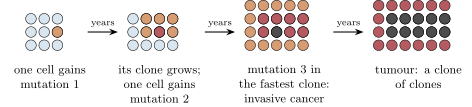
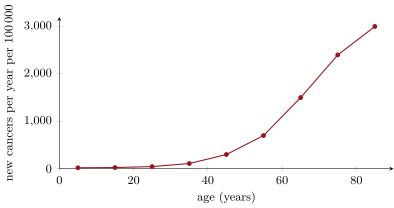
A single mutation does not make a cancer. A cell must accumulate several — typically an oncogene activated and two or more suppressors lost — and each successive mutation, by increasing the clone’s proliferation, increases the number of cells in which the next can occur. The sequence takes years to decades, which is why the incidence of most cancers rises steeply with age, and why a carcinogen’s effect appears twenty or thirty years after exposure.
Evidence. In the colon, the stages can be seen: a small benign polyp carrying one suppressor mutation; a larger polyp with an oncogene added; an invasive tumour with p53 lost as well — a sequence of some four to six mutations over ten to twenty years, each stage found in the cells of the next. Cancer incidence rises roughly as the fifth power of age, the curve expected if about five or six independent rare events must all occur in one cell. People who inherit one mutant allele of a suppressor gene develop the corresponding cancer earlier and more often, having one step already taken in every cell. ∎
17.4 What damages the genome
Definition 17.6 (Carcinogen)
A carcinogen is an agent that raises the risk of cancer. Most are mutagens: the ultraviolet of sunlight (skin cancers), the tars of tobacco smoke (lung, mouth, bladder), ionising radiation, asbestos fibres, alcohol, some moulds. Some act otherwise: certain viruses carry genes that jam the cell’s brakes — human papillomaviruses cause nearly all cancers of the cervix, hepatitis viruses many cancers of the liver — and chronic inflammation or hormones that keep a tissue dividing raise the number of divisions in which mutations can occur.
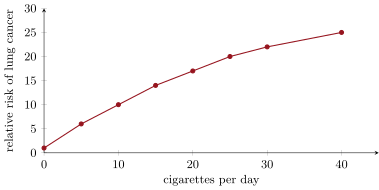
Example 17.7 (Tobacco)
Smoke carries some seventy carcinogens; benzopyrene, once activated by the cells’ own enzymes, attaches to guanines and causes substitutions at those positions. The p53 gene of a smoker’s lung tumour typically carries exactly such a substitution, at one of a few positions where benzopyrene binds most readily — the mutagen leaves its signature in the sequence. Lung cancer was a rarity before cigarettes; smoking causes nine cases in ten, and stopping halves the risk within ten years, because the cells that carried the early steps are gradually replaced.
Proposition 17.8 (Inherited predisposition)
Cancer itself is not inherited — it is a disease of somatic mutations — but a mutant allele of a suppressor gene can be. A person who inherits one non-working allele of such a gene has taken one step in every cell of the body; a single somatic mutation of the other allele completes the loss in any cell, instead of the two required in other people. The result is a high risk of the corresponding cancers, earlier in life: some 70% of women carrying a mutant allele of one particular breast-cancer gene develop the disease, against 12% in general.
Proof. Admitted at this level. ∎
17.5 Prevention, detection, treatment
Method 17.9 (Reducing the risk)
Since most of the mutations behind cancers come from identifiable exposures, and since the process takes years, cancer is largely preventable and detectable.
- Avoid the mutagens: no tobacco (a third of all cancer deaths), little alcohol, sun protection, no unnecessary radiation.
- Vaccinate against the cancer-causing viruses: the papillomavirus vaccine prevents nearly all cervical cancers when given before exposure.
- Screen: find the tumour at the polyp stage — smear tests of the cervix, colonoscopy, mammography — when removing it is simple and curative.
- Know the family: an inherited predisposition calls for earlier and closer surveillance.
Example 17.10 (Treatments and what they target)
Surgery removes a tumour that has not spread. Radiotherapy breaks the DNA of cells in the beam beyond repair, killing dividing cells preferentially. Chemotherapy uses drugs that block replication or the spindle (Chapter 12): tumour cells, dividing constantly, die faster than normal cells — but the fast-dividing normal tissues (bone marrow, gut lining, hair roots) suffer too, which is where the side effects come from. Newer treatments target the specific mutant protein of a tumour, or unleash the immune system on it.
Remark 17.11 (Why we all carry the beginnings)
Every adult carries clones of cells with cancer-related mutations — in the skin, the gut, the blood — that never become cancers: the remaining brakes hold, the immune system removes the worst, and the person dies of something else first. Cancer is the occasional outcome of a process that runs in everyone; the aim of prevention is to keep the number of steps taken, in any one cell, below the number needed.
17.6 Exercises
Exercise 17.1 ★
Exercise 17.2 ★
What is a proto-oncogene, and what does it become when mutated? Why does one mutant allele suffice?
Exercise 17.3 ★
What does a tumour suppressor protein such as p53 do? Why must both alleles be lost?
Exercise 17.4 ★
Name four carcinogens and, for two of them, the cancer they cause.
Exercise 17.5 ★
Why is a cancer described as a clone?
Solution
Solution of Exercise 17.5.
All its cells descend from one cell in which the first mutation occurred; they share that mutation and the ones that followed, and markers such as the same inactive X chromosome.
Exercise 17.6 ★★
From the age figure, read the incidence at 40 and at 80, and compute the factor. Compare with the factor 2 in age.
Solution
Solution of Exercise 17.6.
About 200 at 40 and 2700 at 80: a factor of 13 for a factor of 2 in age — several events multiplying, not one proportional cause.
Exercise 17.7 ★★
From the tobacco figure, give the relative risk at 10 and at 20 cigarettes a day. If a non-smoker’s lifetime risk is 1%, what is a 20-a-day smoker’s?
Solution
Solution of Exercise 17.7.
About 10 and 17. A 20-a-day smoker: , one in six.
Exercise 17.8 ★★
Explain why a cell that has lost p53 accumulates further mutations faster than a normal cell.
Exercise 17.9 ★★
A woman inherits one mutant allele of a breast-cancer suppressor gene. Explain, in terms of "steps", why her risk is high and her cancers early; and why her sisters have a one-in-two chance of the same.
Solution
Solution of Exercise 17.9.
Every cell of her body already lacks one allele; a single somatic mutation of the other completes the loss, instead of two independent ones. With one step taken from birth, the remaining steps are reached sooner and in more cells. Her sisters inherit the allele from the same parent with probability .
Exercise 17.10 ★★
Why do chemotherapy drugs cause hair loss, nausea and a fall in white blood cells?
Exercise 17.11 ★★
A smoker who stops at 40 has, at 60, half the lung-cancer risk of one who continued. Explain with the multi-step model why the risk falls but does not return to a non-smoker’s.
Solution
Solution of Exercise 17.11.
Stopping ends the supply of new mutations, and the lining’s cells are gradually replaced, removing many clones that carried early steps. But some clones with several steps persist, and the mutations already present are not erased; the risk stays above a non-smoker’s.
Exercise 17.12 ★★★
Suppose a cancer requires 3 specific mutations, each occurring with probability per cell division. A tissue’s stem cells divide times over a life. Estimate the expected number of cells that acquire the first mutation; explain why the naive product for all three is far too low, using clonal expansion.
Solution
Solution of Exercise 17.12.
cells acquire the first mutation. Each founds a clone that may divide thousands of times, so the second mutation is sought not in one cell but in the whole clone’s divisions, and likewise the third: the steps multiply the target, and the true probability is many orders of magnitude above .
Exercise 17.13 ★★★
A papillomavirus carries a gene whose protein binds and inactivates p53. Explain how the virus causes cancer without mutating any human gene, why the vaccine prevents it, and why vaccinating before exposure matters.
Solution
Solution of Exercise 17.13.
The viral protein removes the brake without touching the gene: the infected cell behaves as if p53 were lost and accumulates mutations that complete the process. The vaccine makes the immune system destroy the virus before it infects the cervix; once cells are infected and transformed, the vaccine no longer helps — hence vaccination in early adolescence.
Exercise 17.14 ★★★
Screening for colon cancer by colonoscopy every ten years from age 50 removes polyps found. Using the multi-step model, explain why this prevents cancer rather than only detecting it, and why ten years is a reasonable interval.
Solution
Solution of Exercise 17.14.
A polyp is a clone that has taken one or two steps; removing it removes the cells in which the remaining steps could occur, so the cancer never forms. Since the polyp-to-cancer sequence takes ten to twenty years, a ten-year interval catches most polyps before they complete it.
Exercise 17.15 ★★★
"Cancer is a disease of old age, so there is nothing to be done." Discuss in a paragraph with the age curve, the delay of carcinogens, the fraction of cancers attributable to known exposures, and screening.
Solution
Solution of Exercise 17.15.
Incidence rises with age because the steps take decades, but the steps are taken during life, largely under exposures — tobacco alone accounts for a third of cancer deaths, and infections, alcohol, sun and diet for much of the rest. Removing an exposure at any age reduces the mutations still to come; screening removes clones before the last step. Old age is when the account is presented, not when it is written.
17.7 Problem: The Signature in the Gene
Problem 17.1
Weekend problem — a lung tumour sequenced: the mutations counted, the smoker’s signature read, the years reckoned, and the risk a cigarette carries
A lung tumour and healthy tissue from the same patient, a smoker of 20 cigarettes a day for 35 years, are sequenced. The tumour carries somatic substitutions not found in the healthy tissue; 75% of them replace a G by a T, the change benzopyrene causes. Among them: one in the p53 gene, creating a premature stop, on one allele; the other allele of p53 is deleted; and one in a growth-signal receptor gene, making the protein permanently active.
Part I — Reading the sequence.
- Why are the substitutions called somatic? Where would they be found if they were germline?
- In a non-smoker’s tumour, substitutions are of all kinds in roughly equal proportions. What does the 75% of G-to-T changes tell you?
- Classify the p53 mutation (with the vocabulary of Chapter 14) and its effect on the protein.
- Explain why both alleles of p53 had to be lost, but one mutant allele of the receptor gene was enough.
- Which of the two genes is an accelerator and which a brake?
Part II — The years.
- The patient smoked about cigarettes. Compute the number.
- If each cigarette produces, on average, one lasting substitution in each of the lung’s lining cells, how many substitutions would a cell carry after 35 years? Compare with the found.
- The tumour’s mutations are not all in the same cells’ order: the p53 and receptor mutations are in every tumour cell, the other thousands only in subsets. What does this say about when the two key mutations occurred?
- The tumour is across, about cells, and tumour cells double every 100 days. How many doublings from one cell, and how many years, at least?
- Combine questions 8 and 9: roughly when in the 35 years did the last of the key mutations occur?
Part III — The risk of a cigarette.
- From the tobacco figure, the patient’s relative risk was about 17. If 1% of non-smokers develop lung cancer, what fraction of smokers like him do?
- Among 100 such smokers, how many cancers are attributable to smoking?
- Had he stopped at 40 (after 20 years), his risk would have been about a third of the continuing smoker’s. Explain, with the multi-step model and the renewal of the lung lining, why the risk falls after stopping.
- Why does a smoker’s cancer, when it comes, usually come after thirty years and not after five?
- A student argues that since a cigarette causes "only one mutation per cell", it is harmless. Answer with the arithmetic of question 7 and the number of cells.
Part IV — Prevention and the population. In a country of 60 million, 25% of adults smoke; lung cancer kills people a year, 90% of them smokers.
- Compute the yearly lung-cancer deaths among smokers and among non-smokers, and the death rate per 100 000 in each group (take 45 million adults).
- By what factor is the rate higher among smokers? Compare with the figure’s relative risk and comment.
- If smoking disappeared today, what would the yearly number of lung-cancer deaths become in the long run? Why not immediately?
- Screening by low-dose scans finds tumours earlier and lowers deaths among heavy smokers by about 20%. Compare, in deaths avoided per year, screening every smoker with stopping smoking.
- State the result: what the G-to-T signature proved about the origin of the tumour’s mutations, the three genetic events that made the cancer, and the one decision that would have prevented it.
Solution
Solution of Problem 17.1.
1. They are present in the tumour and absent from the patient’s other cells, so they arose in a body cell. Germline mutations would be in every cell, healthy tissue included.
2. That most of the tumour’s mutations were caused by benzopyrene — the mutagen of tobacco smoke left its signature.
3. A nonsense mutation: a premature stop codon truncates p53, which cannot work.
4. p53 is a brake: one working allele still brakes, so both had to go (one mutated, one deleted). The receptor is an accelerator: one permanently active protein drives the cell whatever the other allele does.
5. The receptor gene is the accelerator (proto-oncogene turned oncogene); p53 is the brake (tumour suppressor).
6. cigarettes.
7. About substitutions per cell — fifty times the 5000 found. Most lesions are repaired, and cells with too many mutations die; 5000 is the surviving fraction.
8. They occurred early, in the founding cell or its first descendants, so every tumour cell inherited them; the others arose later in sub-clones.
9. : 33 doublings, at 100 days each about 9 years.
10. If the tumour took 9 years or more to grow from its founding cell, the last key mutation occurred around 25 years into the 35 years of smoking, or earlier.
11. .
12. 17 cancers, of which 1 would have occurred anyway: 16 in 100 attributable to smoking.
13. No new mutations are added; the lining renews itself and many clones carrying early steps are shed and replaced over the years; the remaining clones have fewer steps than they would have acquired by continuing.
14. Several rare mutations must accumulate in one lineage, and the lineage must then grow to a detectable size: each stage takes years, and their sum is decades.
15. One mutation per cell per cigarette, in some lining cells, over cigarettes, is mutations scattered over the lung; a few will hit p53 or a proto-oncogene in a cell that already carries another step. It is the number of trials that makes the improbable certain.
16. Smokers: deaths among , about 240 per 100 000; non-smokers: 3000 among , about 9 per 100 000.
17. About 27 times — of the same order as the figure’s 17 to 25 for heavy smokers; the population figure mixes light and heavy smokers and ex-smokers.
18. About 3000 a year, the non-smokers’ share. Not immediately: the mutations already present in current and former smokers will produce cancers for another twenty or thirty years.
19. Screening every smoker saves about 20% of , some 5000 deaths a year; stopping smoking would eventually prevent about — five times more.
20. The G-to-T signature proved the tumour’s mutations came from tobacco smoke; the cancer was made by an oncogene activated and both alleles of p53 lost; not smoking would have prevented it.