
সব বই

পেশাদার

1 Markets I: The Ecosystem and Exchange-Traded Marketsবাজার অনলাইন 2 Markets II: Rates, FX and Creditবাজার অনলাইন 3 Markets III: Commodities, Energy and Cryptoবাজার অনলাইন 4 Quantitative Methodsপদ্ধতি অনলাইন 5 Derivatives and Volatilityডেরিভেটিভস অনলাইন 6 Rates, Credit, XVA and Riskসুদহার, ঋণ ও ঝুঁকি অনলাইন 7 Research Craft: Predictors, Backtests, Measurement, Portfoliosগবেষণা অনলাইন 8 Strategies I: Equities and Futuresকৌশল অনলাইন 9 Strategies II: Volatility, Relative Value, Macro and the Bank Desksকৌশল অনলাইন 10 Microstructure and Executionএক্সিকিউশন অনলাইন 11 Market Making and High-Frequency Tradingমার্কেট মেকিং অনলাইন 12 Machine Learning for Marketsমেশিন লার্নিং অনলাইন 13 Low-Latency Softwareপ্রযুক্তি অনলাইন 14 Networks, Hardware and Trading Infrastructureপ্রযুক্তি অনলাইন 15 Research, Data and Risk Platformsপ্রযুক্তি অনলাইন 16 The Desk and the Firmপ্রতিষ্ঠান অনলাইন 17 The Industry: Firms, Roles and Careersক্যারিয়ার অনলাইন 18 Interviews I: Maths, Probability and Speedক্যারিয়ার অনলাইন 19 Interviews II: Markets, Trading Games and the Final Roundক্যারিয়ার অনলাইন 20 Interviews III: Codeক্যারিয়ার অনলাইন
অ্যাপ পরিচিতি Coach সাইন ইন পড়া শুরু করো

বইগুলো এখনো বাংলা ভাষায় পাওয়া যায় না — ইংরেজি সংস্করণ দেখানো হচ্ছে।

Biology · পরিভাষা

Glycogen কী?

Definition 7.8 High School Biology · অধ্যায় 7 — Exercise and the Body’s Energy Needs

Glycogen is the animal form of stored carbohydrate: a branched chain of glucose units, held as granules in the muscle cells (about 400 g400\,\mathrm{g} in an adult) and in the liver (about 100 g100\,\mathrm{g}). Muscle glycogen fuels the muscle that stores it; liver glycogen is broken down into glucose released into the blood, keeping the blood glucose near 1 g/L1\,\mathrm{g}/\mathrm{L} for the brain and the other tissues. Fat, stored in adipose cells, is the far larger reserve (Chapter 1), but it can be burned only slowly and only with oxygen.
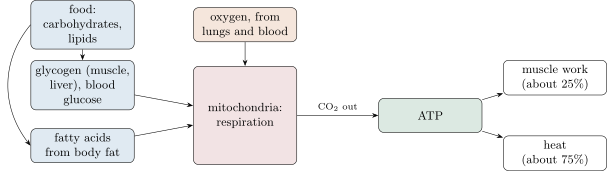
The energy chain of sustained exercise: fuels from food and body stores, oxygen from breathing, ATP made in the mitochondria and spent on contraction — three quarters of it leaving as heat.

উদাহরণ

Example 7.9 (The marathon wall)

Running consumes about 4 kJ4\,\mathrm{kJ} per kilogram of body mass per kilometre; a 70 kg70\,\mathrm{kg} runner spends 280 kJ/km280\,\mathrm{kJ}/\mathrm{km}, and a marathon costs 11 800 kJ11\,800\,\mathrm{kJ}. The glycogen stores hold about 8500 kJ8500\,\mathrm{kJ}. If the runner burns glycogen too fast, the stores run out around the thirtieth kilometre; the muscles must then rely on fat, which supplies energy at barely half the rate, and the pace collapses — "hitting the wall". Trained runners burn a larger share of fat from the start, and eat carbohydrate during the race.

Example 7.11 (An hour of cycling)

One hour at 150 W150\,\mathrm{W} on the pedals: metabolic power about 600 W600\,\mathrm{W}, energy 600×3600=2.16×10⁶ J≈2200 kJ600 \times 3600 = 2.16 \times 10^{6}\,\mathrm{J} \approx 2200\,\mathrm{kJ}; oxygen 2200/20=110 L2200/20 = 110\,\mathrm{L}, i.e. 1.8 L/min1.8\,\mathrm{L}/\mathrm{min} — consistent with the curve. If half comes from carbohydrate: 1100/17≈65 g1100/17 \approx 65\,\mathrm{g} of glucose or glycogen, and 1100/38≈29 g1100/38 \approx 29\,\mathrm{g} of fat.

প্রসঙ্গসহ পড়ো →