
সব বই

পেশাদার

1 Markets I: The Ecosystem and Exchange-Traded Marketsবাজার অনলাইন 2 Markets II: Rates, FX and Creditবাজার অনলাইন 3 Markets III: Commodities, Energy and Cryptoবাজার অনলাইন 4 Quantitative Methodsপদ্ধতি অনলাইন 5 Derivatives and Volatilityডেরিভেটিভস অনলাইন 6 Rates, Credit, XVA and Riskসুদহার, ঋণ ও ঝুঁকি অনলাইন 7 Research Craft: Predictors, Backtests, Measurement, Portfoliosগবেষণা অনলাইন 8 Strategies I: Equities and Futuresকৌশল অনলাইন 9 Strategies II: Volatility, Relative Value, Macro and the Bank Desksকৌশল অনলাইন 10 Microstructure and Executionএক্সিকিউশন অনলাইন 11 Market Making and High-Frequency Tradingমার্কেট মেকিং অনলাইন 12 Machine Learning for Marketsমেশিন লার্নিং অনলাইন 13 Low-Latency Softwareপ্রযুক্তি অনলাইন 14 Networks, Hardware and Trading Infrastructureপ্রযুক্তি অনলাইন 15 Research, Data and Risk Platformsপ্রযুক্তি অনলাইন 16 The Desk and the Firmপ্রতিষ্ঠান অনলাইন 17 The Industry: Firms, Roles and Careersক্যারিয়ার অনলাইন 18 Interviews I: Maths, Probability and Speedক্যারিয়ার অনলাইন 19 Interviews II: Markets, Trading Games and the Final Roundক্যারিয়ার অনলাইন 20 Interviews III: Codeক্যারিয়ার অনলাইন
অ্যাপ পরিচিতি Coach সাইন ইন পড়া শুরু করো

বইগুলো এখনো বাংলা ভাষায় পাওয়া যায় না — ইংরেজি সংস্করণ দেখানো হচ্ছে।

Biology · পরিভাষা

Inhibitors কী?

অন্য নাম: enzyme inhibitor · competitive inhibition

Definition 13.9 University Biology — Year 1 · অধ্যায় 13 — Enzymes and Biochemical Catalysis

An inhibitor lowers the rate of an enzyme. Irreversible inhibitors bind covalently and destroy the enzyme’s activity for good (nerve agents on acetylcholinesterase, penicillin on the enzyme that cross-links the bacterial wall, aspirin on the enzyme that makes prostaglandins). Reversible inhibitors bind by weak bonds and can be washed away; by where they bind:

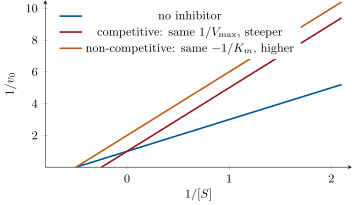
  • competitive: the inhibitor resembles the substrate and occupies the active site; it raises the apparent KmK_m (by the factor 1+[I]/Ki1 + [I]/K_i) and leaves Vmax⁡V_{\max} unchanged — enough substrate displaces it;
  • non-competitive: the inhibitor binds elsewhere and spoils the catalysis whether or not substrate is bound; it lowers Vmax⁡V_{\max} and leaves KmK_m unchanged — no amount of substrate overcomes it;
  • uncompetitive: the inhibitor binds only the ESES complex; both Vmax⁡V_{\max} and KmK_m fall.

KiK_i, the dissociation constant of the inhibitor, measures its potency: the lower, the stronger.
Lineweaver–Burk plots with the two common inhibitors. A competitive inhibitor pivots the line about the y intercept (V_ unchanged, K_m raised); a non-competitive one pivots it about the x intercept (K_m unchanged, V_ lowered).
Lineweaver–Burk plots with the two common inhibitors. A competitive inhibitor pivots the line about the yy intercept (Vmax⁡V_{\max} unchanged, KmK_m raised); a non-competitive one pivots it about the xx intercept (KmK_m unchanged, Vmax⁡V_{\max} lowered).

উদাহরণ

Example 13.10 (Competition as medicine)

Methanol is harmless until the liver’s alcohol dehydrogenase turns it into formaldehyde and formic acid, which blind and kill. The treatment is ethanol: a competing substrate with a lower KmK_m, which keeps the enzyme busy while the methanol is excreted unchanged. Statins are competitive inhibitors, resembling the transition state, of the enzyme that commits carbon to cholesterol; sulfonamides resemble the substrate of a bacterial enzyme that makes folate, which humans do not make and so do not miss.

প্রসঙ্গসহ পড়ো →