Biology · Glossary

What is Joint?

Also known as: elbow · knee · shoulder · wrist · ankle · cartilage · ligament

Definition 4.3 Primary & Middle School Biology · Chapter 4 — My Body

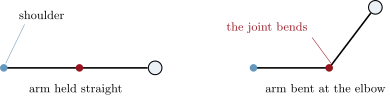
A joint is a place where the body can bend or turn. The elbow bends the arm, the knee bends the leg, the shoulder turns the whole arm, the wrist and the ankle bend the hand and the foot. Between two joints, the body stays straight.

The arm bends only at its joints: shoulder (blue) and elbow (red). Between them, it stays straight.

Examples

Example 4.4 (Try it: the stiff-knee walk)

Try walking without bending your knees. It works — just barely — with stiff little duck steps. Now try picking a pencil off the floor without bending knees, hips or back. Joints are what make the body’s movements smooth, quick and easy.

Read in context →
Definition 9.1 High School Biology · Chapter 9 — Muscles and Joints

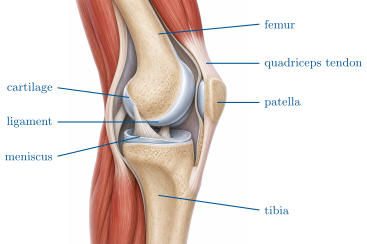
A joint is the place where two bones meet. In a mobile joint such as the knee, hip, shoulder or elbow, the ends of the bones are covered with a layer of smooth cartilage, a few millimetres thick, and enclosed in a sealed sac, the capsule, whose lining secretes the synovial fluid that lubricates the surfaces. Bands of tough tissue, the ligaments, run from bone to bone across the joint and limit its movements to the intended ones. In the knee two crescents of cartilage, the menisci, sit between the bones and spread the load.

The knee in section: femur above, tibia below, the patella (kneecap) in front in the tendon of the thigh muscle; cartilage on the bone ends, the meniscus between them, ligaments holding the bones together.

Examples

Example 9.3 (Sprain, tear, dislocation)

Twist an ankle on a kerb: the ligaments on the outside are stretched beyond their limit — a sprain; the joint swells as the capsule bleeds and fluid accumulates. Pull hard on a cold hamstring: some of its fibres rupture — a muscle tear. Fall on an outstretched arm: the head of the humerus may leave its socket — a dislocation, the ligaments and capsule stretched or torn as it goes. None is a broken bone; all can take longer to heal than one.

Example 9.7 (Holding a bag)

A 5kg5\,\mathrm{kg} bag (weight 49N49\,\mathrm{N}) hangs from the hand, 35cm35\,\mathrm{cm} from the elbow; the biceps tendon attaches 5cm5\,\mathrm{cm} from it. The biceps pulls with 49×35/5=343N49 \times 35/5 = 343\,\mathrm{N} — seven times the load, the weight of 35kg35\,\mathrm{kg} — and the elbow joint is pressed together with about 300N300\,\mathrm{N}. Muscles, tendons and cartilage are built for these forces; what damages them is a sudden force in the wrong direction, or a load repeated beyond what the tissue can repair.

Read in context →