Primary & Middle School Biology · Grades 1–9
4My Body
Stand in front of a mirror and wave: a whole living body waves back. It has been growing since before you were born, it bends in some places and not in others, and it is yours for life. Time to look at it the way we looked at the cat and the daisy — part by part.
4.1 The parts of my body
Definition 4.1 (Parts of the human body)
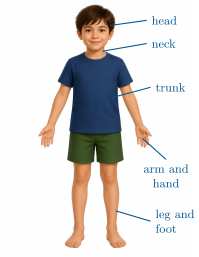
The human body has three main parts:
- the head, which carries the face, the eyes, the ears, the nose and the mouth;
- the trunk, the middle of the body — chest, belly and back;
- the limbs: two arms ending in hands, two legs ending in feet.
The head sits on the neck, which joins it to the trunk.
Example 4.2 (Same plan as the cat?)
Compare yourself with the cat: head, body, four limbs — the plan looks alike. But the cat walks on all four; you stand on two legs and keep two arms free for carrying, drawing and waving. And where the cat has a tail, you have none.
4.2 Bending: the joints
Definition 4.3 (Joint)
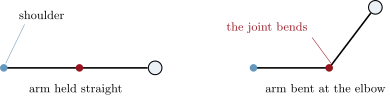
A joint is a place where the body can bend or turn. The elbow bends the arm, the knee bends the leg, the shoulder turns the whole arm, the wrist and the ankle bend the hand and the foot. Between two joints, the body stays straight.
Example 4.4 (Try it: the stiff-knee walk)
Try walking without bending your knees. It works — just barely — with stiff little duck steps. Now try picking a pencil off the floor without bending knees, hips or back. Joints are what make the body’s movements smooth, quick and easy.
Remark 4.5 (Right and left)
The body has two sides, right and left, almost like a mirror: one arm and one leg on each side, one eye and one ear on each side of the head. Knowing your right hand from your left is body knowledge too — it tells people which way you mean.
4.3 My body grows
Proposition 4.6 (Growing up)
A child’s body grows: it gets taller and heavier, year after year, until grown-up size. Growing is slow and steady — too slow to feel, easy to measure.
Proof. Admitted at this level. ∎
Example 4.7 (Marks on the door frame)
Stand against the door frame; a grown-up marks your height with a pencil. Do it again after some months: the new mark is higher! You never felt yourself growing, but the two marks, one above the other, show it plainly.
Method 4.8 (Measuring my height)
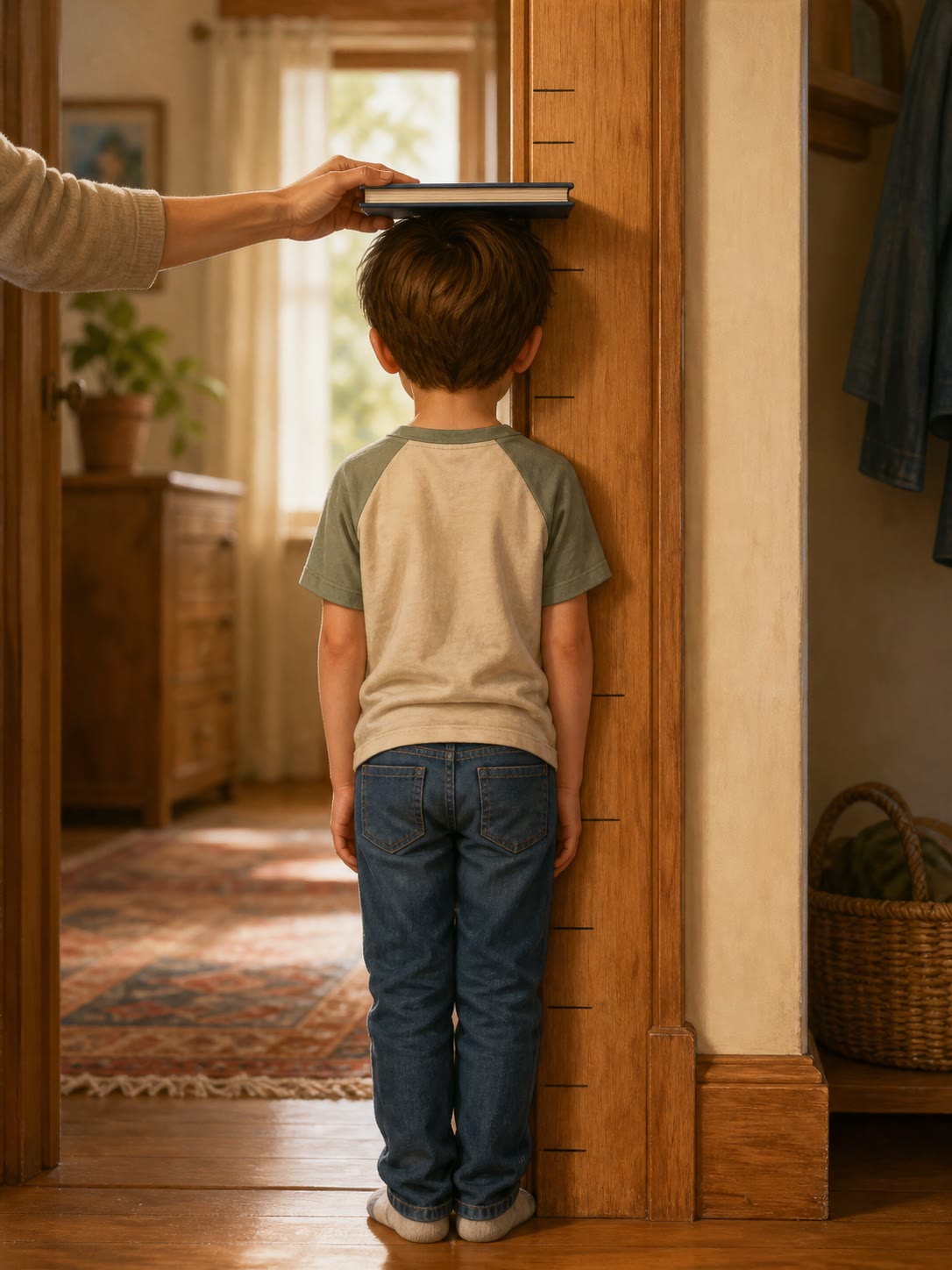
- Take off your shoes;
- stand straight, back and heels against the wall, looking ahead;
- a helper lays a flat book on your head, level, touching the wall;
- mark the spot under the book, and write the date next to it.
Measured the same way each time, the marks can be trusted — and compared.
Remark 4.9 (Every body is different)
In one class, some children are taller, some shorter; some grow sooner, some later. All of that is normal. Bodies are like faces: built on the same plan, and each one different. The marks on your door frame are yours — they are not for racing the neighbor.
4.4 Exercises
Exercise 4.1 ★
Name the three main parts of the human body. What joins the head to the trunk?
Exercise 4.2 ★
Where does each limb end — what is at the end of an arm, and at the end of a leg?
Exercise 4.3 ★
Which joint bends: (a) the arm in the middle? (b) the leg in the middle? (c) the hand at the end of the arm?
Exercise 4.4 ★
Touch your right ear with your left hand. Which joints did your arm just use? Name at least two.
Exercise 4.5 ★
In Example 4.2, find one way your body is like the cat’s and two ways it is different.
Exercise 4.6 ★
Why does the helper in Method 4.8 lay a flat book on your head instead of just looking?
Solution
Solution of Exercise 4.6.
Just looking, you guess the top of the head at a slant and the mark lands too high or too low. The flat book, level and touching the wall, brings the very top of the head straight to the wall: the same fair measurement every time.
Exercise 4.7 ★
Two marks on the door frame: last year’s, and today’s a little higher. What do the marks show? Did you feel it happening?
Solution
Solution of Exercise 4.7.
They show that your body grew taller between the two dates. No — growing is too slow to feel; only the marks make it visible.
Exercise 4.8 ★
Try it: do the stiff-knee walk of Example 4.4, then try clapping without bending your elbows. Which everyday movements turn out to need joints?
Exercise 4.9 ★★
Mia is the smallest in her class and worries about it. What does Remark 4.9 answer her?
Solution
Solution of Exercise 4.9.
That every body is normal at its own size and its own speed: some children grow sooner, some later, and all reach their own grown-up size. Height marks are for watching yourself grow, not for racing anyone.
Exercise 4.10 ★★
A puppet made of one wooden stick cannot sit on a chair. Where would you cut the stick and add turning points so it can sit? Name the body joints your cuts copy.