 Coach
CoachA skeletal muscle is an organ made of thousands of long cells, the muscle fibres, bundled together; each fibre shortens when stimulated by a nerve. At both ends the muscle narrows into a tendon, a cord of non-contractile tissue attached to bone. A muscle can only pull, by shortening, and only along its own length: it moves a joint by pulling on the bone beyond it.
Examples
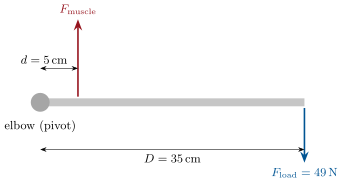
Example 9.7 (Holding a bag)
A bag (weight ) hangs from the hand, from the elbow; the biceps tendon attaches from it. The biceps pulls with — seven times the load, the weight of — and the elbow joint is pressed together with about . Muscles, tendons and cartilage are built for these forces; what damages them is a sudden force in the wrong direction, or a load repeated beyond what the tissue can repair.