 Coach
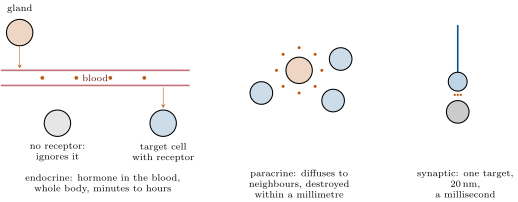
CoachA cell signals to another with a secreted molecule, a messenger or ligand, that binds a receptor on or in the target. By range: endocrine signalling, in which a hormone is released into the blood by a gland and reaches every cell of the body, acting only on those with the receptor, over minutes to hours (insulin, cortisol, adrenaline, thyroxine); paracrine signalling, in which the messenger diffuses to neighbouring cells within a millimetre and is destroyed on the way (growth factors, histamine, prostaglandins, the morphogens of Chapter 10); autocrine, the cell signalling to itself; and synaptic, in which a neuron releases a neurotransmitter across a gap of onto one target cell, in a millisecond (Chapter 20). By chemistry: water-soluble messengers — amino-acid derivatives such as adrenaline, peptides and proteins such as insulin — cannot cross the membrane and act on surface receptors; lipid-soluble messengers — the steroids (cortisol, oestradiol, testosterone), thyroxine, retinoic acid, nitric oxide — cross it and act on receptors inside. The endocrine and nervous systems are the two ways a body of cells coordinates itself: the one broadcasts slowly to everyone, the other wires quickly to someone.
Examples
Example 19.8 (Speed, reach and cost of the two systems)
Adrenaline in the blood reaches every cell in about a minute (the circulation time) and acts for minutes; a nerve impulse reaches its target in milliseconds and acts for milliseconds. A hormone costs almost nothing per cell reached — a nanomole spread over the body — but cannot address one cell; a nerve addresses one cell exactly but must build and maintain a wire to it. The body uses both: the sympathetic nerves of Chapter 18 act on the heart and the arterioles in a second, and the adrenal medulla, itself a modified sympathetic ganglion, backs them up by pouring the same molecule into the blood for the whole body. And at the synapse the two designs meet, for a neurotransmitter is a messenger acting on a receptor by the same mechanisms — a channel that opens, a G protein that switches — only across twenty nanometres instead of a metre.