 Coach
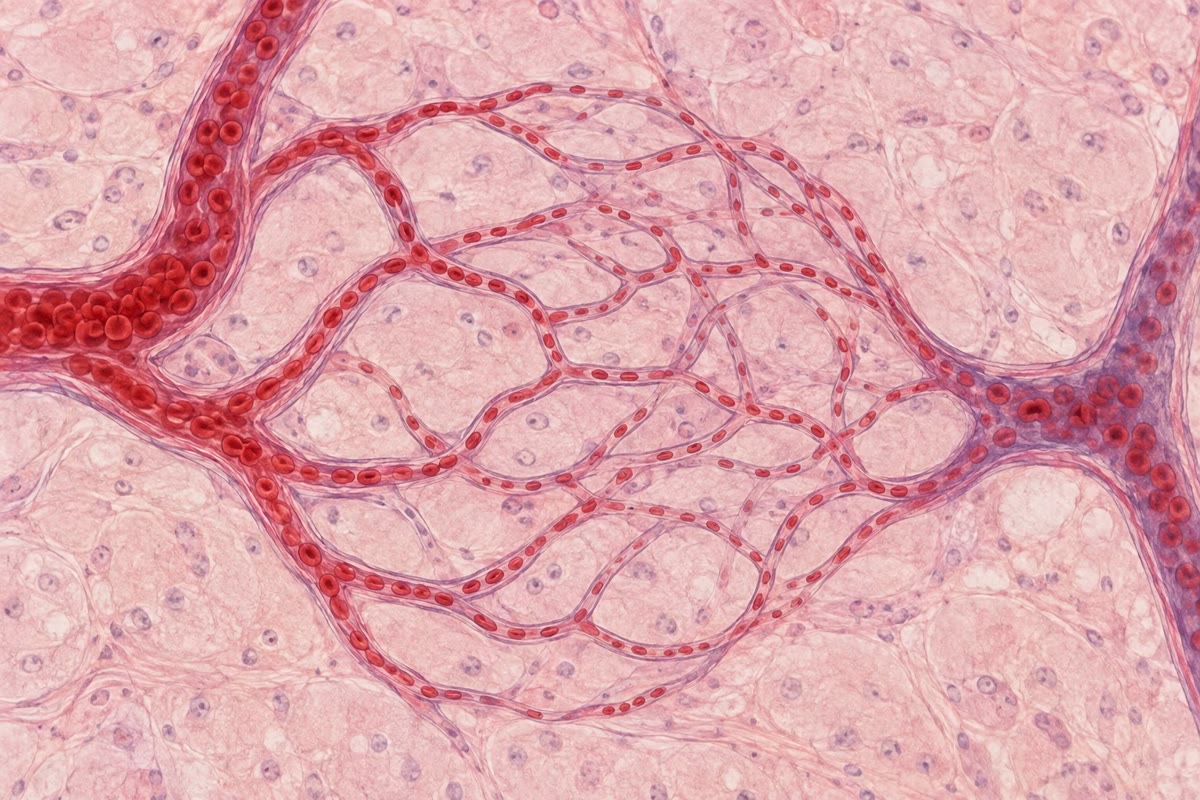
CoachBlood leaves the heart through arteries: thick-walled tubes with elastic layers that stretch at each beat and recoil between beats, smoothing the pulses into a steadier flow (the aorta is across). They branch into arterioles, vessels of a tenth of a millimetre or less whose walls are mostly smooth muscle: by contracting or relaxing, an arteriole changes its radius and so, powerfully, its resistance — arterioles are the taps of the circulation and the site of most of the pressure drop. These open into capillaries: tubes of a single endothelial cell wrapped round a lumen of , about long, some forty billion of them with a total surface near , across whose walls all exchange takes place. Capillaries drain into venules and veins: thin-walled, distensible, holding two thirds of the blood at low pressure, with valves that keep the flow toward the heart while muscles squeeze them. Every vessel is lined with a single layer of endothelium, which is not a passive lining but a gland — it releases nitric oxide to relax the arteriole, and signals that recruit white cells — and a filter.
Examples
Example 16.10 (The circulation as a transport system)
Five litres a minute through of capillary wall is a delivery service without equal. It brings each cell oxygen within a few cell diameters (no cell of the body is more than from a capillary), removes its , lactate and urea, carries the glucose of the liver to the brain and the fatty acids of the fat stores to the muscles, distributes the hormones of Chapter 19 from one gland to every receptor in the body in a minute, moves the heat of the core to the skin and back, and ferries the white cells to a wound within hours. It is also the vulnerability: a clot, a haemorrhage or a failing pump stops all of it at once, and the brain, which stores no fuel, fails within seconds. The rest of this part of the book is about the pump (Chapter 17) and about how the pressure is regulated so that the service continues through standing up, running and bleeding (Chapter 18).