University Biology — Year 2 · Bachelor Year 2
18Regulation of Blood Pressure and Exercise
Stand up quickly after lying down and, for a second, half a litre of blood drains into the veins of your legs; the heart, receiving less, pumps less, the pressure at the head falls, and the brain — which is above the heart and cannot store oxygen — is a second or two from fainting. It almost never does, because within one beat a reflex has tightened the arterioles and quickened the heart. Run for a bus and the muscles need ten times the blood they had at rest; they get it within a minute, and the pressure that drives it is held steady while the resistance of the whole body falls by two thirds. This chapter is about that regulation: what sets the pressure, how it is sensed, the fast reflex and the slow hormones that correct it, and how the system is reorganised, rather than overridden, by exercise.
18.1 What the pressure is
Theorem 18.1 (The equation of the circulation)
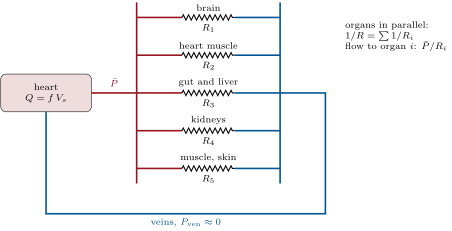
The mean arterial pressure is the product of what the heart puts in and what the vessels let out:
where is the cardiac output (heart rate times stroke volume ), the total peripheral resistance — the arterioles of all the organs in parallel — and the venous pressure, near zero. At rest, gives . Every regulation of the pressure acts on one of three quantities: the rate, the stroke volume (through the filling and the contractility of Chapter 17) or the resistance (through the arteriolar radius, to the fourth power). Because the organs are in parallel, the flow to each is its share of the pressure divided by its own resistance: dilating the arterioles of one organ raises its flow without changing the others’, provided the pressure is held — and holding the pressure is what the regulation is for.
Proof. Ohm’s law for a fluid: the flow through a resistance is the pressure drop across it divided by the resistance (Poiseuille, Chapter 16); for resistances in parallel the flows add and . The mean pressure over a beat is approximately the diastolic plus a third of the pulse pressure: . ∎
Proposition 18.2 (Why the pressure must be regulated)
Too low, and the brain — above the heart in a standing adult, which costs of hydrostatic head — and the heart muscle itself are underperfused: the brain fails within seconds. Too high, and the vessels are damaged: the arterial wall thickens and stiffens, the kidney’s glomeruli scar, the retina bleeds, and the heart labours against the pressure until it fails. The pressure must also stay steady while the demands of the organs change by an order of magnitude — the gut after a meal, the muscles in exercise, the skin in heat — and while the blood volume itself is lost in haemorrhage or sweat. Two systems do this: a nervous reflex that acts within a beat on the rate, the stroke volume and the resistance, and hormonal systems that act over hours and days on the resistance and, above all, on the blood volume through the kidney.

18.2 The fast loop: the baroreflex
Definition 18.3 (The baroreflex)
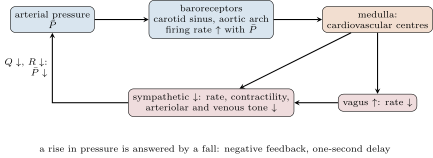
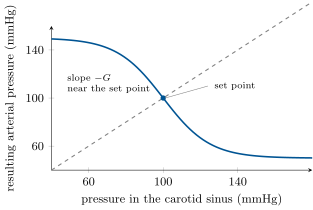
Stretch receptors in the walls of the carotid sinuses (at the fork of each carotid artery, below the jaw) and of the aortic arch — the baroreceptors — fire at a rate that rises with the pressure that distends them, faster for a rising pressure. Their nerves reach the cardiovascular centres of the medulla, which control the two branches of the autonomic outflow: the vagus, whose acetylcholine slows the sinoatrial node, and the sympathetic nerves, whose noradrenaline speeds the node, strengthens the ventricle, constricts the arterioles (raising ) and constricts the veins (squeezing stored blood toward the heart and raising the filling). A rise in pressure increases baroreceptor firing, which excites the vagus and inhibits the sympathetic outflow: the rate falls, the arterioles relax, the pressure comes down. A fall does the reverse. The loop is a negative feedback with a set point near , a delay of about a second, and a gain such that a disturbance is corrected to within a fifth of its size: it is the reason you do not faint on standing.
Evidence. Hering (1923) found that pressing on the carotid sinus slowed the heart and lowered the pressure, and that cutting the sinus nerve abolished the response. Perfusing an isolated carotid sinus at set pressures while recording the animal’s arterial pressure gave the sigmoid curve of the reflex: the animal’s pressure falls as the sinus pressure is raised, steeply around and little outside . Dogs with both sinus and aortic nerves cut keep a normal mean pressure over days but a wildly variable one from minute to minute — the reflex is a buffer, not the setter of the long-term level. ∎
Theorem 18.4 (Gain of a negative feedback loop)
If a disturbance would, without regulation, change the pressure by , and the loop responds to any deviation by a correction of (the open-loop gain ), the deviation that remains once the loop has acted is
The baroreflex has : standing up, which would drop the pressure at the heart by some , drops it by ; a haemorrhage that would halve the pressure lowers it by a tenth — until the loss exceeds what tighter vessels and a faster heart can hide. The reflex does not abolish a disturbance; it divides it by five. And it resets: held at a new pressure for hours, the baroreceptors adapt and defend the new level, which is why the reflex cannot cure hypertension and why the long-term level is set elsewhere.
Proof. The final deviation is the disturbance plus the correction: , hence . With , . ∎
18.3 The slow loops: hormones and the kidney
Proposition 18.5 (Renin, angiotensin, aldosterone, and the volume)
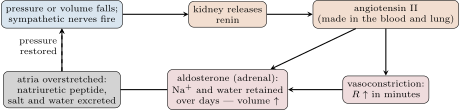
Over hours and days the pressure is set by the blood volume, and the volume by the kidney. When the pressure or the sodium delivered to the kidney falls, or the sympathetic nerves fire, cells of the kidney’s arterioles release the enzyme renin into the blood; renin cuts a plasma protein into angiotensin I, which an enzyme of the lung capillaries converts to angiotensin II — the most powerful vasoconstrictor in the body, raising within minutes, and a hormone that makes the adrenal cortex secrete aldosterone, which makes the kidney retain sodium, and with it water, over the following days. The pituitary’s antidiuretic hormone (vasopressin), released when the blood becomes concentrated or its volume falls, makes the kidney retain water directly and also constricts vessels. And when the atria are overstretched by too much volume they secrete natriuretic peptide, which makes the kidney excrete sodium and water. The kidney is thus the final arbiter: it can excrete or retain litres, and a pressure that persists above the kidney’s set point is corrected, over days, by the loss of volume — unless the kidney’s set point is itself raised, which is what most hypertension is. (The kidney’s own machinery is the subject of the Year 3 volume.)
Evidence. Goldblatt (1934) narrowed the artery to one kidney of a dog: the animal became hypertensive within days and stayed so; the underperfused kidney was found to release renin, and removing it cured the animal. Drugs that block the conversion of angiotensin (ACE inhibitors) or its receptor lower the pressure of most hypertensives, and a kidney transplanted from a hypertensive rat strain makes a normal recipient hypertensive. ∎
Example 18.6 (A haemorrhage)
A donor gives , a tenth of the blood. Within seconds the baroreflex constricts the arterioles and veins and quickens the heart: the pressure barely moves, the skin goes pale and cool (its arterioles closed), the pulse is faster. Within minutes the lowered capillary pressure lets interstitial fluid move into the vessels (the Starling balance of Chapter 16), restoring half the volume by the next hour; renin, angiotensin and antidiuretic hormone reduce the urine to a trickle, and thirst follows; over days the kidney retains salt and water and the plasma volume is back, and over weeks the marrow replaces the red cells. A loss of outruns all of this: the reflex is saturated, the pressure collapses, the underperfused tissues release lactate and the capillaries leak — shock, from which only transfusion returns the patient.
18.4 Exercise: the system reorganised
Proposition 18.7 (Exercise)
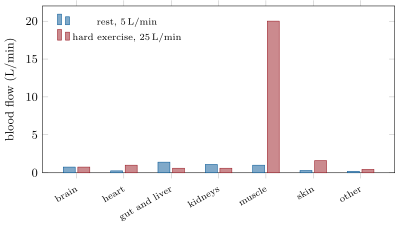
In hard exercise the skeletal muscles’ consumption of oxygen rises twentyfold, and their blood flow from to . Three things happen at once. Locally, the metabolites of the working muscle — , lactate, adenosine, potassium, heat, low oxygen — relax its arterioles (metabolic vasodilation) and open the capillaries, cutting the muscle’s resistance to a tenth. Centrally, a command from the motor cortex to the medulla, reinforced by signals from the muscles’ own receptors, resets the baroreflex to a higher set point and drives the sympathetic outflow: rate to 180, contractility up, the arterioles of the gut, kidneys and resting muscle constricted, the veins squeezed; the muscle pump and deep breathing return the blood faster. The result is an output of with a total resistance a third of the resting value, a systolic pressure of and a diastolic no higher than at rest; four fifths of the flow goes to muscle, the brain’s share is unchanged in absolute terms, the gut’s is halved, the skin’s rises to shed the heat. The reflex is not overridden but re-tuned: it defends a higher pressure while the vessels reopen the body.
Theorem 18.8 (Oxygen delivery and the Fick principle)
The oxygen a body consumes per minute equals the cardiac output times the difference in oxygen content between arterial and mixed venous blood:
At rest, ; in maximal exercise, , a sixteenfold rise from a fivefold rise in flow and a threefold rise in extraction. This maximal rate, , is the standard measure of endurance fitness, and its ceiling is the heart: the muscles could extract still more and the lungs could load still more, but the output can rise no further. Training raises the stroke volume (a bigger, more compliant ventricle, more blood volume) and so the output — the athlete’s resting rate of 45 is the sign of a stroke volume of — and adds capillaries and mitochondria to the muscle so that it extracts more. Conversely, the Fick principle is how the output itself is measured in a patient, from the oxygen consumed and the two blood samples.
Proof. Each litre of blood passing through the tissues leaves millilitres of oxygen behind, and litres pass per minute; at steady state that is what the lungs take up and the body consumes. Solving for gives the measurement. ∎
Example 18.9 (Standing up, fainting, and the astronaut)
On standing, of blood shifts into the leg veins, the venous return and the stroke volume fall by a third, and the pressure at the carotid sinus drops — the baroreflex answers within a beat with a faster heart and tighter vessels, and the pressure at the head is back within ten seconds. A soldier standing motionless on a hot parade ground loses the muscle pump, pools blood in dilated skin veins, and faints: lying flat cures him at once. An astronaut after months without gravity has lost a litre of blood volume (the kidney excreted what it read as excess when the blood pooled in the chest), and on landing the reflex, unpractised, cannot keep him upright. And the giraffe, whose head is two metres above its heart, runs a mean pressure of and wears compression stockings of skin — the hydrostatics of Chapter 16 set the requirements, and the reflexes of this chapter meet them.
18.5 Exercises
Exercise 18.1 ★
Write the equation relating mean pressure, cardiac output and peripheral resistance, and list the three quantities the body can change and the organ or tissue that changes each.
Solution
Solution of Exercise 18.1.
. Heart rate (the sinoatrial node, under the vagus and sympathetic nerves); stroke volume (the ventricle: its filling, set by the veins, and its contractility, set by the sympathetic nerves); resistance (the arteriolar smooth muscle, under the sympathetic nerves, hormones and local metabolites).
Exercise 18.2 ★
Describe the baroreflex: sensors, centre, effectors, sign of the feedback and delay. What happens to the pressure minute to minute in an animal whose baroreceptor nerves are cut?
Solution
Solution of Exercise 18.2.
Sensors: stretch receptors in the carotid sinuses and aortic arch. Centre: the cardiovascular centres of the medulla. Effectors: the vagus (rate) and the sympathetic nerves (rate, contractility, arteriolar and venous tone). Negative feedback, about one second’s delay. Without the sensors the mean pressure over a day stays normal but the minute-to-minute pressure swings wildly with every posture and emotion.
Exercise 18.3 ★
Give the sequence renin angiotensin aldosterone, with the organ that makes each and what each does, and say what starts it.
Solution
Solution of Exercise 18.3.
Kidney (arteriolar cells) releases renin when its perfusion or sodium delivery falls or its sympathetic nerves fire; renin cuts angiotensinogen (liver) to angiotensin I; lung enzyme converts it to angiotensin II, which constricts arterioles and stimulates the adrenal cortex to secrete aldosterone; aldosterone makes the kidney retain sodium and water, raising the blood volume.
Exercise 18.4 ★
Name the three mechanisms that multiply the blood flow of a working muscle by twenty, and say which organs give up flow to make it possible.
Solution
Solution of Exercise 18.4.
Metabolic dilation of the muscle’s own arterioles by its metabolites; a fivefold cardiac output driven by the sympathetic nerves and the muscle pump; sympathetic constriction of the arterioles of the gut, kidneys and resting muscle, which give up flow.
Exercise 18.5 ★★
Compute the mean pressure for and ; for and . In the second case, by what factor has the mean arteriolar radius changed?
Solution
Solution of Exercise 18.5.
; . Resistance down by : radius up by .
Exercise 18.6 ★★
A disturbance would drop the pressure by . Compute the residual drop for reflex gains of 2, 4 and 8. A drug halves the gain of a patient’s baroreflex: what does she feel on standing?
Solution
Solution of Exercise 18.6.
: 10, 6 and . With half the gain the residual fall doubles: she is dizzy on standing, sees grey, and may faint.
Exercise 18.7 ★★
Blood density ; the brain is above the heart in a standing adult and the feet below. Compute the hydrostatic pressure differences in mmHg, and the arterial pressure at the brain and at the ankle when the heart’s is . What does a giraffe with a head above its heart need?
Solution
Solution of Exercise 18.7.
: ; . Brain ; ankle . A giraffe’s head at costs : it needs a mean pressure of some at the heart, and thick vessel walls and tight skin in the legs.
Exercise 18.8 ★★
Using the Fick principle, compute the cardiac output of a patient consuming of oxygen a minute with arterial content and mixed venous . An athlete consumes at maximum with contents 200 and : compute her output and, at a rate of 190, her stroke volume.
Exercise 18.9 ★★
A haemorrhage of would, unregulated, lower the pressure by . Give the pressure after the baroreflex (), list the four things that restore the volume with their time scales, and explain the pale cold skin.
Solution
Solution of Exercise 18.9.
down: about . Restoring the volume: reabsorption of interstitial fluid into the capillaries (minutes to an hour); reduced urine under antidiuretic hormone and aldosterone (hours to days); thirst and drinking (hours); red cells from the marrow (weeks). The skin is pale and cold because the reflex has shut its arterioles to save the pressure for the brain and heart.
Exercise 18.10 ★★★
Muscle at rest has and receives ; in exercise its resistance falls to a tenth. If the pressure were held at and nothing else changed, what flow would muscle draw, and what output would the heart need? If instead the heart’s output were fixed at , what would the pressure fall to? Explain why the body does neither and what it does.
Solution
Solution of Exercise 18.10.
Muscle at : , ; with the other organs’ the heart would need . With fixed at , the total resistance falls from 1.14 to and the pressure to — the brain would faint. The body raises the output toward the first case and constricts the other beds, so that the pressure holds and the muscle gets its flow.
Exercise 18.11 ★★★
Goldblatt narrowed one renal artery; the dog became permanently hypertensive, with normal baroreflex responses. Explain (a) why the kidney raised the pressure, (b) why the baroreflex did not prevent it, (c) why removing the kidney cured it, (d) what an ACE inhibitor would have done.
Solution
Solution of Exercise 18.11.
(a) The underperfused kidney read a low pressure, released renin, and angiotensin and aldosterone raised the resistance and the volume. (b) The baroreflex buffers changes but resets to whatever level persists, and cannot alter the kidney’s retention of volume. (c) The source of renin, and the organ demanding a higher pressure, was gone. (d) Blocked the conversion to angiotensin II: lower resistance, less aldosterone, a lower pressure.
Exercise 18.12 ★★★
“The baroreflex is a buffer; the kidney is a thermostat.” Discuss the time scales, gains and set points of the two systems, and what each can and cannot do about a chronically raised pressure.
Solution
Solution of Exercise 18.12.
The baroreflex acts in a second with a gain of about four and a set point that drifts to the prevailing pressure: it damps fluctuations and cannot hold a level. The kidney acts over hours and days, with in effect infinite gain — it goes on excreting or retaining until the pressure it is set to is reached — and its set point is fixed by its own physiology: it holds the level. A chronic rise therefore means the kidney’s set point has moved, and only drugs that act on the kidney’s loop or on the resistance it demands bring it down.
18.6 Problem: Standing, Bleeding, Running
Problem 18.1
Weekend problem — one circulation taken through three challenges, with its pressure, flows, reflex corrections and oxygen delivery computed, ending on the residual drop on standing, the pressure after a haemorrhage, and the output and oxygen uptake in exercise
Data at rest: , rate 70, , , blood , baroreflex gain , arterial oxygen , venous . Organ resistances at rest (): brain 7.6, heart 22.8, gut and liver 4.1, kidneys 5.2, muscle 5.7, skin 19, other 28.5. Blood density ; .
Part I — At rest.
- Compute the total peripheral resistance from the organ resistances in parallel, and check it against .
- Compute the flow to each organ and the fraction of the output it receives.
- Compute the stroke volume and the oxygen consumption.
- The brain weighs and the kidneys . Compute their flows per kilogram and comment.
- Why must the pressure, and not the flow, be the regulated variable?
- The heart muscle receives and extracts of the oxygen; muscle at rest extracts . Compute the oxygen used by each per minute and explain why the heart’s only reserve is more flow.
Part II — Standing up.
- On standing, shift into the leg veins and the stroke volume falls by . Compute the unregulated fall of (resistance unchanged).
- Compute the residual fall after the baroreflex.
- The reflex achieves this by raising the rate to 85 and the resistance. Compute the new resistance needed.
- Compute the hydrostatic pressure difference between the heart and a brain higher, and the brain’s arterial pressure before and after the reflex.
- A patient on a drug that blocks the sympathetic nerves has . Compute her residual fall and the brain pressure, and say what she experiences.
- Explain why lying the fainted patient flat restores consciousness in seconds.
Part III — Bleeding.
- A loss of would, unregulated, lower by . Compute the pressure after the reflex.
- The reflex constricts the skin and gut arterioles so that their resistances double. Recompute the total resistance and the flows to skin, gut and brain at the pressure of question 13.
- Over the next hour, of interstitial fluid enter the capillaries. Explain the mechanism with the Starling forces, and what happens to the haematocrit.
- Over three days the kidney restores the plasma volume. Name the two hormones responsible and their triggers.
- How long does the marrow take to replace the red cells at million a second ( per litre)?
- A loss of saturates the reflex. Explain, with the gain and the reflex curve, why the pressure then collapses.
Part IV — Running. In hard exercise the muscle resistance falls to , skin to 5, gut and kidneys double, brain and heart resistances fall so that the brain keeps its flow and the heart muscle quadruples its flow at the new pressure; rises to .
- Compute the flow to muscle and to skin.
- Compute the total resistance and the cardiac output.
- At a rate of 180, compute the stroke volume.
- The venous oxygen falls to . Compute the oxygen uptake and the factor by which it exceeds rest.
- Attribute that factor to flow and to extraction.
- Explain how the baroreflex can permit a pressure of instead of correcting it.
- State the result: the residual drop on standing, the pressure after the haemorrhage, and the output and oxygen uptake in exercise.
Solution
Solution of Problem 18.1.
1. : ; . 2. : brain 0.75, heart 0.25, gut and liver 1.39, kidneys 1.10, muscle 1.0, skin 0.30, other ; fractions 15, 5, 28, 22, 20, 6 and . 3. ; of oxygen a minute. 4. Brain ; kidneys , seven times the brain’s and fifty times the body’s average: the kidneys are perfused to filter, not to feed. 5. With one pressure shared by all organs, each draws the flow its own resistance sets; regulating flows centrally would starve any organ whose demand changed. Pressure is the common currency. 6. Heart: ; muscle: . The heart already extracts most of what passes, so it can gain oxygen only by more flow, which is why its arterioles dilate the moment it works harder. 7. down at fixed : down , , to . 8. : about . 9. ; , up . 10. ; brain before the reflex, after. 11. : at the heart, at the brain — dizziness, grey vision, a near-faint on every rise from a chair. 12. Lying flat removes the hydrostatic loss and drains the pooled blood back to the heart; stroke volume and brain pressure return within a few beats. 13. : . 14. : . Brain ; skin ; gut . 15. With less blood and tighter arterioles the capillary pressure falls below the oncotic pressure along the whole capillary, so fluid is reabsorbed instead of filtered; the plasma is diluted and the haematocrit falls. 16. Aldosterone, via renin and angiotensin, triggered by the kidney’s low perfusion and sympathetic drive; antidiuretic hormone, triggered by the fall in volume and the rise in plasma concentration. 17. cells at a second: s, about three weeks. 18. Below about the reflex curve is flat: the vessels are as tight and the heart as fast as they can be, the gain is zero, and every further loss lowers the pressure by its full amount; the underperfused tissues then release acid and dilate, and the pressure collapses. 19. Muscle ; skin . 20. Brain resistance (flow 0.75 at 110), heart (flow 1.0): : ; . 21. . 22. , sixteen times the resting . 23. Flow , extraction ; . 24. The command from the motor cortex, and the signals from the muscles’ receptors, re-weight the baroreceptor input in the medulla so that the reflex defends instead of 95 — the set point is raised, not the loop disabled. 25. Residual drop on standing ; after the haemorrhage; and of oxygen a minute in exercise.