
সব বই

পেশাদার

1 Markets I: The Ecosystem and Exchange-Traded Marketsবাজার অনলাইন 2 Markets II: Rates, FX and Creditবাজার অনলাইন 3 Markets III: Commodities, Energy and Cryptoবাজার অনলাইন 4 Quantitative Methodsপদ্ধতি অনলাইন 5 Derivatives and Volatilityডেরিভেটিভস অনলাইন 6 Rates, Credit, XVA and Riskসুদহার, ঋণ ও ঝুঁকি অনলাইন 7 Research Craft: Predictors, Backtests, Measurement, Portfoliosগবেষণা অনলাইন 8 Strategies I: Equities and Futuresকৌশল অনলাইন 9 Strategies II: Volatility, Relative Value, Macro and the Bank Desksকৌশল অনলাইন 10 Microstructure and Executionএক্সিকিউশন অনলাইন 11 Market Making and High-Frequency Tradingমার্কেট মেকিং অনলাইন 12 Machine Learning for Marketsমেশিন লার্নিং অনলাইন 13 Low-Latency Softwareপ্রযুক্তি অনলাইন 14 Networks, Hardware and Trading Infrastructureপ্রযুক্তি অনলাইন 15 Research, Data and Risk Platformsপ্রযুক্তি অনলাইন 16 The Desk and the Firmপ্রতিষ্ঠান অনলাইন 17 The Industry: Firms, Roles and Careersক্যারিয়ার অনলাইন 18 Interviews I: Maths, Probability and Speedক্যারিয়ার অনলাইন 19 Interviews II: Markets, Trading Games and the Final Roundক্যারিয়ার অনলাইন 20 Interviews III: Codeক্যারিয়ার অনলাইন
অ্যাপ পরিচিতি Coach সাইন ইন পড়া শুরু করো

বইগুলো এখনো বাংলা ভাষায় পাওয়া যায় না — ইংরেজি সংস্করণ দেখানো হচ্ছে।

Biology · পরিভাষা

Monosaccharide কী?

অন্য নাম: carbohydrate · aldose · ketose

Definition 10.1 University Biology — Year 1 · অধ্যায় 10 — Carbohydrates

Carbohydrates are molecules of composition (CH2O)n(\mathrm{CH_2O})_n and their derivatives. A monosaccharide (simple sugar) is a chain of three to seven carbons, one of which carries a carbonyl group and the others hydroxyls: an aldose when the carbonyl is terminal (an aldehyde: glucose, galactose, ribose), a ketose when it is internal (a ketone: fructose). By length: trioses (n=3n = 3: glyceraldehyde), pentoses (n=5n = 5: ribose, deoxyribose), hexoses (n=6n = 6: glucose, fructose, galactose). Every carbon bearing four different groups is a chiral centre, so each formula stands for several stereoisomers: glucose has four chiral carbons and sixteen isomers, of which living things use one, D-glucose. Epimers differ at one carbon only (glucose and galactose at C4).
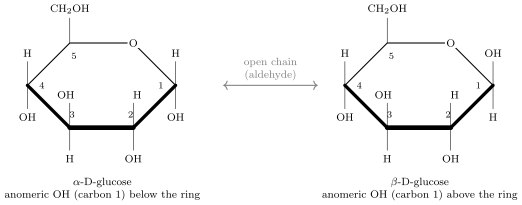
The two anomers of D-glucose in Haworth projection: the ring seen edge-on with its thick edge toward the reader, the hydroxyl of the anomeric carbon 1 below () or above () the plane. They interconvert through the open-chain aldehyde.
The two anomers of D-glucose in Haworth projection: the ring seen edge-on with its thick edge toward the reader, the hydroxyl of the anomeric carbon 1 below (α\alpha) or above (β\beta) the plane. They interconvert through the open-chain aldehyde.

উদাহরণ

Example 10.4 (Sugars that are not (CH2O)n(\mathrm{CH_2O})_n)

Deoxyribose lacks the hydroxyl at C2 (Chapter 11); glucosamine and N-acetylglucosamine carry an amine instead of the C2 hydroxyl (chitin, peptidoglycan); glucuronic acid has a carboxyl at C6 (the matrix polysaccharides); sugar phosphates (glucose-6-phosphate, ribose-5-phosphate) are the forms in which sugars enter metabolism; sugar alcohols (glycerol, sorbitol) have no carbonyl. The core is the same: a small polyhydroxylated carbon chain that water loves.

Example 10.15 (A day’s sugar)

A human eats some 300 g300\,\mathrm{g} of carbohydrate a day, nearly all as starch and sucrose; the gut hydrolyses it to glucose, fructose and galactose, the liver turns the last two into glucose, and glucose circulates at 5 g5\,\mathrm{g} in the whole blood — twenty minutes’ supply for the brain, which takes 120 g120\,\mathrm{g} a day, refilled continuously from the liver’s glycogen. The lens of the eye, the red cells and the kidney medulla live on glucose alone; nothing else in the diet can replace it, and when it runs out the liver makes it from protein.

প্রসঙ্গসহ পড়ো →