 Coach
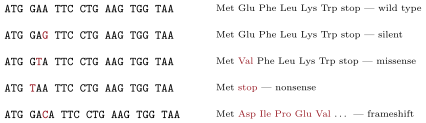
CoachA mutation is a heritable change in the sequence of the genome. Point mutations change one or a few bases: a substitution replaces one base by another (a transition swaps purine for purine or pyrimidine for pyrimidine, AG or CT; a transversion swaps the classes); an insertion or deletion adds or removes bases. In a coding sequence a substitution is silent if the new codon specifies the same amino acid, missense if it specifies another, nonsense if it creates a stop; an insertion or deletion not a multiple of three shifts the reading frame (frameshift) and garbles every codon downstream. Chromosomal rearrangements move large segments: deletion, duplication, inversion, translocation between chromosomes. Genome mutations change the number of chromosomes: aneuploidy (one chromosome too many or too few, as in trisomy 21) and polyploidy (whole extra sets). A mutation in a somatic cell is inherited by that cell’s descendants only; a mutation in the germ line is inherited by the organism’s descendants, and only these matter for evolution.
Examples
Example 3.8 (Resistance on the move)
A resistance gene typically arises once, by mutation or from the soil bacterium that makes the antibiotic, and then travels: from a chromosome onto a transposon, from the transposon onto a conjugative plasmid, from the plasmid across species by conjugation and across strains by transduction, and back into a chromosome by transformation. Plasmids carrying five or six resistances at once (assembled in integrons, which capture gene cassettes) were found in Japan in the 1950s, a few years after the drugs came into use; the gene for the carbapenemase NDM-1, first seen in 2008, reached every continent within three years on a plasmid. The evolution of resistance is mostly not the evolution of new genes but the movement of old ones.