সব বই

পেশাদার

1 Markets I: The Ecosystem and Exchange-Traded Marketsবাজার অনলাইন 2 Markets II: Rates, FX and Creditবাজার অনলাইন 3 Markets III: Commodities, Energy and Cryptoবাজার অনলাইন 4 Quantitative Methodsপদ্ধতি অনলাইন 5 Derivatives and Volatilityডেরিভেটিভস অনলাইন 6 Rates, Credit, XVA and Riskসুদহার, ঋণ ও ঝুঁকি অনলাইন 7 Research Craft: Predictors, Backtests, Measurement, Portfoliosগবেষণা অনলাইন 8 Strategies I: Equities and Futuresকৌশল অনলাইন 9 Strategies II: Volatility, Relative Value, Macro and the Bank Desksকৌশল অনলাইন 10 Microstructure and Executionএক্সিকিউশন অনলাইন 11 Market Making and High-Frequency Tradingমার্কেট মেকিং অনলাইন 12 Machine Learning for Marketsমেশিন লার্নিং অনলাইন 13 Low-Latency Softwareপ্রযুক্তি অনলাইন 14 Networks, Hardware and Trading Infrastructureপ্রযুক্তি অনলাইন 15 Research, Data and Risk Platformsপ্রযুক্তি অনলাইন 16 The Desk and the Firmপ্রতিষ্ঠান অনলাইন 17 The Industry: Firms, Roles and Careersক্যারিয়ার অনলাইন 18 Interviews I: Maths, Probability and Speedক্যারিয়ার অনলাইন 19 Interviews II: Markets, Trading Games and the Final Roundক্যারিয়ার অনলাইন 20 Interviews III: Codeক্যারিয়ার অনলাইন
অ্যাপ পরিচিতি Coach সাইন ইন পড়া শুরু করো

বইগুলো এখনো বাংলা ভাষায় পাওয়া যায় না — ইংরেজি সংস্করণ দেখানো হচ্ছে।

Biology · পরিভাষা

Nucleotide কী?

অন্য নাম: base (DNA) · nitrogenous base · purine · pyrimidine

Definition 3.4 High School Biology · অধ্যায় 3 — DNA: A Universal Genetic Molecule

DNA is a chain of nucleotides. Each nucleotide is made of three parts: a phosphate group, a sugar (deoxyribose) and one of four nitrogen-containing bases: adenine (A), thymine (T), guanine (G) and cytosine (C). Sugars and phosphates alternate to form the backbone of the chain; the bases stick out from it, one per nucleotide. The four nucleotides differ only by their base, so a strand of DNA is described by the sequence of its bases, written as a string of letters: ATGGCTTAC…

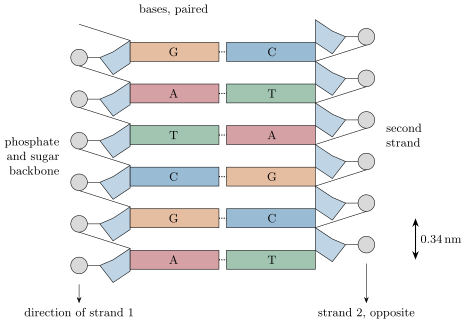
The two strands of DNA, drawn flat. Each strand is a chain of nucleotides (phosphate, sugar, base). The strands run in opposite directions and are held together by base pairs: A always faces T, G always faces C. One base pair follows the next every 0.34\, nm.
The two strands of DNA, drawn flat. Each strand is a chain of nucleotides (phosphate, sugar, base). The strands run in opposite directions and are held together by base pairs: A always faces T, G always faces C. One base pair follows the next every 0.34 nm0.34\,\mathrm{nm}.
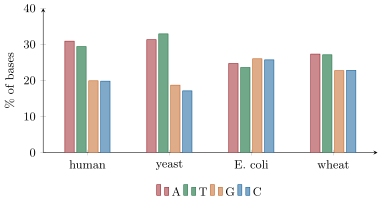
Base composition of DNA in four species. In each, the A and T bars match and the G and C bars match — the signature of base pairing — while the A+T share differs from one species to another.

উদাহরণ

Example 3.6 (Chargaff’s rule in numbers)

Human DNA: A 30.9%, T 29.4%, G 19.9%, C 19.8% — A ≈ \,\approx\,T and G ≈ \,\approx\,C to within the precision of the measurement, and A+T =60%= 60\%. E. coli: A 24.7%, T 23.6%, G 26.0%, C 25.7%, A+T =48%= 48\%. Yeast: A+T =64%= 64\%. If a DNA sample contains 32% of A, complementarity predicts 32% of T and (100−64)/2=18%(100 - 64)/2 = 18\% each of G and C.

প্রসঙ্গসহ পড়ো →
Definition 11.1 University Biology — Year 1 · অধ্যায় 11 — Nucleotides and Nucleic Acids

A nucleotide is made of three parts: a nitrogenous base — a purine (adenine A, guanine G: two fused rings) or a pyrimidine (cytosine C, thymine T, uracil U: one ring); a five-carbon sugar, ribose in RNA or 2′'-deoxyribose in DNA (lacking the hydroxyl on carbon 2′2'); and one to three phosphate groups on the sugar’s carbon 5′5'. The base is attached to carbon 1′1'; the sugar carbons are numbered with primes to distinguish them from the base’s. Base plus sugar is a nucleoside (adenosine, guanosine, cytidine, thymidine, uridine); with phosphates it is a nucleotide (AMP, ADP, ATP and their kin).

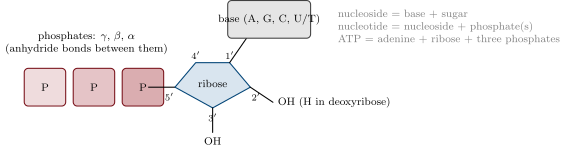
The parts of a nucleotide: a base on carbon 1' of a pentose, phosphates on carbon 5'. The 3' hydroxyl is where the next nucleotide of a chain will attach; the 2' position distinguishes RNA (OH) from DNA (H).
The parts of a nucleotide: a base on carbon 1′1' of a pentose, phosphates on carbon 5′5'. The 3′3' hydroxyl is where the next nucleotide of a chain will attach; the 2′2' position distinguishes RNA (OH) from DNA (H).

উদাহরণ

Example 11.4 (RNA is fragile, DNA is durable)

The 2′2' hydroxyl of ribose can attack the neighbouring phosphodiester bond: in mild alkali RNA is hydrolysed to nucleotides within hours, while DNA, lacking that hydroxyl, survives boiling in alkali and has been recovered intact from bones tens of thousands of years old. Uracil in RNA is thymine without a methyl group; DNA uses thymine so that cytosine, which slowly loses its amino group to become uracil, can be recognised as damaged and repaired — a uracil in DNA is always a mistake.

Example 11.7 (Reading a strand)

If one strand reads 5′5'-ATGGCATTC-3′3', its partner, written 5′→3′5' \to 3', is 5′5'-GAATGCCAT-3′3': complement each base, then reverse the order. Nine pairs, 3.1 nm3.1\,\mathrm{nm} of helix, twenty-two hydrogen bonds (five G–C, four A–T). A human chromosome of 2.5×1082.5 \times 10^{8} pairs is 8.5 cm8.5\,\mathrm{cm} long in this form and must be folded a hundred thousand times to fit a nucleus (Chapter 17).

Example 11.11 (A probe finds a gene)

A twenty-nucleotide probe complementary to one gene, at 5 ∘C5\,{}^{\circ}\mathrm{C} below its own TmT_m, binds its exact complement and nothing else in three billion base pairs: a single mismatch in twenty lowers TmT_m by several degrees and the mismatched hybrid melts. The specificity of base pairing, multiplied over twenty positions, is what every DNA test, from paternity to pathogen detection, relies on.

প্রসঙ্গসহ পড়ো →