
সব বই

পেশাদার

1 Markets I: The Ecosystem and Exchange-Traded Marketsবাজার অনলাইন 2 Markets II: Rates, FX and Creditবাজার অনলাইন 3 Markets III: Commodities, Energy and Cryptoবাজার অনলাইন 4 Quantitative Methodsপদ্ধতি অনলাইন 5 Derivatives and Volatilityডেরিভেটিভস অনলাইন 6 Rates, Credit, XVA and Riskসুদহার, ঋণ ও ঝুঁকি অনলাইন 7 Research Craft: Predictors, Backtests, Measurement, Portfoliosগবেষণা অনলাইন 8 Strategies I: Equities and Futuresকৌশল অনলাইন 9 Strategies II: Volatility, Relative Value, Macro and the Bank Desksকৌশল অনলাইন 10 Microstructure and Executionএক্সিকিউশন অনলাইন 11 Market Making and High-Frequency Tradingমার্কেট মেকিং অনলাইন 12 Machine Learning for Marketsমেশিন লার্নিং অনলাইন 13 Low-Latency Softwareপ্রযুক্তি অনলাইন 14 Networks, Hardware and Trading Infrastructureপ্রযুক্তি অনলাইন 15 Research, Data and Risk Platformsপ্রযুক্তি অনলাইন 16 The Desk and the Firmপ্রতিষ্ঠান অনলাইন 17 The Industry: Firms, Roles and Careersক্যারিয়ার অনলাইন 18 Interviews I: Maths, Probability and Speedক্যারিয়ার অনলাইন 19 Interviews II: Markets, Trading Games and the Final Roundক্যারিয়ার অনলাইন 20 Interviews III: Codeক্যারিয়ার অনলাইন
অ্যাপ পরিচিতি Coach সাইন ইন পড়া শুরু করো

বইগুলো এখনো বাংলা ভাষায় পাওয়া যায় না — ইংরেজি সংস্করণ দেখানো হচ্ছে।

Biology · পরিভাষা

Olfaction and taste কী?

Definition 18.7 University Biology — Year 3 · অধ্যায় 18 — Sensory Systems

Smell begins in a patch of epithelium at the top of the nose, where some ten million olfactory sensory neurons each express one olfactory receptor gene out of about 400400 in humans (11001100 in a mouse, the largest gene family in either genome) — G-protein- coupled receptors that bind odorant molecules in a pocket and, through cyclic AMP, open a channel. Each receptor binds several odorants and each odorant binds several receptors, so an odour is a combinatorial code, a pattern of activity across the 400400 receptor types, and a change of one carbon in a molecule changes the pattern and the smell. All the neurons expressing one receptor send their axons to the same one or two glomeruli in the olfactory bulb, so the bulb holds a map in which each odour is a spatial pattern of active glomeruli, read by the cortex without passing through the thalamus. Taste is simpler: five modalities, each a labelled line from its own receptor cells — sweet, umami and bitter through G-protein-coupled receptors (one sweet receptor, one umami, some twenty-five bitter), salt through a sodium channel, sour through a proton channel — and the rest of what we call flavour is smell, reaching the nose through the back of the mouth.
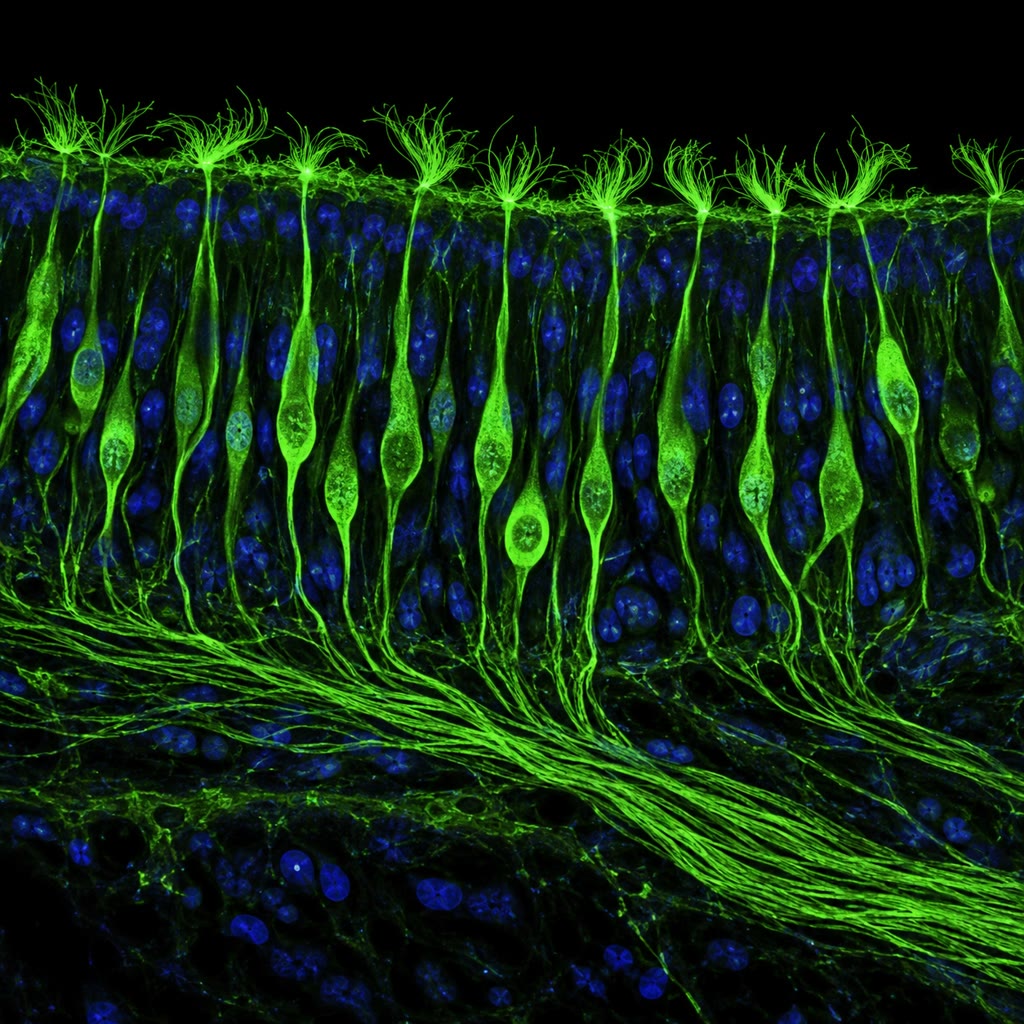
The olfactory epithelium: sensory neurons (green) with ciliated dendrites at the surface, where odorants bind, and axons bundling below toward the bulb. Each neuron expresses one receptor gene of the four hundred.
প্রসঙ্গসহ পড়ো →