
সব বই

পেশাদার

1 Markets I: The Ecosystem and Exchange-Traded Marketsবাজার অনলাইন 2 Markets II: Rates, FX and Creditবাজার অনলাইন 3 Markets III: Commodities, Energy and Cryptoবাজার অনলাইন 4 Quantitative Methodsপদ্ধতি অনলাইন 5 Derivatives and Volatilityডেরিভেটিভস অনলাইন 6 Rates, Credit, XVA and Riskসুদহার, ঋণ ও ঝুঁকি অনলাইন 7 Research Craft: Predictors, Backtests, Measurement, Portfoliosগবেষণা অনলাইন 8 Strategies I: Equities and Futuresকৌশল অনলাইন 9 Strategies II: Volatility, Relative Value, Macro and the Bank Desksকৌশল অনলাইন 10 Microstructure and Executionএক্সিকিউশন অনলাইন 11 Market Making and High-Frequency Tradingমার্কেট মেকিং অনলাইন 12 Machine Learning for Marketsমেশিন লার্নিং অনলাইন 13 Low-Latency Softwareপ্রযুক্তি অনলাইন 14 Networks, Hardware and Trading Infrastructureপ্রযুক্তি অনলাইন 15 Research, Data and Risk Platformsপ্রযুক্তি অনলাইন 16 The Desk and the Firmপ্রতিষ্ঠান অনলাইন 17 The Industry: Firms, Roles and Careersক্যারিয়ার অনলাইন 18 Interviews I: Maths, Probability and Speedক্যারিয়ার অনলাইন 19 Interviews II: Markets, Trading Games and the Final Roundক্যারিয়ার অনলাইন 20 Interviews III: Codeক্যারিয়ার অনলাইন
অ্যাপ পরিচিতি Coach সাইন ইন পড়া শুরু করো

বইগুলো এখনো বাংলা ভাষায় পাওয়া যায় না — ইংরেজি সংস্করণ দেখানো হচ্ছে।

Biology · পরিভাষা

Pattern recognition কী?

Definition 15.2 University Biology — Year 3 · অধ্যায় 15 — Innate Immunity and Inflammation

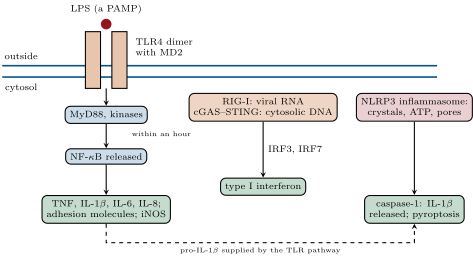
Innate cells recognise pathogen-associated molecular patterns (PAMPs): molecules common to whole classes of microbes, essential to them, and absent from the host — lipopolysaccharide of Gram-negative walls, peptidoglycan and lipoteichoic acid of Gram-positives, flagellin, fungal β\beta-glucans, double-stranded RNA, RNA without a 5′' cap, DNA with unmethylated CpG, DNA in the cytosol. The receptors are pattern recognition receptors (PRRs), a few dozen in all, each encoded by one gene: the Toll-like receptors (TLRs) on the surface and in endosomes (TLR4 for lipopolysaccharide, TLR5 for flagellin, TLR3 for double-stranded RNA, TLR9 for CpG DNA); the cytosolic NOD proteins for peptidoglycan fragments, RIG-I for viral RNA, cGAS–STING for cytosolic DNA; C-type lectins for fungal sugars. The same receptors, or others of the same families, recognise damage-associated molecular patterns (DAMPs) released by injured cells — ATP, uric acid, the nuclear protein HMGB1, mitochondrial DNA — so that sterile injury also inflames. Binding activates the transcription factors NF-κ\kappaB and the interferon regulatory factors, which switch on cytokines, chemokines, adhesion molecules and antimicrobial genes within an hour; a subset of the cytosolic sensors assemble the inflammasome, a platform that activates caspase-1 to cut interleukin-1β\beta into its active form and to trigger the inflammatory death called pyroptosis (Chapter 10).
Three arms of pattern recognition. A surface Toll-like receptor bound by lipopolysaccharide signals through NF-B to the inflammatory cytokines; cytosolic sensors of viral nucleic acid induce interferon; the inflammasome turns the stored precursor of interleukin-1 into the active cytokine.
Three arms of pattern recognition. A surface Toll-like receptor bound by lipopolysaccharide signals through NF-κ\kappaB to the inflammatory cytokines; cytosolic sensors of viral nucleic acid induce interferon; the inflammasome turns the stored precursor of interleukin-1 into the active cytokine.
প্রসঙ্গসহ পড়ো →