
সব বই

পেশাদার

1 Markets I: The Ecosystem and Exchange-Traded Marketsবাজার অনলাইন 2 Markets II: Rates, FX and Creditবাজার অনলাইন 3 Markets III: Commodities, Energy and Cryptoবাজার অনলাইন 4 Quantitative Methodsপদ্ধতি অনলাইন 5 Derivatives and Volatilityডেরিভেটিভস অনলাইন 6 Rates, Credit, XVA and Riskসুদহার, ঋণ ও ঝুঁকি অনলাইন 7 Research Craft: Predictors, Backtests, Measurement, Portfoliosগবেষণা অনলাইন 8 Strategies I: Equities and Futuresকৌশল অনলাইন 9 Strategies II: Volatility, Relative Value, Macro and the Bank Desksকৌশল অনলাইন 10 Microstructure and Executionএক্সিকিউশন অনলাইন 11 Market Making and High-Frequency Tradingমার্কেট মেকিং অনলাইন 12 Machine Learning for Marketsমেশিন লার্নিং অনলাইন 13 Low-Latency Softwareপ্রযুক্তি অনলাইন 14 Networks, Hardware and Trading Infrastructureপ্রযুক্তি অনলাইন 15 Research, Data and Risk Platformsপ্রযুক্তি অনলাইন 16 The Desk and the Firmপ্রতিষ্ঠান অনলাইন 17 The Industry: Firms, Roles and Careersক্যারিয়ার অনলাইন 18 Interviews I: Maths, Probability and Speedক্যারিয়ার অনলাইন 19 Interviews II: Markets, Trading Games and the Final Roundক্যারিয়ার অনলাইন 20 Interviews III: Codeক্যারিয়ার অনলাইন
অ্যাপ পরিচিতি Coach সাইন ইন পড়া শুরু করো

বইগুলো এখনো বাংলা ভাষায় পাওয়া যায় না — ইংরেজি সংস্করণ দেখানো হচ্ছে।

Biology · পরিভাষা

Reflex কী?

অন্য নাম: reflex arc · stretch reflex

Definition 35.1 High School Biology · অধ্যায় 35 — The Stretch Reflex and the Nerve Message

A reflex is an involuntary, rapid and stereotyped response of an effector (a muscle or a gland) to a stimulus, produced by a fixed circuit of neurons, the reflex arc, that runs through the spinal cord or brainstem without requiring the brain. The stretch reflex is the simplest: the sudden stretching of a muscle makes that same muscle contract.
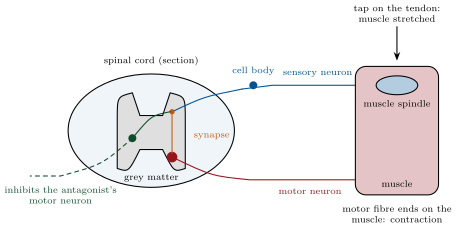
The stretch reflex arc, seen in a section of the spinal cord. The spindle’s sensory neuron (blue) enters by the dorsal root and connects, through one synapse (orange), to the motor neuron (red) of the same muscle, which leaves by the ventral root; an interneuron (green) inhibits the antagonist.
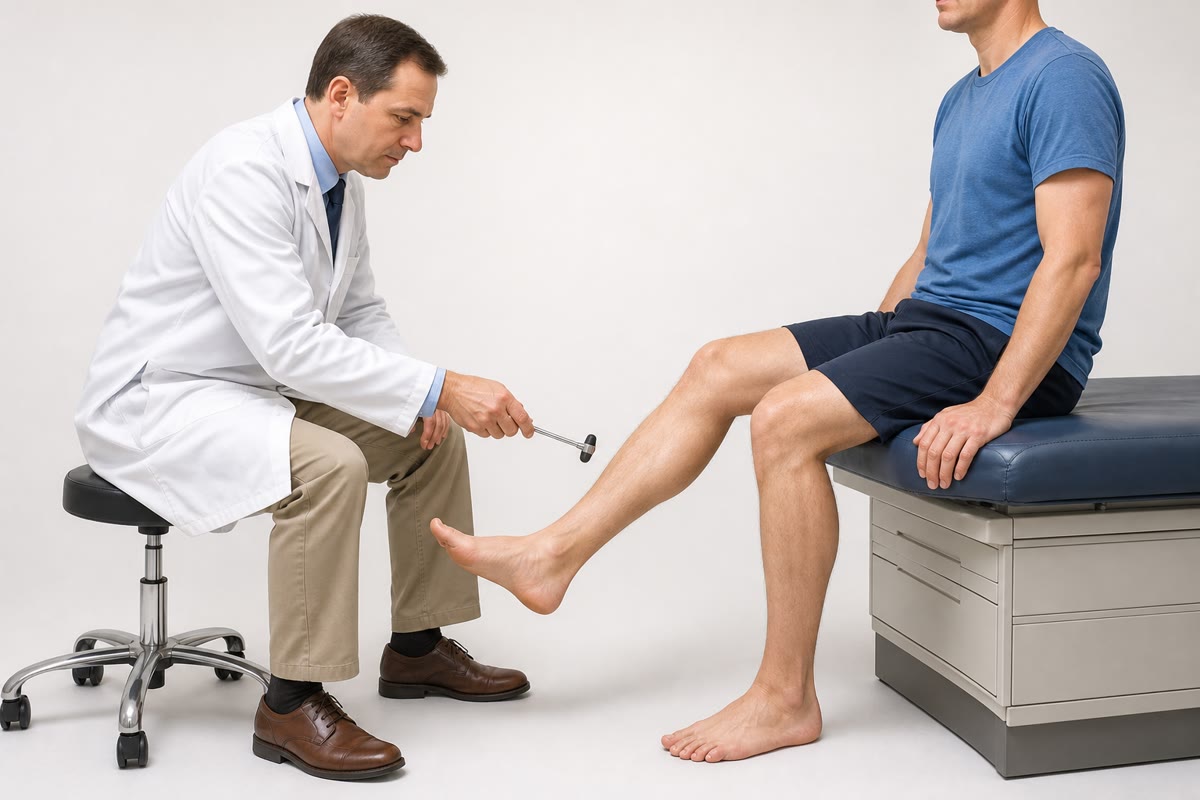
The knee-jerk test: a tap on the patellar tendon stretches the thigh muscle, and thirty milliseconds later the leg kicks. The reflex checks, in a second, the whole arc from spindle to muscle.

উদাহরণ

Example 35.3 (What the reflex is for)

Standing, you sway; each sway stretches the muscles of one side of the ankle, whose spindles fire and whose reflex contraction pulls you back before you notice. Carrying a tray, a sudden extra weight stretches the arm muscles and the reflex stiffens them within 30 ms30\,\mathrm{ms}, before the tray tips. The stretch reflex is a servomechanism: it opposes any change of a muscle’s length, and the brain adjusts its sensitivity to set the body’s tone — higher when you brace, lower when you sleep.

Example 35.6 (Speed)

Action potentials travel at 1 m/s1\,\mathrm{m}/\mathrm{s} in thin unmyelinated fibres and up to 100 m/s100\,\mathrm{m}/\mathrm{s} in the thick myelinated fibres of the stretch reflex. From the knee to the spinal cord and back is about 1.5 m1.5\,\mathrm{m}: some 15 ms15\,\mathrm{ms} of travel, to which the spindle’s response, one synapse and the muscle’s activation add another 15 ms15\,\mathrm{ms} — the 30 ms30\,\mathrm{ms} of the knee jerk. A message from a toe to the brain, 1.8 m1.8\,\mathrm{m} away, takes about 20 ms20\,\mathrm{ms}; the decision to move it, and its execution, some 150 ms150\,\mathrm{ms} more.

প্রসঙ্গসহ পড়ো →