 Coach
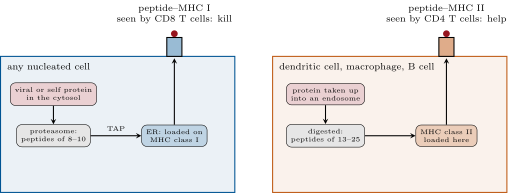
CoachThe T cell receptor is a two-chain molecule built by the same recombination, never secreted, and it does not bind antigen free in solution: it recognises a short peptide held in the groove of a major histocompatibility complex (MHC) molecule on another cell’s surface. MHC class I, on every nucleated cell, displays peptides of eight to ten residues cut by the proteasome from the cell’s own cytosolic proteins — a sample of what the cell is making, including any virus — to CD8 T cells, which kill the cell if the peptide is foreign. MHC class II, on dendritic cells, macrophages and B cells, displays peptides of thirteen to twenty-five residues from proteins the cell has taken up and digested in endosomes, to CD4 T cells, which respond by helping. A T cell is restricted: it recognises its peptide only on the MHC allele it was selected on. The MHC genes (HLA in humans) are the most polymorphic in the genome, with thousands of alleles each differing in the groove, so that each person displays a different sample of each protein’s peptides and no pathogen can escape presentation in everyone — and so that a transplanted organ from an unmatched donor is recognised as foreign by a large fraction of the recipient’s T cells.
Examples
Example 16.9 (Hypersensitivity, deficiency, transplantation)
Allergy is a Th2 response to a harmless antigen — pollen, peanut, penicillin — that produces IgE; on re-exposure the antigen cross-links IgE on mast cells, which release histamine within minutes, and if the antigen is in the blood the systemic release is anaphylaxis, treated with adrenaline. Immunodeficiency: children lacking RAG or the enzyme ADA make no lymphocytes (severe combined immunodeficiency) and die of infection unless given marrow or gene therapy; HIV destroys CD4 T cells and with them the help every response needs. Transplantation: the recipient’s T cells see the donor’s HLA molecules as foreign, and up to a tenth of all T cells respond — far more than to any pathogen — so grafts are matched at the HLA loci and the recipient is immunosuppressed for life; a graft of marrow can attack its new host instead. And the deliberate uses: the monoclonal antibodies of Chapter 6, the checkpoint inhibitors that release T cells against tumours (Chapter 11), and T cells engineered with a chimaeric receptor for a tumour antigen (CAR-T), which have cured leukaemias that nothing else touched.