 Coach
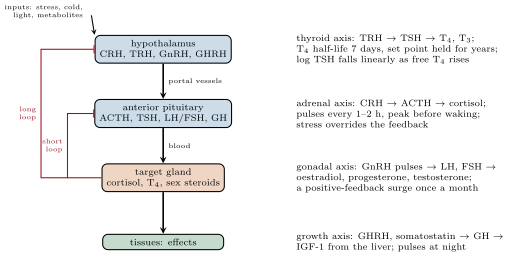
CoachThe hypothalamus, a few grams of brain above the pituitary, turns neural information — stress, cold, day length, the blood’s osmolarity and glucose — into hormonal commands. Its neurosecretory cells release releasing hormones (peptides: CRH, TRH, GnRH, GHRH, and the inhibitor somatostatin; dopamine for prolactin) into a private portal system of vessels that carries them, undiluted, a centimetre down to the anterior pituitary, whose cells respond with tropic hormones: ACTH to the adrenal cortex, TSH to the thyroid, LH and FSH to the gonads, growth hormone to the liver and tissues, prolactin to the breast. The target glands’ hormones — cortisol, thyroxine, sex steroids — feed back on both pituitary and hypothalamus to shut off their own commands: negative feedback, in three tiers. The posterior pituitary is not a gland but the axon terminals of hypothalamic neurons, releasing vasopressin and oxytocin straight into the blood. Each axis has its own dynamics: the thyroid axis is slow and steady, holding a set point for years; the adrenal axis is pulsatile and circadian, cortisol peaking before dawn and secreted in hourly bursts; the gonadal axis of a woman runs a monthly cycle on a positive feedback that the others lack.
Examples
Example 21.6 (Cortisol: the stress axis)
Cortisol, from the adrenal cortex under ACTH, mobilises fuel (glucose from the liver, amino acids from muscle, fatty acids from fat), sensitises vessels to adrenaline, and suppresses inflammation and the immune response — the reason its synthetic relatives are the commonest anti-inflammatory drugs. Its rhythm is set by the clock: at 8 a.m., a fifth of that at midnight, and pulses every hour or two throughout, since the hypothalamic CRH neurons fire in bursts. Stress — haemorrhage, infection, surgery, fear — raises it tenfold within minutes, overriding the feedback. Too little (Addison’s disease, destruction of the adrenal cortex) gives weakness, low blood pressure, low glucose, and, under stress, collapse and death unless replaced; too much (Cushing’s syndrome: a pituitary tumour making ACTH, an adrenal tumour, or, most often, prescribed steroids) gives the round face, thin skin, wasted muscle, high glucose, high pressure and brittle bones of prolonged exposure. Stopping a long course of steroids abruptly is dangerous for the reason the axis predicts: the suppressed hypothalamus and pituitary take weeks to recover, and the adrenal, unstimulated, has shrunk.