
সব বই

পেশাদার

1 Markets I: The Ecosystem and Exchange-Traded Marketsবাজার অনলাইন 2 Markets II: Rates, FX and Creditবাজার অনলাইন 3 Markets III: Commodities, Energy and Cryptoবাজার অনলাইন 4 Quantitative Methodsপদ্ধতি অনলাইন 5 Derivatives and Volatilityডেরিভেটিভস অনলাইন 6 Rates, Credit, XVA and Riskসুদহার, ঋণ ও ঝুঁকি অনলাইন 7 Research Craft: Predictors, Backtests, Measurement, Portfoliosগবেষণা অনলাইন 8 Strategies I: Equities and Futuresকৌশল অনলাইন 9 Strategies II: Volatility, Relative Value, Macro and the Bank Desksকৌশল অনলাইন 10 Microstructure and Executionএক্সিকিউশন অনলাইন 11 Market Making and High-Frequency Tradingমার্কেট মেকিং অনলাইন 12 Machine Learning for Marketsমেশিন লার্নিং অনলাইন 13 Low-Latency Softwareপ্রযুক্তি অনলাইন 14 Networks, Hardware and Trading Infrastructureপ্রযুক্তি অনলাইন 15 Research, Data and Risk Platformsপ্রযুক্তি অনলাইন 16 The Desk and the Firmপ্রতিষ্ঠান অনলাইন 17 The Industry: Firms, Roles and Careersক্যারিয়ার অনলাইন 18 Interviews I: Maths, Probability and Speedক্যারিয়ার অনলাইন 19 Interviews II: Markets, Trading Games and the Final Roundক্যারিয়ার অনলাইন 20 Interviews III: Codeক্যারিয়ার অনলাইন
অ্যাপ পরিচিতি Coach সাইন ইন পড়া শুরু করো

বইগুলো এখনো বাংলা ভাষায় পাওয়া যায় না — ইংরেজি সংস্করণ দেখানো হচ্ছে।

Biology · পরিভাষা

The water molecule কী?

অন্য নাম: polar molecule · hydrogen bond

Definition 8.1 University Biology — Year 1 · অধ্যায় 8 — Water and Small Biomolecules

Water, H2O\mathrm{H_2O}, is a bent molecule (the H–O–H angle is 104.5∘104.5^\circ) in which the oxygen draws the shared electrons toward itself: it is polar, with a partial negative charge on the oxygen and partial positive charges on the hydrogens. Each molecule can form up to four hydrogen bonds — an electrostatic attraction between a hydrogen bound to an electronegative atom (O, N) and a lone pair of another electronegative atom — two through its hydrogens, two through its oxygen. Liquid water is a network of such bonds, each lasting a few picoseconds.
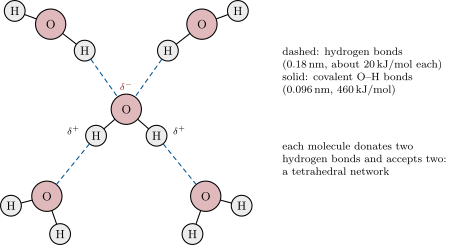
A water molecule (H–O–H angle 104.5) and its four hydrogen-bonded neighbours. The polar bent molecule donates two hydrogen bonds through its hydrogens and accepts two on its oxygen; the network they form gives water its cohesion, its heat capacity and its power as a solvent.
A water molecule (H–O–H angle 104.5∘104.5^\circ) and its four hydrogen-bonded neighbours. The polar bent molecule donates two hydrogen bonds through its hydrogens and accepts two on its oxygen; the network they form gives water its cohesion, its heat capacity and its power as a solvent.
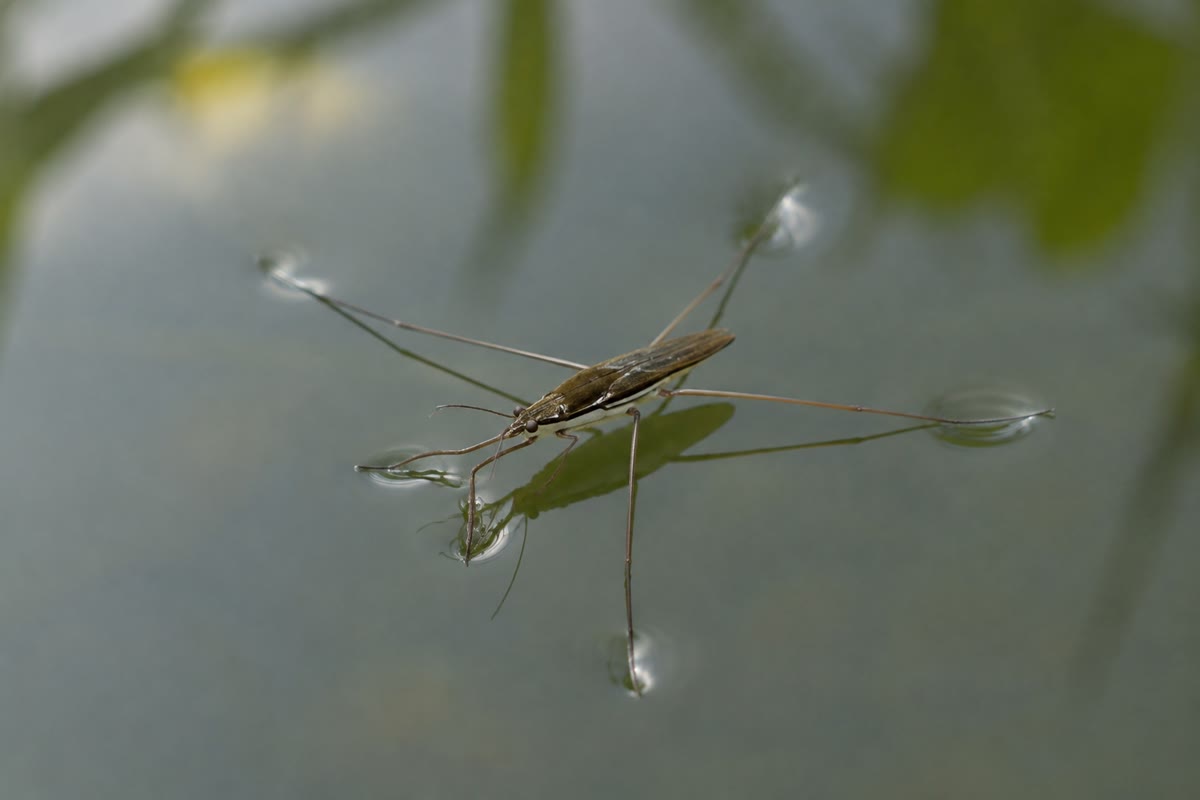
A water strider on a pond: the dimples under its feet are the surface held taut by the cohesion of hydrogen-bonded water.

উদাহরণ

Example 8.3 (The hydrophobic effect at work)

Shake oil into water and within minutes the droplets have merged: water squeezes out what it cannot bond to. The same effect folds a protein (its oily residues hide inside, Chapter 12), assembles a membrane (the tails of the lipids gather away from water, Chapter 9), and drives two matching molecular surfaces together. Nothing attracts the oil to the oil; water pushes.

Example 8.6 (Melting a double helix)

The two strands of DNA are held by two or three hydrogen bonds per base pair plus the stacking (van der Waals) of neighbouring pairs; a single pair would separate at once, but a thousand pairs in a row hold until the temperature reaches about 90 ∘C90\,{}^{\circ}\mathrm{C}, and reunite, in exactly the same register, when it is lowered (Chapter 11). Specific, strong in number, reversible.

প্রসঙ্গসহ পড়ো →