全部书籍

专业

应用 关于 Coach 登录 开始阅读

书籍暂未推出简体中文版——当前显示英文版。

Chemistry · 术语表

什么是 Hydrogen bond?

Definition 30.12 School Chemistry — Grades 1 to 12 · 第 30 章 — Electronegativity, Polarity and Intermolecular Forces

A hydrogen bond is an attraction between a hydrogen atom bonded to a very electronegative atom (nitrogen, oxygen or fluorine), which carries a marked δ+\delta^+, and a lone pair of another nitrogen, oxygen or fluorine atom, often on a neighbouring molecule. It is drawn as a dashed line, and the three atoms involved are nearly in a straight line.
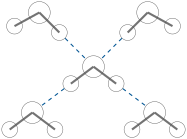
Hydrogen bonds (dashed) around a water molecule in liquid water: its two hydrogen atoms bond to the oxygen atoms of two neighbours, and the two lone pairs of its oxygen atom receive the hydrogen atoms of two others.

示例

Example 30.13 (Ethanol and propane)

Ethanol, CHX3−CHX2−OH\ce{CH3-CH2-OH} (46.0 g/mol46.0\,\mathrm{g}/\mathrm{mol}), and propane, CHX3−CHX2−CHX3\ce{CH3-CH2-CH3} (44.0 g/mol44.0\,\mathrm{g}/\mathrm{mol}), have molecules of nearly the same size. Yet ethanol boils at 78 ∘C78\,{}^{\circ}\mathrm{C} and propane at −42 ∘C-42\,{}^{\circ}\mathrm{C}. Ethanol molecules, with their O−H\ce{O-H} group, form hydrogen bonds with one another; propane molecules cannot.

Example 30.16 (Three solids)

Sodium chloride, an ionic solid, melts at 801 ∘C801\,{}^{\circ}\mathrm{C}; ice, held by hydrogen bonds, at 0 ∘C0\,{}^{\circ}\mathrm{C}; solid methane, held only by van der Waals interactions between small molecules, far below −150 ∘C-150\,{}^{\circ}\mathrm{C}.

在原文中阅读 →
Definition 4.4 University Chemistry — Year 1 · 第 4 章 — Intermolecular Forces and Solvents

A hydrogen bond is an attraction X−H⋯Y\ce{X-H}\cdots\ce{Y} between a hydrogen atom bonded to a small, very electronegative atom X (N\ce{N}, O\ce{O} or F\ce{F}) and a lone pair of another electronegative atom Y. The molecule that carries X−H\ce{X-H} is the hydrogen-bond donor, the one that carries Y the acceptor. Its energy, 10 to 40 kJ/mol40\,\mathrm{kJ}/\mathrm{mol}, lies between van der Waals interactions and covalent bonds; the three atoms X\ce{X}, H\ce{H}, Y\ce{Y} are nearly aligned.

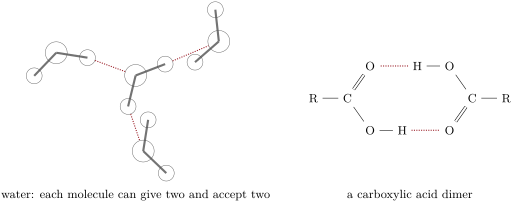
Hydrogen bonds (red dotted). In liquid water each molecule takes part in up to four of them; carboxylic acids pair up in cyclic dimers held by two hydrogen bonds.
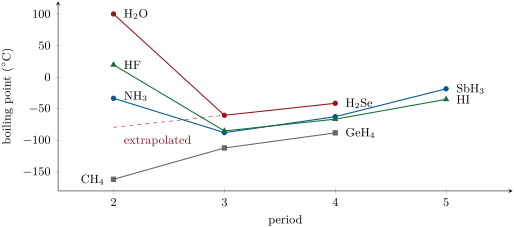
Boiling points of the hydrides of group 14 (grey squares), 15 (blue), 16 (red) and 17 (green). Water would boil near -79\, C if it followed its heavier analogues (dashed); its hydrogen bonds raise it by about 180\, C.
Boiling points of the hydrides of group 14 (grey squares), 15 (blue), 16 (red) and 17 (green). Water would boil near −79 ∘C-79\,{}^{\circ}\mathrm{C} if it followed its heavier analogues (dashed); its hydrogen bonds raise it by about 180 ∘C180\,{}^{\circ}\mathrm{C}.
在原文中阅读 →