সব বই

পেশাদার

1 Markets I: The Ecosystem and Exchange-Traded Marketsবাজার অনলাইন 2 Markets II: Rates, FX and Creditবাজার অনলাইন 3 Markets III: Commodities, Energy and Cryptoবাজার অনলাইন 4 Quantitative Methodsপদ্ধতি অনলাইন 5 Derivatives and Volatilityডেরিভেটিভস অনলাইন 6 Rates, Credit, XVA and Riskসুদহার, ঋণ ও ঝুঁকি অনলাইন 7 Research Craft: Predictors, Backtests, Measurement, Portfoliosগবেষণা অনলাইন 8 Strategies I: Equities and Futuresকৌশল অনলাইন 9 Strategies II: Volatility, Relative Value, Macro and the Bank Desksকৌশল অনলাইন 10 Microstructure and Executionএক্সিকিউশন অনলাইন 11 Market Making and High-Frequency Tradingমার্কেট মেকিং অনলাইন 12 Machine Learning for Marketsমেশিন লার্নিং অনলাইন 13 Low-Latency Softwareপ্রযুক্তি অনলাইন 14 Networks, Hardware and Trading Infrastructureপ্রযুক্তি অনলাইন 15 Research, Data and Risk Platformsপ্রযুক্তি অনলাইন 16 The Desk and the Firmপ্রতিষ্ঠান অনলাইন 17 The Industry: Firms, Roles and Careersক্যারিয়ার অনলাইন 18 Interviews I: Maths, Probability and Speedক্যারিয়ার অনলাইন 19 Interviews II: Markets, Trading Games and the Final Roundক্যারিয়ার অনলাইন 20 Interviews III: Codeক্যারিয়ার অনলাইন
অ্যাপ পরিচিতি Coach সাইন ইন পড়া শুরু করো

বইগুলো এখনো বাংলা ভাষায় পাওয়া যায় না — ইংরেজি সংস্করণ দেখানো হচ্ছে।

Chemistry · পরিভাষা

Ionisation energies কী?

অন্য নাম: first ionisation energy · successive ionisation energies

Definition 2.9 University Chemistry — Year 1 · অধ্যায় 2 — Periodicity

The first ionisation energy Ei1E_{i1} of an element is the energy needed to remove one electron from the isolated atom in its ground state, in the gas phase:

X(g)→XX+(g)+eX−,Ei1=E(XX+)+E(eX−)−E(X)>0.\ce{X(g) -> X+(g) + e-}, \qquad E_{i1} = E(\ce{X+}) + E(\ce{e-}) - E(\ce{X}) > 0 .

The successive ionisation energies Ei2,Ei3,…E_{i2}, E_{i3}, \dots remove the second, the third electron… from XX+\ce{X+}, XX2+\ce{X^{2+}}… They are given in electronvolts per atom or in kilojoules per mole (1 eV↔96.49 kJ/mol1\,\mathrm{eV} \leftrightarrow 96.49\,\mathrm{kJ}/\mathrm{mol}).

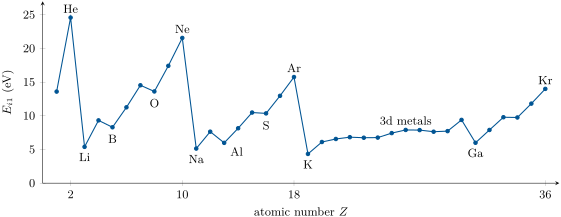
First ionisation energies of the first 36 elements. Maxima at the noble gases, minima at the alkali metals; the small dips at B, Al, Ga and at O, S are the subshell effects of .
First ionisation energies of the first 36 elements. Maxima at the noble gases, minima at the alkali metals; the small dips at B, Al, Ga and at O, S are the subshell effects of Proposition 2.12.
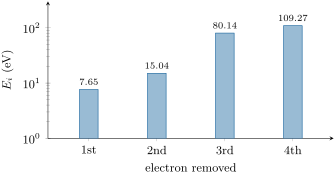
Successive ionisation energies of magnesium (logarithmic axis). The third is five times the second: the 3s shell is empty and the core is reached.

উদাহরণ

Example 2.11 (Magnesium)

The successive ionisation energies of magnesium are 7.65, 15.04, 80.14 and 109.27 eV109.27\,\mathrm{eV}. The ratio Ei2/Ei1≈2E_{i2}/E_{i1} \approx 2 is moderate; Ei3/Ei2≈5.3E_{i3}/E_{i2} \approx 5.3 is a jump: the third electron comes from the 2p core. Magnesium gives up its two 3s electrons and stops at MgX2+\ce{Mg^{2+}}, the noble-gas configuration of neon.

Example 2.24 (Lithium in a battery)

Lithium has the lowest electronegativity of period 2 and loses its 2s electron easily, while it is the lightest metal: it carries the most transferable charge per gram of any element, the reason it powers rechargeable batteries. Its first ionisation energy, 5.39 eV5.39\,\mathrm{eV}, is larger than that of sodium (5.14) or potassium (4.34), yet in water it is the most reducing alkali metal, a paradox resolved by the strong hydration of the small LiX+\ce{Li+} ion (Chapter 13).

প্রসঙ্গসহ পড়ো →