
সব বই

পেশাদার

1 Markets I: The Ecosystem and Exchange-Traded Marketsবাজার অনলাইন 2 Markets II: Rates, FX and Creditবাজার অনলাইন 3 Markets III: Commodities, Energy and Cryptoবাজার অনলাইন 4 Quantitative Methodsপদ্ধতি অনলাইন 5 Derivatives and Volatilityডেরিভেটিভস অনলাইন 6 Rates, Credit, XVA and Riskসুদহার, ঋণ ও ঝুঁকি অনলাইন 7 Research Craft: Predictors, Backtests, Measurement, Portfoliosগবেষণা অনলাইন 8 Strategies I: Equities and Futuresকৌশল অনলাইন 9 Strategies II: Volatility, Relative Value, Macro and the Bank Desksকৌশল অনলাইন 10 Microstructure and Executionএক্সিকিউশন অনলাইন 11 Market Making and High-Frequency Tradingমার্কেট মেকিং অনলাইন 12 Machine Learning for Marketsমেশিন লার্নিং অনলাইন 13 Low-Latency Softwareপ্রযুক্তি অনলাইন 14 Networks, Hardware and Trading Infrastructureপ্রযুক্তি অনলাইন 15 Research, Data and Risk Platformsপ্রযুক্তি অনলাইন 16 The Desk and the Firmপ্রতিষ্ঠান অনলাইন 17 The Industry: Firms, Roles and Careersক্যারিয়ার অনলাইন 18 Interviews I: Maths, Probability and Speedক্যারিয়ার অনলাইন 19 Interviews II: Markets, Trading Games and the Final Roundক্যারিয়ার অনলাইন 20 Interviews III: Codeক্যারিয়ার অনলাইন
অ্যাপ পরিচিতি Coach সাইন ইন পড়া শুরু করো

বইগুলো এখনো বাংলা ভাষায় পাওয়া যায় না — ইংরেজি সংস্করণ দেখানো হচ্ছে।

Chemistry · পরিভাষা

Protecting group কী?

অন্য নাম: protection · deprotection

Definition 48.6 School Chemistry — Grades 1 to 12 · অধ্যায় 48 — Synthesis Strategy and Green Chemistry

A protecting group is a group attached to a functional group to stop it from reacting during one or more steps of a synthesis, and removed afterwards to give back the original group. The three operations are protection, reaction and deprotection.
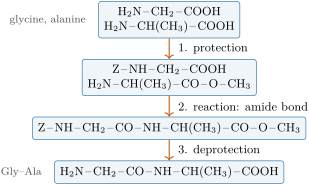
Protection, reaction, deprotection: the only amide bond that can form is the one wanted.

উদাহরণ

Example 48.8 (Making one dipeptide, not four)

Glycine, HX2N−CHX2−COOH\ce{H2N-CH2-COOH}, and alanine, HX2N−CH(CHX3)−COOH\ce{H2N-CH(CH3)-COOH}, each carry an amine group and an acid group. An amide bond between the acid of glycine and the amine of alanine gives the dipeptide Gly–Ala. Mixed directly, the two amino acids give four dipeptides, Gly–Ala, Ala–Gly, Gly–Gly and Ala–Ala, in a mixture hard to separate. The plan:

  1. protect the amine of glycine with a group written Z\ce{Z}, and the acid of alanine as its methyl ester;
  2. form the amide bond: only one acid group and one amine group are left free;
  3. remove both protecting groups.
প্রসঙ্গসহ পড়ো →
Definition 23.6 University Chemistry — Year 1 · অধ্যায় 23 — Carbonyls: Nucleophilic Additions, Acetals and Protection

A protecting group is a group introduced into a molecule to mask a function temporarily, so that it does not react in a step aimed at another part of the molecule. Its introduction is the protection, its removal the deprotection.

উদাহরণ

Example 23.8 (A ketone in the way)

To add a Grignard reagent to the aldehyde group of a molecule that also carries a ketone, no simple acetal choice exists (aldehydes form acetals more readily than ketones, so the wrong group would be protected); the order of the steps or the reagents must change. Protection is a strategy, not a reflex.

প্রসঙ্গসহ পড়ো →