
全部书籍

专业

应用 关于 Coach 登录 开始阅读

书籍暂未推出简体中文版——当前显示英文版。

Chemistry · 术语表

什么是 Protecting group?

又称: protection · deprotection

Definition 48.6 School Chemistry — Grades 1 to 12 · 第 48 章 — Synthesis Strategy and Green Chemistry

A protecting group is a group attached to a functional group to stop it from reacting during one or more steps of a synthesis, and removed afterwards to give back the original group. The three operations are protection, reaction and deprotection.
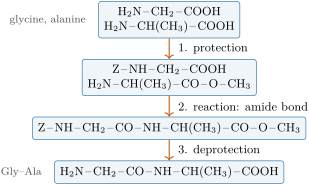
Protection, reaction, deprotection: the only amide bond that can form is the one wanted.

示例

Example 48.8 (Making one dipeptide, not four)

Glycine, HX2N−CHX2−COOH\ce{H2N-CH2-COOH}, and alanine, HX2N−CH(CHX3)−COOH\ce{H2N-CH(CH3)-COOH}, each carry an amine group and an acid group. An amide bond between the acid of glycine and the amine of alanine gives the dipeptide Gly–Ala. Mixed directly, the two amino acids give four dipeptides, Gly–Ala, Ala–Gly, Gly–Gly and Ala–Ala, in a mixture hard to separate. The plan:

  1. protect the amine of glycine with a group written Z\ce{Z}, and the acid of alanine as its methyl ester;
  2. form the amide bond: only one acid group and one amine group are left free;
  3. remove both protecting groups.
在原文中阅读 →
Definition 23.6 University Chemistry — Year 1 · 第 23 章 — Carbonyls: Nucleophilic Additions, Acetals and Protection

A protecting group is a group introduced into a molecule to mask a function temporarily, so that it does not react in a step aimed at another part of the molecule. Its introduction is the protection, its removal the deprotection.

示例

Example 23.8 (A ketone in the way)

To add a Grignard reagent to the aldehyde group of a molecule that also carries a ketone, no simple acetal choice exists (aldehydes form acetals more readily than ketones, so the wrong group would be protected); the order of the steps or the reagents must change. Protection is a strategy, not a reflex.

在原文中阅读 →