
সব বই

পেশাদার

1 Markets I: The Ecosystem and Exchange-Traded Marketsবাজার অনলাইন 2 Markets II: Rates, FX and Creditবাজার অনলাইন 3 Markets III: Commodities, Energy and Cryptoবাজার অনলাইন 4 Quantitative Methodsপদ্ধতি অনলাইন 5 Derivatives and Volatilityডেরিভেটিভস অনলাইন 6 Rates, Credit, XVA and Riskসুদহার, ঋণ ও ঝুঁকি অনলাইন 7 Research Craft: Predictors, Backtests, Measurement, Portfoliosগবেষণা অনলাইন 8 Strategies I: Equities and Futuresকৌশল অনলাইন 9 Strategies II: Volatility, Relative Value, Macro and the Bank Desksকৌশল অনলাইন 10 Microstructure and Executionএক্সিকিউশন অনলাইন 11 Market Making and High-Frequency Tradingমার্কেট মেকিং অনলাইন 12 Machine Learning for Marketsমেশিন লার্নিং অনলাইন 13 Low-Latency Softwareপ্রযুক্তি অনলাইন 14 Networks, Hardware and Trading Infrastructureপ্রযুক্তি অনলাইন 15 Research, Data and Risk Platformsপ্রযুক্তি অনলাইন 16 The Desk and the Firmপ্রতিষ্ঠান অনলাইন 17 The Industry: Firms, Roles and Careersক্যারিয়ার অনলাইন 18 Interviews I: Maths, Probability and Speedক্যারিয়ার অনলাইন 19 Interviews II: Markets, Trading Games and the Final Roundক্যারিয়ার অনলাইন 20 Interviews III: Codeক্যারিয়ার অনলাইন
অ্যাপ পরিচিতি Coach সাইন ইন পড়া শুরু করো

বইগুলো এখনো বাংলা ভাষায় পাওয়া যায় না — ইংরেজি সংস্করণ দেখানো হচ্ছে।

Mathematics · পরিভাষা

Group কী?

অন্য নাম: abelian group

Definition 7.3 University Mathematics — Year 1 · অধ্যায় 7 — Algebraic Structures

A group (G,∗)(G, *) is a set with an associative law admitting an identity and in which every element has an inverse. The group is abelian when the law is commutative.
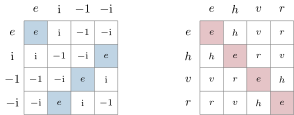
Two groups with four elements: U_4 = \e, , -1, - \ (left) and the rectangle group (right), with the identity’s positions shaded. On the left the identity meanders (one element of order 4 generates everything); on the right it fills the diagonal (every element squares to e). No relabeling can turn one table into the other: the groups are not isomorphic.
Two groups with four elements: U4={e,i,−1,−i}\mathbb U_4 = \{e, \iu, -1, -\iu\} (left) and the rectangle group (right), with the identity’s positions shaded. On the left the identity meanders (one element of order 44 generates everything); on the right it fills the diagonal (every element squares to ee). No relabeling can turn one table into the other: the groups are not isomorphic.

উদাহরণ

Example 7.4

(Z,+)(\Z, +), (Q,+)(\Q, +), (R,+)(\R, +), (C,+)(\C, +); (Q∗,×)(\Q^*, \times), (R∗,×)(\R^*, \times), (C∗,×)(\C^*, \times), (Un,×)(\mathbb{U}_n, \times) (roots of unity, Definition 3.17); the set S(E)\mathfrak{S}(E) of bijections of a set EE onto itself, under composition — the symmetric group of EE, non-abelian as soon as ∣E∣≥3\abs E \geq 3. Not groups: (N,+)(\N, +) (no inverses), (Z,×)(\Z, \times) (only ±1\pm 1 invertible).

Example 7.6 (The symmetries of a rectangle)

A (non-square) rectangle admits exactly four isometries onto itself: the identity ee, the horizontal-axis reflection hh, the vertical-axis reflection vv, and the half-turn rr about the center. Composition makes this four-element set a group: each element is its own inverse (h2=v2=r2=eh^2 = v^2 = r^2 = e), and the product of any two distinct non-identity elements is the third (hv=vh=rhv = vh = r: reflecting in both axes is the half-turn). The full table is symmetric, so the group is abelian — yet it is not the same group as the rotations U4\mathbb U_4 of Example 7.15: there, i\iu has order 44, while here every element has order ≤2\leq 2. Two groups of the same size can thus have genuinely different multiplication structures — the figure below displays both tables side by side. This four-element group returns as {±1}×{±1}\{\pm1\} \times \{\pm1\}, and Exercise 7.7 explains why any group with all squares trivial must, like this one, be abelian.

Example 7.13 (The sign morphism)

The map s ⁣:(R∗,×)→({±1},×)s \colon (\R^*, \times) \to (\{\pm1\}, \times) sending xx to its sign is a morphism: the sign of a product is the product of the signs. Its kernel is (0, +∞)\intoo0{+\infty} (a subgroup, as Definition 7.10 promises), its image all of {±1}\{\pm1\}: surjective, massively non-injective. Two general lessons in miniature. First, a morphism may crush information: ss remembers nothing of xx but one bit, and that is its virtue — sign arguments are exactly the computations that factor through ss. Second, morphisms to {±1}\{\pm1\} are the simplest “invariants”: the signature of permutations, built in this chapter’s weekend problem, is the same phenomenon on the group Sn\mathfrak S_n, and the parity arguments it powers all descend through such a two-valued morphism.

প্রসঙ্গসহ পড়ো →