Primary & Middle School Mathematics · Grades 1–9
52Central Symmetry and Parallelograms
Turn a figure by half a turn around a point: this is central symmetry, the second transformation of the book after the reflections of Chapter 42. Its star figure is the parallelogram — the quadrilateral that is symmetric about the crossing point of its own diagonals.
52.1 Central symmetry
Definition 52.1 (Symmetric about a point)
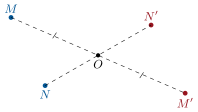
The symmetric of a point about a point is the point such that is the midpoint of . The symmetric figure is what the original becomes after a half-turn () around .
Method 52.2 (Constructing the symmetric of a point)
To construct the symmetric of about :
- draw the line and extend it beyond ;
- measure (ruler or compass);
- place on the extension with .
On grid paper: count the horizontal and vertical steps from to , and repeat the same steps from to reach .
Example 52.3 (On a grid)
If is squares left and square up from , its symmetric is squares right and square down from : central symmetry reverses both directions at once (a reflection reverses only one).
Proposition 52.4 (What a half-turn preserves)
Central symmetry preserves lengths, angles, perimeters and areas; the image of a line is a parallel line, the image of a segment is a parallel segment of the same length, the image of a circle is a circle of the same radius (centered at the symmetric of the center).
Proof. Admitted at this level. ∎
Remark 52.5
Compare with reflections (Proposition 42.4): both preserve lengths and angles; but the reflection flips figures over (a “b” becomes a “d”), while the half-turn keeps them readable — upside down (a “b” becomes a “q”). And unlike a reflection, a half-turn sends every line to a line parallel to it.
Definition 52.6 (Center of symmetry)
A point is a center of symmetry of a figure when the half-turn around sends the figure exactly onto itself. For instance, the letters S, N, Z have a center of symmetry; a circle has one (its center); a triangle never has one.
52.2 Parallelograms
Definition 52.7 (Parallelogram)
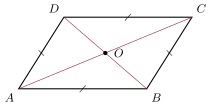
A parallelogram is a quadrilateral whose diagonals cross at their common midpoint. That crossing point is then a center of symmetry of the figure: each vertex is the half-turn image of the opposite vertex.
Theorem 52.8 (Properties of a parallelogram)
In a parallelogram with center :
- opposite sides are parallel: and ;
- opposite sides have the same length: and ;
- opposite angles are equal: and .
Proof. The half-turn around sends to and to (definition: is the midpoint of both diagonals). So it sends the segment to the segment ; by Proposition 52.4 the image is parallel to and of the same length: points 1 and 2. It also sends the angle at to the angle at , and angles are preserved: point 3. ∎
Theorem 52.9 (Recognizing a parallelogram)
A quadrilateral (with no crossing sides) is a parallelogram as soon as one of the following holds:
Proof. Admitted at this level. ∎
Example 52.10
has and cm. Criterion 3 applies: is a parallelogram — so without any further measuring we also know , , and that its diagonals cut each other in their middle.
Remark 52.11 (Special parallelograms)
The rectangle, rhombus and square of Chapter 41 are exactly the parallelograms with an extra property: equal diagonals (rectangle), perpendicular diagonals (rhombus), both (square). The angle argument promised in Example 41.6 now works: in a parallelogram, consecutive angles are supplementary (alternate/corresponding angles with the parallels, Theorem 51.2), so one right angle forces all four.
52.3 Exercises
Exercise 52.1 ★
On grid paper, place , then four squares right of and one square up. Construct the symmetric of about , and the symmetric of across the vertical grid line through . Compare the two images.
Solution
Solution of Exercise 52.1.
Half-turn image: is four squares left of and one square down (both directions reversed). Reflection image across the vertical line: four squares left but still one square up. The two images differ: they are vertical mirror images of each other.
Exercise 52.2 ★
Draw a triangle and a point outside it. Construct its image by the half-turn around . What can you say about the lengths and ? About the lines and ?
Solution
Solution of Exercise 52.2.
(half-turns preserve lengths) and (the image of a line is a parallel line, Proposition 52.4).
Exercise 52.3 ★
Which digits, written as on a calculator display ( to ), have a center of symmetry? Which capital letters among H, A, N, S, T, Z, O?
Solution
Solution of Exercise 52.3.
Calculator digits with a center of symmetry: , , , (and if drawn as a plain bar). Letters: H, N, S, Z, O have one; A and T do not (they have an axis instead).
Exercise 52.4 ★
is a parallelogram of center with cm, cm and . Give, with reasons: , , , and the midpoint of .
Solution
Solution of Exercise 52.4.
Opposite sides equal: cm and cm. Opposite angles equal: . The diagonals cut each other at their common midpoint, and that point is : the midpoint of is .
Exercise 52.5 ★
Construct a parallelogram from its diagonals: cm and cm, crossing at their midpoints with an angle of between them. (Draw the diagonals first!)
Solution
Solution of Exercise 52.5.
Draw a segment of cm, mark its midpoint , draw through a line making with , and place and on it at cm from on either side. Join , , , : the diagonals cut at their midpoints, so is a parallelogram by definition.
Exercise 52.6 ★
In a parallelogram, one angle measures . Using the remark on supplementary consecutive angles, give the three other angles.
Solution
Solution of Exercise 52.6.
Consecutive angles are supplementary: next to sits . Opposite angles are equal, so the four angles are , , , (sum ).
Exercise 52.7 ★★
Plot , and the point . Compute the coordinates of the images and by the half-turn around (use the grid counting of Example 52.3).
Solution
Solution of Exercise 52.7.
From to : right and up; continuing the same: . From to : left and up; continuing: .
Exercise 52.8 ★★
is a quadrilateral in which . Is that enough to make it a parallelogram? If not, sketch a counterexample (an isosceles trapezoid helps), and state what must be added to the hypothesis.
Solution
Solution of Exercise 52.8.
No. An isosceles trapezoid has its two slanted sides equal without being a parallelogram (the two parallel sides have different lengths). What suffices is criterion 3 of Theorem 52.9: two opposite sides equal and parallel.
Exercise 52.9 ★★
Let be a triangle and the midpoint of . Construct the symmetric of about . Show that is a parallelogram. (Which criterion of Theorem 52.9 is free of charge here?)
Solution
Solution of Exercise 52.9.
is the midpoint of by choice, and it is the midpoint of by construction of the symmetric. The quadrilateral has diagonals and sharing the midpoint : criterion 1 (the definition) makes it a parallelogram at no extra cost.
Exercise 52.10 ★★
True or false, with a reason: “a quadrilateral whose opposite angles are equal two by two is a parallelogram”; “a parallelogram with perpendicular diagonals is a rhombus”; “a parallelogram with one right angle is a rectangle”.
Solution
Solution of Exercise 52.10.
“Opposite angles equal parallelogram”: true (this is another recognition criterion; with the angle sum , equal opposite pairs force supplementary consecutive angles, hence parallel sides by Theorem 51.2).
“Perpendicular diagonals rhombus”: true for a parallelogram (the diagonals already cut at their midpoints).
“One right angle rectangle”: true — consecutive angles are supplementary, so all four become right.
Exercise 52.11 ★★★
Let be any quadrilateral and , , , the midpoints of its sides , , , . Draw several examples. What does always seem to be? (The proof, with the midpoint theorem, comes in Chapter 59 — and again with vectors, in the High School volume.)
Solution
Solution of Exercise 52.11.
Whatever the quadrilateral — even a very irregular one — the midpoints , , , always form a parallelogram. The proof with the midpoint theorem is in Chapter 59 (Exercise 59.9).
52.4 Problem: The cake, the median, and the impossible second center
Problem 52.1
Weekend problem — half-turns at work: fair cake cuts, a bound on medians, and why no shape can have two centers of symmetry
The half-turn looks like the simplest of transformations — yet it cuts cakes into provably fair halves, measures the medians of a triangle, and hides a small pearl of pure mathematics: a bounded figure can have one center of symmetry, but never two. The proof uses a discovery you will make in Part I: two half-turns, performed one after the other, add up to a slide.
Part I — Half-turn gymnastics.
- On grid paper, take the origin as center. Using the grid counting of Example 52.3, give the images of , and by the half-turn about . What is the general rule for ?
- Now the center is . Compute the image of , and check the general recipe: each coordinate of the image is twice the center’s minus the point’s.
- Playing cards are designed to read the same upside down — a central symmetry, so neither player sees the card “wrongly”. Explain why, on a card with an odd number of pips, one pip must sit exactly at the card’s center.
- Two half-turns in a row: take the centers and . Send the point through the half-turn about , then send the image through the half-turn about . Compare start and finish. Repeat with . What single, simple transformation did the two half-turns amount to?
- Measure the slide of question 4 against the distance , and state the discovery. (Compare with the two parallel mirrors of Problem 42.1: same phenomenon, new actors.)
Part II — Cakes and medians.
- Let be the center of a parallelogram. Explain why any line through meets the boundary at two points that are symmetric about , and why the line cuts the parallelogram into two pieces that are exact half-turn copies of each other — hence of equal areas.
- The baker’s theorem: a rectangular cake is shared perfectly fairly by any straight cut through its center. Better: a rectangular cake has a rectangular hole (any size, any position, even tilted). Describe the one straight cut that gives two parts with equally much cake — and justify it with question 6.
- Three vertices of a parallelogram are , and . Compute the coordinates of and of the center .
Exercise 52.9 built, from a triangle and the midpoint of , the parallelogram where is the symmetric of about . Use it, together with the triangle inequality (Theorem 51.6) in the triangle , to prove the median bound: the median satisfies
(Note that and .)
- In a triangle with cm and cm, between which two values must the length of the median from lie? (Use both directions of the triangle inequality in .)
Part III — How many centers can a figure have?
- For each figure, say whether it has a center of symmetry, and where: a segment; a full line; an equilateral triangle; a square; a circle; the letters S and Z.
- Prove your claim for the equilateral triangle: a half-turn sending the triangle to itself would pair up the three vertices — but three is odd, so some vertex would be sent to itself. What would that force the vertex to be, and why is it impossible?
- Generalize question 12: explain why no polygon with an odd number of vertices has a center of symmetry.
- The pearl: suppose a figure had two distinct centers of symmetry and . Perform the two half-turns one after the other and use the discovery of question 5: what motion must send the figure exactly onto itself? Explain why a figure that fits on a sheet of paper cannot survive that, and conclude.
- Question 14’s conclusion leaves a loophole: unbounded figures. Verify on an infinite frieze — say, an endless strip of footprints, left, right, left, right … — that it has (at least) two different centers of symmetry, and identify the translation that question 14 predicted.
Solution
Solution of Problem 52.1.
1. ; ; . Rule: the half-turn about the origin sends to — both coordinates change sign.
2. From : three squares right of becomes three squares left, two up becomes two down: image . Recipe check: twice the center minus the point, .
3. The half-turn about the card’s center swaps the pips in pairs. With an odd number of pips, one pip has no partner: it must be its own image, and the only point that is its own image is the center itself. Hence the middle pip of the 3, the 5, the 7 … sits dead center (look at a real card: it does).
4. About : ; about : . Start , finish : slid to the right, not flipped. Same for : slid right. The two half-turns amount to a translation.
5. The slide is , and : the translation covers twice the distance between the centers (in the direction from to ) — just as two parallel mirrors translated by twice their gap in Problem 42.1.
6. The half-turn about sends the parallelogram onto itself (that is what “center of symmetry” means for it, Theorem 52.8). A line through is also sent onto itself, so the two points where it crosses the boundary swap with each other: they are symmetric about . The two pieces of the parallelogram on either side of the line swap too, so they are exact copies (Proposition 52.4) — equal areas.
7. Cut along the line through the two centers: the center of the cake rectangle and the center of the hole. By question 6 applied to the cake rectangle, the cut halves the cake; applied to the hole rectangle (the line passes through its center too), it halves the hole. Each part gets half the cake minus half the hole: perfectly fair.
8. (the diagonals share their midpoint, so is the half-turn image of about the center). Center: midpoint of , .
9. In the parallelogram , opposite sides are equal: . The triangle inequality in gives . Since is the midpoint of , , so , i.e. .
10. Upper bound: cm. Lower bound: in , , so cm. The median from lies strictly between and cm.
11. Segment: yes, its midpoint. Line: yes — every one of its points is a center. Equilateral triangle: none. Square: yes, the crossing of the diagonals. Circle: yes, its center. S and Z: yes, their middle point (turn the page upside down: they read the same).
12. The half-turn would pair the three vertices among themselves; three being odd, one vertex would be its own image, forcing to be the center of the half-turn. The two other vertices and would then be symmetric about — so would be the midpoint of , putting the three vertices on one line. A triangle has no three aligned vertices: contradiction. No center exists.
13. The same parity argument: a half-turn preserving the polygon pairs up its vertices; an odd number of vertices forces a fixed vertex, which must be the center and the midpoint of the segment joining two other vertices — three aligned vertices, impossible in a polygon … so no polygon with an odd number of vertices has a center of symmetry.
14. Performing the half-turn about , then about , sends the figure onto itself both times — so their combination does too. By question 5, that combination is a translation by twice the distance , which is not zero since the centers differ. A figure fitting on a sheet cannot equal itself slid by a fixed nonzero amount (slide it enough times and it leaves the sheet entirely). So a bounded figure has at most one center of symmetry.
15. On the endless strip, a half-turn about the point midway between a left footprint and the following right one sends the pattern onto itself; the point one full step further does too: two distinct centers. Composing the two half-turns gives the translation by twice the half-step — exactly the one-step slide that visibly maps the infinite frieze onto itself, as question 14 predicts. Unbounded patterns live by different rules: that is the mathematics of wallpaper.