Primary & Middle School Mathematics · Grades 1–9
41Triangles and Quadrilaterals
Triangles and quadrilaterals are the basic shapes of geometry. The goal of this chapter is to know their special families — isosceles, equilateral, right triangles; rectangles, rhombuses, squares — by their defining properties, and to construct them precisely with ruler and compass.
41.1 Triangles
Definition 41.1 (Special triangles)
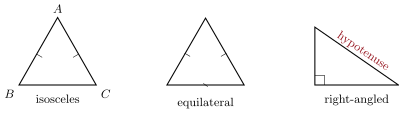
A triangle has three vertices and three sides. It is:
- isosceles at when (two equal sides);
- equilateral when (three equal sides);
- right-angled at when the angle is a right angle. The side opposite the right angle is called the hypotenuse.
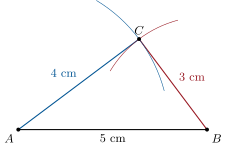
Method 41.2 (Constructing a triangle from its three sides)
To construct with cm, cm, cm:
41.2 Quadrilaterals
Definition 41.3 (Special quadrilaterals)
A quadrilateral has four vertices and four sides. It is a:
- rectangle when its four angles are right angles;
- rhombus when its four sides have the same length;
- square when it is both: four right angles and four equal sides.
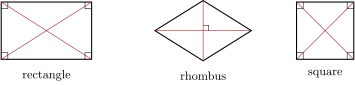
Proposition 41.4 (Properties of the diagonals)
In these quadrilaterals, the two diagonals cut each other at their common midpoint, and moreover:
- in a rectangle, the diagonals have the same length;
- in a rhombus, the diagonals are perpendicular;
- in a square, both at once.
Proof. Admitted at this level. ∎
Remark 41.5
A square is automatically a rectangle (it has four right angles) and automatically a rhombus (four equal sides). So “rectangle” does not mean “not a square”! In mathematics, the more special shape belongs to the more general family.
Example 41.6 (Recognizing a shape from its properties)
A quadrilateral has four sides of length cm and one right angle. What is it? Four equal sides make it a rhombus. In a rhombus, opposite angles are equal and the four angles add up to ; one right angle then forces all four to be right (this will be proved with parallelograms in Chapter 52). So the shape is a square.
Method 41.7 (Construction programs)
A construction program is a list of instructions that anyone can follow to reproduce a figure exactly. Write one instruction per line, name every point when it is created, and only use: “draw the segment / line / circle…”, “place the point where … cross”. Test your program by following it literally, word for word.
Example 41.8
Program for a square of side cm:
- Draw a segment with cm.
- Draw the perpendicular to at ; on it, place at cm from (choose one side of the line and stick to it).
- Draw the perpendicular to at ; on it, place at cm from , on the same side as .
- Join and .
Check with the ruler: should measure cm too.
41.3 Exercises
Exercise 41.1 ★
Construct a triangle with cm, cm and cm, following Method 41.2.
Exercise 41.2 ★
Construct an isosceles triangle with cm and cm. Which two angles of this triangle look equal? Measure them to check.
Solution
Solution of Exercise 41.2.
Base of cm, then two arcs of radius cm centered at and ; their crossing is . The two base angles and are equal (about each) — symmetry of the isosceles triangle (Example 42.8).
Exercise 41.3 ★
Construct an equilateral triangle of side cm using only ruler and compass. Measure one of its angles.
Exercise 41.4 ★
Classify each triangle from its data (isosceles, equilateral, right-angled — several answers may apply): (a) sides , , ; (b) sides , , ; (c) angles , , ; (d) angles , , .
Solution
Solution of Exercise 41.4.
(a) equilateral (hence also isosceles). (b) isosceles (). (c) right-angled and isosceles (two equal angles of face two equal sides). (d) equilateral (three equal angles).
Exercise 41.5 ★
In a right triangle, which side is the hypotenuse? Draw a triangle right-angled at , and name its hypotenuse. Which vertex does the hypotenuse never touch?
Solution
Solution of Exercise 41.5.
The hypotenuse is the side opposite the right angle, always the longest side. In right-angled at , the hypotenuse is : it never touches the vertex of the right angle, .
Exercise 41.6 ★
True or false? Justify each answer in one sentence.
- Every square is a rectangle.
- Every rectangle is a square.
- Every square is a rhombus.
- A rhombus with a right angle is a square.
Solution
Solution of Exercise 41.6.
1. True: a square has four right angles, which is the definition of a rectangle.
2. False: a rectangle has unequal sides.
3. True: a square has four equal sides, the definition of a rhombus.
4. True: see Example 41.6.
Exercise 41.7 ★
Construct a rectangle with cm and cm. Measure its two diagonals: what do you observe?
Solution
Solution of Exercise 41.7.
Construction with perpendiculars, as in Example 41.8. Both diagonals measure about cm: the diagonals of a rectangle have the same length (Proposition 41.4).
Exercise 41.8 ★
Construct a rhombus with diagonals of cm and cm. (Use Proposition 41.4: draw the two diagonals first — perpendicular, crossing at their midpoints — then join the four ends.)
Solution
Solution of Exercise 41.8.
Draw a segment of cm; its midpoint ; the perpendicular at ; on it, two points at cm from on either side. Joining the four endpoints gives the rhombus (all four vertices are at distances cm and cm from along perpendicular lines, so the four sides are equal by symmetry).
Exercise 41.9 ★★
Write a construction program for an isosceles triangle with base cm and equal sides of cm, in the style of Example 41.8. Exchange with a classmate: can they follow it without seeing your figure?
Exercise 41.10 ★★
Draw a circle of center and one of its diameters . Place any point on the circle and draw the triangle . Measure the angle . Move and measure again. What do you conjecture? (This surprising fact is proved in Chapter 60.)
Solution
Solution of Exercise 41.10.
Whatever the position of on the circle, the angle measures : the triangle is right-angled at whenever is a diameter. The proof waits for Chapter 60.
Exercise 41.11 ★★
A quadrilateral has diagonals of the same length that cut each other at their common midpoint. Sort out which shape it must be, using Proposition 41.4: rectangle, rhombus or square? (Careful: only one property is given.)
Solution
Solution of Exercise 41.11.
Diagonals that cut each other at their midpoint and have equal lengths: that is the property list of the rectangle (Proposition 41.4). Nothing forces the diagonals to be perpendicular, so it need not be a rhombus or a square — a rectangle is the right answer (a square would satisfy it too, but is not forced).
Exercise 41.12 ★★★
On a dotted grid, how many different squares can you draw whose corners are grid dots — counting also the “tilted” squares? Draw at least one tilted square and explain why its sides are equal.
Solution
Solution of Exercise 41.12.
With dots there are grid cells. Grid-aligned squares: sides , or give squares. Tilted squares also exist: the small ones whose sides are diagonals of cells (like , , , ) — four of them; and the larger ones whose sides are diagonals of rectangles, like , , , — two of them. All four sides of such a square are equal because they are diagonals of identical rectangles. Total: squares. (Any count with a correct tilted example and the aligned ones is a success at this level.)
41.4 Problem: What the diagonals know
Problem 41.1
Weekend problem — rebuilding every special quadrilateral from its diagonals alone, and counting the diagonals of any polygon
Proposition 41.4 reads a shape and tells you about its diagonals. This problem plays the game backwards: given only two crossing segments — the future diagonals — what shape appears when you join their four ends? You will build a complete “diagonal dictionary”, understand why the rhombus construction of Exercise 41.8 works, meet a shape that has no name yet, and finish by counting the diagonals of polygons with many more than four sides.
Part I — The diagonal dictionary. For each question, draw the two segments as described, join their four ends in order, and identify the quadrilateral you get.
- Two segments of cm each, perpendicular, crossing at their common midpoint. Measure the four sides and the four angles of the resulting shape: what is it?
- Two segments of cm and cm, perpendicular, crossing at their common midpoint. What shape appears (Exercise 41.8)?
- Two segments of cm each — equal but not perpendicular — crossing at their common midpoint. Measure the sides and angles: what do you conjecture the shape to be?
- Two segments of cm and cm, not perpendicular, crossing at their common midpoint. The shape you get is none of the three of Definition 41.3 — describe what you see (which sides look equal? parallel?). This quadrilateral receives its name in Chapter 52.
- Summarize questions 1–4 in a dictionary with four entries: diagonals equal / perpendicular / both / neither (always crossing at their midpoints) name (or description) of the shape.
Part II — Why the constructions work.
- In question 2, the two diagonals cut the shape into four right triangles around the crossing point. What are the two leg lengths of each of these triangles? Explain why all four triangles are exact copies of one another, and deduce why the four sides of the shape are equal — the secret of Exercise 41.8.
- Deduce a compass-only test: after building any shape from its diagonals, how can you check with the compass alone (no ruler measurements) that the four sides are equal?
- Write a construction program (Method 41.7) for a square whose diagonals measure cm — not its sides.
- In the square of question 8, is the side longer or shorter than cm — half the diagonal? Measure to find out. One half of the answer can already be proved: going from one corner to the next via the center is a cm detour, and a straight path is always shorter than a detour — so the side is shorter than cm. (Proving that it also beats cm, and computing it exactly, is a job for Chapter 58.)
- A new entry for the dictionary: draw a segment of cm; on it, mark the point at cm from ; draw through the perpendicular segment of cm with as its midpoint. Join . This shape is a kite (one diagonal bisects the other, at a right angle). Using corner triangles as in question 6, find which sides of a kite are equal to which.
Part III — Counting diagonals. A diagonal of a polygon joins two vertices that are not neighbours.
- Draw a quadrilateral, a pentagon (five vertices) and a hexagon (six vertices), and draw all their diagonals. Count them: how many in each case?
- Counting without drawing, for the hexagon: from one vertex, how many diagonals leave? (To how many of the six vertices can it not be joined by a diagonal?) Multiplying by the six vertices counts every diagonal exactly twice — why? Recover your count of question 11. (The same double-counting appeared in the handshakes of Problem 37.1.)
- Use the method of question 12 to count the diagonals of a polygon with vertices, then with vertices.
- A polygon has exactly diagonals. How many vertices does it have? (Try the method of question 13 on a few candidates.)
- Check your method on the smallest polygon of all: how many diagonals does a triangle have, and what does the counting method of question 12 answer? Conclude with one sentence on what handshakes and diagonals have in common.
Solution
Solution of Problem 41.1.
1. The four sides all measure the same (about cm) and the four angles are right: the shape is a square. (Equal diagonals give the right angles, as in the rectangle; perpendicular ones give the equal sides, as in the rhombus; both at once give the square, Proposition 41.4 read backwards.)
2. A rhombus: four equal sides (about cm), but no right angle — exactly the construction of Exercise 41.8.
3. The four angles come out right but the sides come in two different lengths: a rectangle — this is the situation of Exercise 41.11.
4. No equal-length claim survives measuring and no right angle appears; but opposite sides are equal two by two and look parallel. It is the general “slanted rectangle” whose diagonals merely bisect each other — the parallelogram, named and studied in Chapter 52.
5. Diagonals crossing at their common midpoint:
| diagonals… | shape |
|---|---|
| equal and perpendicular | square |
| perpendicular only | rhombus |
| equal only | rectangle |
| neither | the nameless one (see Chapter 52) |
6. Each corner triangle has one leg along each diagonal: half of cm and half of cm, so legs of cm and cm, with a right angle between them — the same data for all four. Triangles built from the same two legs and the right angle between them are exact copies of one another (construct them: the compass settings are identical). Their four hypotenuses — the sides of the shape — are therefore equal: the shape is a rhombus.
7. Open the compass to the length of one side, then walk it around the shape: if its point and pencil land exactly on each pair of neighbouring corners, all four sides equal that one opening. No ruler needed.
8. Program:
- Draw a segment with cm and place its midpoint (measure cm from ).
- Draw the perpendicular to at .
- On it, place and at cm from , one on each side.
- Join , , , .
Diagonals equal ( cm), perpendicular, bisecting each other: by the dictionary, is a square.
9. Measuring gives about cm: longer than cm — the common guess “half the diagonal” is wrong. The provable half: to go from corner to the next corner , one can walk the side straight, or take the detour through the center, costing cm; the straight side is shorter, so the side measures less than cm. That it is also more than cm is what the ruler shows; Chapter 58 will prove it and give the exact value ( cm multiplied by the square root of , about cm).
10. The four corner triangles at now come in two matching pairs: two with legs cm and cm (hypotenuses and ), two with legs cm and cm (hypotenuses and ). So and : a kite has two pairs of equal neighbouring sides (the rhombus is the special kite where all four match).
11. Quadrilateral: diagonals. Pentagon: . Hexagon: .
12. From one vertex of the hexagon, diagonals go to every vertex except itself and its two neighbours: diagonals. Six vertices launch diagonal-ends — but each diagonal has been counted at both of its ends, once from each endpoint, exactly like a handshake counted by both shakers (Problem 37.1). True count: . It matches the drawing.
13. Ten vertices: from each, so diagonals. Twenty vertices: diagonals.
14. Try candidates: vertices give (question 13); vertices give . Found: the polygon has vertices.
15. A triangle has no diagonals at all: every vertex’s “non-neighbours” are … nobody, since the other two vertices are both its neighbours. The method agrees: from each vertex, total . Handshakes and diagonals are the same count in different clothes: pairs chosen from a group, each pair counted once — mathematics recycles its good ideas.