সব বই

পেশাদার

1 Markets I: The Ecosystem and Exchange-Traded Marketsবাজার অনলাইন 2 Markets II: Rates, FX and Creditবাজার অনলাইন 3 Markets III: Commodities, Energy and Cryptoবাজার অনলাইন 4 Quantitative Methodsপদ্ধতি অনলাইন 5 Derivatives and Volatilityডেরিভেটিভস অনলাইন 6 Rates, Credit, XVA and Riskসুদহার, ঋণ ও ঝুঁকি অনলাইন 7 Research Craft: Predictors, Backtests, Measurement, Portfoliosগবেষণা অনলাইন 8 Strategies I: Equities and Futuresকৌশল অনলাইন 9 Strategies II: Volatility, Relative Value, Macro and the Bank Desksকৌশল অনলাইন 10 Microstructure and Executionএক্সিকিউশন অনলাইন 11 Market Making and High-Frequency Tradingমার্কেট মেকিং অনলাইন 12 Machine Learning for Marketsমেশিন লার্নিং অনলাইন 13 Low-Latency Softwareপ্রযুক্তি অনলাইন 14 Networks, Hardware and Trading Infrastructureপ্রযুক্তি অনলাইন 15 Research, Data and Risk Platformsপ্রযুক্তি অনলাইন 16 The Desk and the Firmপ্রতিষ্ঠান অনলাইন 17 The Industry: Firms, Roles and Careersক্যারিয়ার অনলাইন 18 Interviews I: Maths, Probability and Speedক্যারিয়ার অনলাইন 19 Interviews II: Markets, Trading Games and the Final Roundক্যারিয়ার অনলাইন 20 Interviews III: Codeক্যারিয়ার অনলাইন
অ্যাপ পরিচিতি Coach সাইন ইন পড়া শুরু করো

বইগুলো এখনো বাংলা ভাষায় পাওয়া যায় না — ইংরেজি সংস্করণ দেখানো হচ্ছে।

Physics · পরিভাষা

Moment about a point; about an axis কী?

Definition 15.1 University Physics — Year 1 · অধ্যায় 15 — Angular Momentum

The moment (or torque) about a point OO of a force F→\vect F applied at MM is the vector

M→O(F→)=OM→∧F→(N m),\vect{\mathcal M}_O(\vect F) = \vect{OM}\wedge\vect F \qquad (\mathrm{N}\,\mathrm{m}),

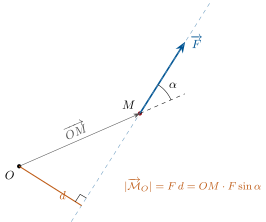
perpendicular to the plane of OM→\vect{OM} and F→\vect F, of norm OM⋅Fsin⁡α=F dOM\cdot F\sin\alpha = F\,d, where dd — the lever arm — is the distance from OO to the line of action of F→\vect F. The moment about an oriented axis Δ\Delta (unit vector e→Δ\vect e_\Delta) through OO is the scalar MΔ=M→O⋅e→Δ\mathcal M_\Delta = \vect{\mathcal M}_O\cdot\vect e_\Delta, independent of the choice of OO on Δ\Delta; it vanishes if F→\vect F is parallel to Δ\Delta or meets it. Two opposite forces on different lines of action form a couple, whose moment F→∧AB→\vect F\wedge\vect{AB} is the same about every point.

The moment of F about O: the cross product OM F, of norm F\,d with d the distance from O to the line of action (the lever arm), directed perpendicular to the figure — here toward the reader.
The moment of F→\vect F about OO: the cross product OM→∧F→\vect{OM}\wedge\vect F, of norm F dF\,d with dd the distance from OO to the line of action (the lever arm), directed perpendicular to the figure — here toward the reader.

উদাহরণ

Example 15.2 (The door)

A 20 N20\,\mathrm{N} push perpendicular to a door at 0.80 m0.80\,\mathrm{m} from the hinges has moment 16 N m16\,\mathrm{N}\,\mathrm{m} about the hinge axis; the same push at 0.10 m0.10\,\mathrm{m}, 2 N m2\,\mathrm{N}\,\mathrm{m}; along the door (line of action through the hinges), zero. The hinge’s own reaction, meeting the axis, has no moment about it: that is what makes the axis the natural place to take moments.

Example 15.6 (The pendulum by moments)

Simple pendulum, axis Δ\Delta through the pivot perpendicular to the plane of swing: LΔ=mℓ2θ˙L_\Delta = m\ell^2\dot\theta; the tension meets the axis (no moment), the weight’s moment is −mgℓsin⁡θ-mg\ell\sin\theta (lever arm ℓsin⁡θ\ell\sin\theta, restoring). The theorem gives mℓ2θ¨=−mgℓsin⁡θm\ell^2\ddot\theta = -mg\ell\sin\theta, the equation of Example 12.12 without ever writing the tension — the chief advantage of moments: forces through the axis disappear.

Example 15.10 (The skater)

Arms out, a skater’s body has J≈4 kg m2J \approx 4\,\mathrm{kg}\,\mathrm{m}^{2} plus two 3 kg3\,\mathrm{kg} arms at 0.8 m0.8\,\mathrm{m}: J1=4+2×3×0.64=7.8 kg m2J_1 = 4 + 2 \times 3 \times 0.64 = 7.8\,\mathrm{kg}\,\mathrm{m}^{2}. Arms in (0.2 m0.2\,\mathrm{m}): J2=4.2 kg m2J_2 = 4.2\,\mathrm{kg}\,\mathrm{m}^{2}. The ice’s reaction and the weight have no moment about the vertical axis: JωJ\omega is conserved and the spin rate rises by J1/J2=1.85J_1/J_2 = 1.85 — from 22 to 3.73.7 turns per second — while the kinetic energy rises by the same factor, paid by the muscles pulling the arms in.

প্রসঙ্গসহ পড়ো →