
সব বই

পেশাদার

1 Markets I: The Ecosystem and Exchange-Traded Marketsবাজার অনলাইন 2 Markets II: Rates, FX and Creditবাজার অনলাইন 3 Markets III: Commodities, Energy and Cryptoবাজার অনলাইন 4 Quantitative Methodsপদ্ধতি অনলাইন 5 Derivatives and Volatilityডেরিভেটিভস অনলাইন 6 Rates, Credit, XVA and Riskসুদহার, ঋণ ও ঝুঁকি অনলাইন 7 Research Craft: Predictors, Backtests, Measurement, Portfoliosগবেষণা অনলাইন 8 Strategies I: Equities and Futuresকৌশল অনলাইন 9 Strategies II: Volatility, Relative Value, Macro and the Bank Desksকৌশল অনলাইন 10 Microstructure and Executionএক্সিকিউশন অনলাইন 11 Market Making and High-Frequency Tradingমার্কেট মেকিং অনলাইন 12 Machine Learning for Marketsমেশিন লার্নিং অনলাইন 13 Low-Latency Softwareপ্রযুক্তি অনলাইন 14 Networks, Hardware and Trading Infrastructureপ্রযুক্তি অনলাইন 15 Research, Data and Risk Platformsপ্রযুক্তি অনলাইন 16 The Desk and the Firmপ্রতিষ্ঠান অনলাইন 17 The Industry: Firms, Roles and Careersক্যারিয়ার অনলাইন 18 Interviews I: Maths, Probability and Speedক্যারিয়ার অনলাইন 19 Interviews II: Markets, Trading Games and the Final Roundক্যারিয়ার অনলাইন 20 Interviews III: Codeক্যারিয়ার অনলাইন
অ্যাপ পরিচিতি Coach সাইন ইন পড়া শুরু করো

বইগুলো এখনো বাংলা ভাষায় পাওয়া যায় না — ইংরেজি সংস্করণ দেখানো হচ্ছে।

Physics · পরিভাষা

Power and work of a force কী?

Definition 13.1 University Physics — Year 1 · অধ্যায় 13 — Work, Energy, and Potential Energy

The power of a force F→\vect F acting on a point moving at velocity v→\vect v is

P=F→⋅v→(watts),\mathcal P = \vect F\cdot\vect v \qquad (\text{watts}),

and its work between times t1t_1 and t2t_2 (positions AA and BB) is the accumulated power,

WA→B=∫t1t2F→⋅v→  ⁣dt=∫ABF→⋅ ⁣dℓ→(joules),W_{A\to B} = \int_{t_1}^{t_2}\vect F\cdot\vect v\,\dd t = \int_A^B \vect F\cdot\dd\vect\ell \qquad (\text{joules}),

the sum of the elementary works δW=F→⋅ ⁣dℓ→\delta W = \vect F\cdot\dd\vect\ell along the elementary displacements  ⁣dℓ→=v→  ⁣dt\dd\vect\ell = \vect v\,\dd t of the trajectory. Work is positive if the force pushes along the motion (motive), negative if against it (resistive), zero if perpendicular.
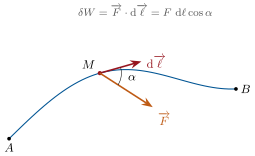
The elementary work of a force along a small displacement of its point of application: only the component of F along the motion works. Summed along the path from A to B, it gives W_A B.
The elementary work of a force along a small displacement of its point of application: only the component of F→\vect F along the motion works. Summed along the path from AA to BB, it gives WA→BW_{A\to B}.

উদাহরণ

Example 13.10 (The loop’s speed law)

On the frictionless loop of Problem 11.1 the track’s reaction is normal to the motion and works not: EmE_m is conserved. With z=R(1−cos⁡θ)z = R(1 - \cos\theta) above the bottom, 12mv2+mgR(1−cos⁡θ)=12mv02\tfrac12 mv^2 + mgR(1 - \cos\theta) = \tfrac12 mv_0^2: the speed law v2=v02−2gR(1−cos⁡θ)v^2 = v_0^2 - 2gR(1 - \cos\theta) used there, now derived in one line. The minimum entry speed 5gR\sqrt{5gR} then follows from the top condition v2≥gRv^2 \geq gR of Example 12.16.

প্রসঙ্গসহ পড়ো →