
সব বই

পেশাদার

1 Markets I: The Ecosystem and Exchange-Traded Marketsবাজার অনলাইন 2 Markets II: Rates, FX and Creditবাজার অনলাইন 3 Markets III: Commodities, Energy and Cryptoবাজার অনলাইন 4 Quantitative Methodsপদ্ধতি অনলাইন 5 Derivatives and Volatilityডেরিভেটিভস অনলাইন 6 Rates, Credit, XVA and Riskসুদহার, ঋণ ও ঝুঁকি অনলাইন 7 Research Craft: Predictors, Backtests, Measurement, Portfoliosগবেষণা অনলাইন 8 Strategies I: Equities and Futuresকৌশল অনলাইন 9 Strategies II: Volatility, Relative Value, Macro and the Bank Desksকৌশল অনলাইন 10 Microstructure and Executionএক্সিকিউশন অনলাইন 11 Market Making and High-Frequency Tradingমার্কেট মেকিং অনলাইন 12 Machine Learning for Marketsমেশিন লার্নিং অনলাইন 13 Low-Latency Softwareপ্রযুক্তি অনলাইন 14 Networks, Hardware and Trading Infrastructureপ্রযুক্তি অনলাইন 15 Research, Data and Risk Platformsপ্রযুক্তি অনলাইন 16 The Desk and the Firmপ্রতিষ্ঠান অনলাইন 17 The Industry: Firms, Roles and Careersক্যারিয়ার অনলাইন 18 Interviews I: Maths, Probability and Speedক্যারিয়ার অনলাইন 19 Interviews II: Markets, Trading Games and the Final Roundক্যারিয়ার অনলাইন 20 Interviews III: Codeক্যারিয়ার অনলাইন
অ্যাপ পরিচিতি Coach সাইন ইন পড়া শুরু করো

বইগুলো এখনো বাংলা ভাষায় পাওয়া যায় না — ইংরেজি সংস্করণ দেখানো হচ্ছে।

Physics · পরিভাষা

Real and virtual images কী?

অন্য নাম: real image · virtual image

Definition 10.6 High School Physics · অধ্যায় 10 — Lenses, Images, and the Eye

An image is real when the outgoing rays actually pass through it: a screen placed there catches it; virtual when only their backward extensions meet: no screen catches it, but an eye looking into the lens sees it perfectly well. A converging lens gives a real, inverted image of any object beyond FF; slide the object inside the focal length and the image turns virtual, upright, enlarged.
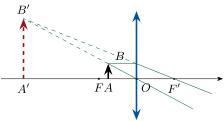
Object inside the focal length (the magnifier setting): the backward extensions build a virtual, upright, enlarged image A'B'.
Object inside the focal length (the magnifier setting): the backward extensions build a virtual, upright, enlarged image A′B′A'B'.

উদাহরণ

Example 10.10 (The formula at work)

An object stands 30 cm30\,\mathrm{cm} in front of a converging lens with f′=10 cmf' = 10\,\mathrm{cm}: OA‾=−30 cm\overline{OA} = -30\,\mathrm{cm}, so

1OA′‾=110−130=115,OA′‾=+15 cm,γ=15−30=−0.50:\frac{1}{\overline{OA'}} = \frac{1}{10} - \frac{1}{30} = \frac{1}{15}, \qquad \overline{OA'} = +15\,\mathrm{cm}, \qquad \gamma = \frac{15}{-30} = -0.50 :

a real image 15 cm15\,\mathrm{cm} behind the lens, inverted, half-size — exactly what the three rays draw.

Example 10.14 (Prescribing for a myope)

A myopic eye has its far point at 50 cm50\,\mathrm{cm}: the correcting lens must show distant objects at the far point — object at infinity, image at OA′‾=−0.50 m\overline{OA'} = -0.50\,\mathrm{m} (virtual, in front). Then 1/f′=1/OA′‾1/f' = 1/\overline{OA'}: f′=−0.50 mf' = -0.50\,\mathrm{m}, C=−2.0C = -2.0 D; the relaxed eye looks at that virtual image and sees it sharply.

Example 10.16 (A jeweler’s loupe)

Loupe with f′=5.0 cmf' = 5.0\,\mathrm{cm}, stone at 4.0 cm4.0\,\mathrm{cm}: 1/OA′‾=1/5.0−1/4.0=−1/201/\overline{OA'} = 1/5.0 - 1/4.0 = -1/20, so OA′‾=−20 cm\overline{OA'} = -20\,\mathrm{cm} and γ=(−20)/(−4.0)=+5.0\gamma = (-20)/(-4.0) = +5.0: a virtual, upright image, five times larger, a comfortable 20 cm20\,\mathrm{cm} from the lens.

প্রসঙ্গসহ পড়ো →