সব বই

পেশাদার

1 Markets I: The Ecosystem and Exchange-Traded Marketsবাজার অনলাইন 2 Markets II: Rates, FX and Creditবাজার অনলাইন 3 Markets III: Commodities, Energy and Cryptoবাজার অনলাইন 4 Quantitative Methodsপদ্ধতি অনলাইন 5 Derivatives and Volatilityডেরিভেটিভস অনলাইন 6 Rates, Credit, XVA and Riskসুদহার, ঋণ ও ঝুঁকি অনলাইন 7 Research Craft: Predictors, Backtests, Measurement, Portfoliosগবেষণা অনলাইন 8 Strategies I: Equities and Futuresকৌশল অনলাইন 9 Strategies II: Volatility, Relative Value, Macro and the Bank Desksকৌশল অনলাইন 10 Microstructure and Executionএক্সিকিউশন অনলাইন 11 Market Making and High-Frequency Tradingমার্কেট মেকিং অনলাইন 12 Machine Learning for Marketsমেশিন লার্নিং অনলাইন 13 Low-Latency Softwareপ্রযুক্তি অনলাইন 14 Networks, Hardware and Trading Infrastructureপ্রযুক্তি অনলাইন 15 Research, Data and Risk Platformsপ্রযুক্তি অনলাইন 16 The Desk and the Firmপ্রতিষ্ঠান অনলাইন 17 The Industry: Firms, Roles and Careersক্যারিয়ার অনলাইন 18 Interviews I: Maths, Probability and Speedক্যারিয়ার অনলাইন 19 Interviews II: Markets, Trading Games and the Final Roundক্যারিয়ার অনলাইন 20 Interviews III: Codeক্যারিয়ার অনলাইন
অ্যাপ পরিচিতি Coach সাইন ইন পড়া শুরু করো

বইগুলো এখনো বাংলা ভাষায় পাওয়া যায় না — ইংরেজি সংস্করণ দেখানো হচ্ছে।

Physics · পরিভাষা

Solid; rotation about a fixed axis কী?

Definition 19.9 University Physics — Year 1 · অধ্যায় 19 — Systems of Points; Introduction to Rigid Bodies

A rigid body (solid) is a system whose points keep fixed mutual distances. If it turns about an axis Δ\Delta fixed in the frame, every point describes a circle centered on Δ\Delta at the same angular velocity ω=θ˙\omega = \dot\theta; a point at distance rir_i from the axis has speed riωr_i\omega.

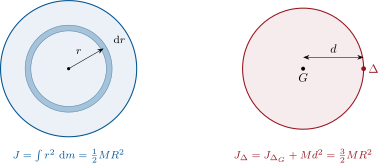
Left: the moment of inertia of a disk, summed ring by ring. Right: Huygens’ theorem — about an axis through the rim of a disk, parallel to the axis through its center, J = 1/2 MR2 + MR2.
Left: the moment of inertia of a disk, summed ring by ring. Right: Huygens’ theorem — about an axis through the rim of a disk, parallel to the axis through its center, J=12MR2+MR2J = \tfrac12 MR^2 + MR^2.
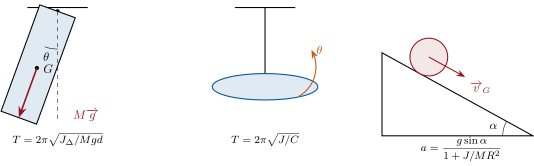
Three solids in motion: a compound pendulum swinging about a pivot (moment of the weight about the axis), a torsion pendulum (moment of the wire), and a solid rolling without slipping down an incline — the larger its J/MR2, the slower it rolls.
Three solids in motion: a compound pendulum swinging about a pivot (moment of the weight about the axis), a torsion pendulum (moment of the wire), and a solid rolling without slipping down an incline — the larger its J/MR2J/MR^2, the slower it rolls.

উদাহরণ

Example 19.12 (Compound pendulum; torsion pendulum)

A solid of mass MM pivoting about a horizontal axis at distance dd from GG: the weight’s moment is −Mgdsin⁡θ-Mgd\sin\theta, so JΔθ¨=−Mgdsin⁡θJ_\Delta\ddot\theta = -Mgd\sin\theta and small swings have the period

T=2πJΔMgd,T = 2\pi\sqrt{\frac{J_\Delta}{Mgd}} ,

that of a simple pendulum of length JΔ/MdJ_\Delta/Md — for a uniform rod pivoted at one end, 2L/32L/3. A disk hung from a wire of torsion constant CC (restoring moment −Cθ-C\theta): Jθ¨=−CθJ\ddot\theta = -C\theta, T=2πJ/CT = 2\pi\sqrt{J/C} — the torsion balance that measured GG and Coulomb’s law.

প্রসঙ্গসহ পড়ো →