University Physics — Year 1 · Bachelor Year 1
19Systems of Points; Introduction to Rigid Bodies
A diver leaves the board, tucks, somersaults twice and straightens out; through all of it one point of her body — her center of mass — traces the same plain parabola a stone would. A yo-yo dropped from the hand takes three times longer to reach the end of its string than a stone would, and arrives spinning at two thousand turns a minute. A solid sphere beats a hollow one down any incline, whatever their sizes or masses. The mechanics of a single point, carried through the previous chapters, extends to systems of many points — and to the rigid bodies of everyday life — through a handful of theorems: the center of mass moves as a point, energy and angular momentum split into a center-of-mass part and a part “around” it, and a body turning about a fixed axis is a one-degree-of-freedom system governed by its moment of inertia.
19.1 Center of mass and momentum
Definition 19.1 (Center of mass; momentum of a system)
For particles of masses at , total mass , the center of mass (barycenter) is defined by
for any origin . The momentum of the system is .
Theorem 19.2 (Theorem of the center of mass)
In an inertial frame,
the center of mass moves as a point particle of mass subject to the resultant of the external forces alone. For a closed system with no external force, is conserved and moves uniformly.
Proof. Sum Newton’s second law over the particles; the internal forces cancel in action–reaction pairs; by differentiating the definition of twice. ∎
Example 19.3 (Diver, recoil, collision)
The diver’s follows a parabola under her weight alone, however she twists — her muscles are internal forces. A rifle of firing a bullet at : before and after, so the rifle recoils at . Two cars, at and at rest, that lock together: — momentum conserved, while of the kinetic energy has gone into crumpled metal and heat. Momentum is conserved in every collision; kinetic energy only in elastic ones (Exercise 19.12).
19.2 Koenig’s theorems
Definition 19.4 (Barycentric frame)
The barycentric frame has its origin at and is in translation with respect to the inertial frame (its axes keep fixed directions). Quantities measured in it are starred: , and .
Theorem 19.5 (Koenig’s theorems)
The angular momentum about a point and the kinetic energy of a system split into the contribution of its center of mass, carrying the whole mass, and the contributions in the barycentric frame:
where and do not depend on the frame’s origin.
Proof. and ; expand and : the cross terms contain or and vanish. ∎
Example 19.6 (A rolling wheel)
A wheel of mass , radius , moment of inertia about its axle, rolling without slipping at speed : the contact point is at rest, so , and — three quarters of for a uniform disk (), for a hoop. The second term is why a bicycle’s wheels are made light: their rotation costs energy that the frame’s mass does not.
19.3 The two-body problem
Proposition 19.7 (Reduced mass)
Two particles interacting only with each other (force on from , on ): moves uniformly, and the relative position obeys
the equation of a single fictitious particle of reduced mass moving under about a fixed center. In , and .
Proof. . In , and ; substitute into and . ∎
Example 19.8 (When the center moves too)
In Chapter 16 the Sun was fixed: exact only in the limit ; in general Kepler’s third law reads . For the vibrating HCl molecule of Problem 13.1, the mass that oscillates in the well is , which raises the frequency by ; for the hydrogen atom, the electron’s differs from by one part in — measurable in the spectrum.
19.4 Rigid body rotating about a fixed axis
Definition 19.9 (Solid; rotation about a fixed axis)
A rigid body (solid) is a system whose points keep fixed mutual distances. If it turns about an axis fixed in the frame, every point describes a circle centered on at the same angular velocity ; a point at distance from the axis has speed .
Proposition 19.10 (Moment of inertia; angular momentum; kinetic energy)
With the moment of inertia (an integral for a continuous body):
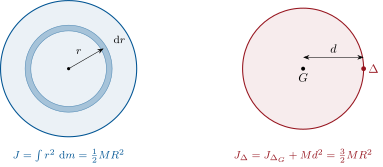
Standard values (mass ): thin ring or hollow cylinder about its axis, ; uniform disk or solid cylinder, ; thin rod of length about its center, , about one end, ; solid sphere about a diameter, . Huygens’ theorem: about an axis parallel to an axis through at distance , .
Proof. and : Proposition 15.9. Rod about its end: ; about the center, . Disk: ring of radius , width , mass : ; the ring and the sphere are admitted (the sphere needs a double integral). Huygens: with , the cross term sums to zero by definition of . ∎
Theorem 19.11 (Dynamics of a solid about a fixed axis)
For a solid rotating about a fixed axis in an inertial frame,
the moments of the external forces about the axis drive the angular acceleration, and a moment delivers the power . An ideal pivot (frictionless bearing) exerts no moment about its axis and so neither accelerates nor brakes the rotation.
Proof. Theorem 15.8 projected on , with and constant for a rigid body; multiply by for the energy form (the internal forces of a rigid body do no work: the distances do not change). ∎
Example 19.12 (Compound pendulum; torsion pendulum)
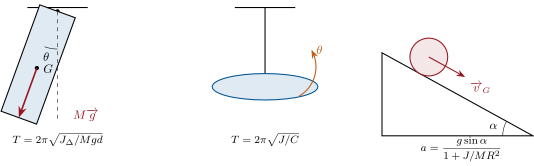
A solid of mass pivoting about a horizontal axis at distance from : the weight’s moment is , so and small swings have the period
that of a simple pendulum of length — for a uniform rod pivoted at one end, . A disk hung from a wire of torsion constant (restoring moment ): , — the torsion balance that measured and Coulomb’s law.
Proposition 19.13 (Rolling without slipping down an incline)
A solid of revolution ( about its axis) released on an incline of angle rolls without slipping with the acceleration
for a solid sphere, for a disk, for a hoop — independent of mass and radius.
Proof. Energy: along the slope (the static friction at the resting contact point does no work), so with as stated; or Newton for and the moment theorem about with the friction : , , . ∎
Remark 19.14 (Deformable systems)
For a system that is not rigid, the kinetic energy theorem reads : the internal forces do work (muscles, springs, friction inside the system). The skater pulling her arms in, the diver tucking, a cyclist standing on the pedals all gain kinetic energy with no external work — the center of mass theorem stays true, the energy comes from inside.
19.5 Exercises
Exercise 19.1 ★
Masses at and at : position of . The Earth–Moon system (, ): distance of from the Earth’s center; compare with the Earth’s radius.
Solution
Solution of Exercise 19.1.
. Earth–Moon: from the Earth’s center, inside the Earth (): the Earth wobbles about a point below its surface.
Exercise 19.2 ★
A rifle fires a bullet at . Recoil speed; kinetic energies of bullet and rifle; where did the energy come from?
Solution
Solution of Exercise 19.2.
: . Bullet , rifle : from the powder’s chemical energy; the light body takes almost all of it ( with equal ).
Exercise 19.3 ★
A car at hits a car at rest; they lock together. Common speed; fraction of kinetic energy lost.
Solution
Solution of Exercise 19.3.
; : before, after: lost.
Exercise 19.4 ★
Derive the moment of inertia of a uniform rod of mass , length , about a perpendicular axis through its end, then through its center; check Huygens’ theorem between the two.
Solution
Solution of Exercise 19.4.
End: ; center: ; Huygens with : .
Exercise 19.5 ★★
Kinetic energy of a rolling uniform cylinder and of a rolling hoop of the same mass and speed, as multiples of . Which stops first on a rough flat floor, and which climbs higher up a slope?
Solution
Solution of Exercise 19.5.
: cylinder , hoop times . Same speed, more energy for the hoop: it rolls farther on a flat floor (same friction) and climbs higher ().
Exercise 19.6 ★★
Reduced mass of HCl () and of the hydrogen atom (); relative correction to a vibration or orbital frequency computed with the light mass alone.
Solution
Solution of Exercise 19.6.
HCl: ; atom: . Frequencies : for HCl, for hydrogen (the isotope shift between H and D spectra rests on it).
Exercise 19.7 ★★
A uniform rod of length pivots freely about one end. Period of small oscillations; length of the simple pendulum with the same period; the point of the rod (the center of percussion) where a sharp blow produces no reaction at the pivot is at that distance — why does a batter look for it?
Solution
Solution of Exercise 19.7.
, : ; equivalent length . A blow at the center of percussion sets the rod rotating about the pivot with no impulsive reaction there: hit the ball at the bat’s “sweet spot” and the hands feel no sting.
Exercise 19.8 ★★
A disk (, ) hangs from a wire and oscillates in torsion with a period. Torsion constant of the wire.
Solution
Solution of Exercise 19.8.
; .
Exercise 19.9 ★★
A flywheel of moment of inertia spins at . Stored energy; braking moment that stops it in ; number of turns during the braking.
Solution
Solution of Exercise 19.9.
, ; ; turns: .
Exercise 19.10 ★★★
A solid sphere, a solid cylinder and a hoop are released together at the top of an incline. Order of arrival, and the ratio of their accelerations. Does the result depend on their radii or masses?
Solution
Solution of Exercise 19.10.
: sphere () , cylinder () , hoop () times : sphere first, hoop last; no mass or radius anywhere.
Exercise 19.11 ★★★
Ballistic pendulum: a bullet at embeds in a block hanging from a string. Speed just after impact; height reached; fraction of the bullet’s kinetic energy lost. Why can one not use energy conservation for the impact itself?
Solution
Solution of Exercise 19.11.
Momentum: : ; then energy: . : before, after: lost to deformation and heat. The impact is inelastic — energy is not conserved through it, momentum is (the string’s tension is vertical and the impact brief).
Exercise 19.12 ★★★
Elastic head-on collision of at with at rest: derive and . Fraction of energy transferred when a neutron hits a proton; a carbon nucleus (); a lead nucleus (). Why are reactors moderated with light nuclei?
Solution
Solution of Exercise 19.12.
and give (divide the energy equation by the momentum one), whence the formulas. Energy fraction to the target : proton ; carbon ; lead . Light nuclei take the neutron’s energy in a few collisions (water, graphite); lead would need hundreds.

19.6 Problem: The yo-yo
Problem 19.1
Weekend problem — a disk on a thin axle at the end of a string: why it falls so slowly, how fast it spins at the bottom, why it “sleeps” there, and which way a spool rolls when you pull its thread
A yo-yo is a uniform disk of mass and radius with a thin axle of radius around which a string of length is wound; the string’s upper end is held fixed. ; about the axis.
Part I — Kinematics and energy.
- Where is the center of mass of the yo-yo? Why?
- Show from Koenig’s theorem that its kinetic energy is .
- Derive by integrating over rings, and compute .
- As the string unwinds without slipping from the axle, relate and .
- Deduce and compute the factor in parentheses. Comment.
Part II — The fall.
- Forces on the yo-yo; write the center-of-mass theorem (vertical axis downward).
- Write the angular momentum theorem about the axis through (which forces have a moment?).
- Combine with question 4 to find the acceleration ; compute it.
- Compute the string tension and compare with the weight.
- Time to unwind the of string, and the speed then; compare with a stone dropped from the same height.
- Angular velocity at the bottom, in rad/s and turns per minute.
- Split the kinetic energy at the bottom into its translational and rotational parts.
- Check the energy balance: compare with the kinetic energy at the bottom, and say why the string’s tension, though large, does no work.
Part III — At the bottom: the sleeper. When the string is fully unwound it stops the center of mass in a few milliseconds; the yo-yo keeps spinning in the loop at the end of the string (“sleeping”).
- Why does the spin survive the stop of ? (Which theorem, and which force would have been needed to stop it?)
- Estimate the average tension during the stop if is halted over .
- The loop rubs on the axle with a friction moment : how long does the yo-yo sleep?
- A sharp upward jerk on the string makes the string grip the axle again; the spinning yo-yo then climbs. Using energy, to what height could it rise if nothing were lost? Why, in practice, less?
- During the climb, is the tension larger or smaller than the weight? (Sign of .)
- What would happen with a yo-yo whose axle radius equalled (string wound on the rim)? Compute its fall acceleration.
Part IV — The spool on the table. The same object lies on a rough table, axle horizontal, and its string leaves the bottom of the axle horizontally; one pulls with a force . It rolls without slipping.
- At the contact point with the table, what is the velocity of the spool’s material? Deduce that the motion is, at each instant, a rotation about .
- Compute the moment of about (lever arm ) and that of the weight and of the table’s reaction.
- Using the angular momentum theorem about with (Huygens), find and show the spool rolls toward the hand.
- Now the string is pulled at an angle above the horizontal. Show that the spool does not roll when the line of action of passes through , i.e. , and rolls away from the hand for steeper pulls. Compute that angle.
- Compute for pulled horizontally, and the friction force needed; what limits before the spool slips?
- Summarize: the three theorems used (center of mass, angular momentum about an axis, energy) and what each decided.
Solution
Solution of Problem 19.1.
1. On the axis, at the center of the disk, by symmetry.
2. Koenig: , and in the barycentric frame the yo-yo rotates about its axis: .
3. Ring of radius , mass : .
4. The string is fixed and unwinds from the axle: the point of the axle in contact with it is momentarily at rest, so .
5. ; : factor — almost all the energy is in the spin.
6. Weight downward, tension upward: .
7. Only the tension has a moment about the axis (lever arm ): .
8. : ; then , .
9. , of the weight: the string nearly holds it.
10. ; . A stone: and .
11. .
12. against : times more energy in the spin than in the fall.
13. ; . The tension acts at the point of the string that is at rest (the string does not move): zero power.
14. The stopping force acts along the string, through the axis: no moment about it; the angular momentum is untouched. Only a tangential force (friction on the axle) could slow the spin.
15. , eighteen times the weight — hence the jerk felt by the finger.
16. : .
17. All the spin energy converts to : , nearly the full height; less in practice because of the axle friction during the sleep and the losses in the jerk.
18. is downward (the yo-yo decelerates on the way up) while is upward: — smaller than the weight.
19. : factor , — a fast drop, little spin: a thin axle is what makes a yo-yo.
20. Rolling without slipping: the material point at has zero velocity; the velocity field of a rigid body with one point at rest is a rotation about that point (axis through , same ).
21. acts at the bottom of the axle, a height above the table, horizontally toward the hand: moment about in the sense that rolls the spool toward the hand; the weight and the reaction pass through (no moment).
22. , : toward the hand.
23. The line of action of passes through when the string from the bottom of the axle meets the table at : , . Steeper: the moment about reverses, the spool rolls away (and for large enough lifts).
24. ; friction from (friction opposes ): ; it must stay below (for ), i.e. .
25. Center of mass: the translation of and the tension; angular momentum about an axis: the spin and the rolling direction; energy: the speed at the bottom and the height of the climb.