সব বই

পেশাদার

1 Markets I: The Ecosystem and Exchange-Traded Marketsবাজার অনলাইনইংরেজি 2 Markets II: Rates, FX and Creditবাজার অনলাইনইংরেজি 3 Markets III: Commodities, Energy and Cryptoবাজার অনলাইনইংরেজি 4 Quantitative Methodsপদ্ধতি অনলাইনইংরেজি 5 Derivatives and Volatilityডেরিভেটিভস অনলাইনইংরেজি 6 Rates, Credit, XVA and Riskসুদহার, ঋণ ও ঝুঁকি অনলাইনইংরেজি 7 Research Craft: Predictors, Backtests, Measurement, Portfoliosগবেষণা অনলাইনইংরেজি 8 Strategies I: Equities and Futuresকৌশল অনলাইনইংরেজি 9 Strategies II: Volatility, Relative Value, Macro and the Bank Desksকৌশল অনলাইনইংরেজি 10 Microstructure and Executionএক্সিকিউশন অনলাইনইংরেজি 11 Market Making and High-Frequency Tradingমার্কেট মেকিং অনলাইনইংরেজি 12 Machine Learning for Marketsমেশিন লার্নিং অনলাইনইংরেজি 13 Low-Latency Softwareপ্রযুক্তি অনলাইনইংরেজি 14 Networks, Hardware and Trading Infrastructureপ্রযুক্তি অনলাইনইংরেজি 15 Research, Data and Risk Platformsপ্রযুক্তি অনলাইনইংরেজি 16 The Desk and the Firmপ্রতিষ্ঠান অনলাইনইংরেজি 17 The Industry: Firms, Roles and Careersক্যারিয়ার অনলাইনইংরেজি 18 Interviews I: Maths, Probability and Speedক্যারিয়ার অনলাইনইংরেজি 19 Interviews II: Markets, Trading Games and the Final Roundক্যারিয়ার অনলাইনইংরেজি 20 Interviews III: Codeক্যারিয়ার অনলাইনইংরেজি
অ্যাপ পরিচিতি Coach সাইন ইন পড়া শুরু করো

বইগুলো এখনো বাংলা ভাষায় পাওয়া যায় না — Français সংস্করণ দেখানো হচ্ছে।

Mathématiques · পরিভাষা

projection কী?

অন্য নাম: symétrie

Définition 20.14 Mathématiques universitaires — Licence 1 · অধ্যায় 20 — Applications linéaires

Soit E=F⊕GE = F \oplus G. La projection sur FF parallèlement à GG envoie x=f+gx = f + g (décomposition unique) sur p(x)=fp(x) = f ; la symétrie associée est s(x)=f−gs(x) = f - g. Toutes deux sont linéaires, et s=2p−ids = 2p - \mathrm{id}.

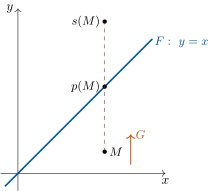
La projection sur F = Vect(1,1) parallèlement à G = Vect(0,1) et sa symétrie, sur le point M = (2,\ 0.5) : en glissant verticalement, M atteint F en p(M) = (2,2) et arrive en s(M) = 2p(M) - M = (2,\ 3.5), aussi loin au-dessus de F (mesuré le long de G) que M était en dessous.
La projection sur F=Vect⁡(1,1)F = \operatorname{Vect}(1,1) parallèlement à G=Vect⁡(0,1)G = \operatorname{Vect}(0,1) et sa symétrie, sur le point M=(2, 0.5)M = (2,\ 0.5) : en glissant verticalement, MM atteint FF en p(M)=(2,2)p(M) = (2,2) et arrive en s(M)=2p(M)−M=(2, 3.5)s(M) = 2p(M) - M = (2,\ 3.5), aussi loin au-dessus de FF (mesuré le long de GG) que MM était en dessous.

উদাহরণ

Exemple 20.16 (Une projection et sa symétrie, explicitement)

Dans R2\R^2, projetons sur F=Vect⁡(1,1)F = \operatorname{Vect}(1,1) parallèlement à G=Vect⁡(0,1)G = \operatorname{Vect}(0,1). Décomposons (x,y)=a(1,1)+b(0,1)(x, y) = a(1,1) + b(0,1) : la première coordonnée donne a=xa = x, la seconde b=y−xb = y - x. D’où

p(x,y)=(x,x),s(x,y)=2p(x,y)−(x,y)=(x, 2x−y).p(x, y) = (x, x), \qquad s(x, y) = 2p(x,y) - (x,y) = (x,\ 2x - y).

Vérifions l’algèbre : p(p(x,y))=p(x,x)=(x,x)p(p(x,y)) = p(x,x) = (x,x), et s(s(x,y))=s(x,2x−y)=(x,2x−(2x−y))=(x,y)s(s(x,y)) = s(x, 2x - y) = (x, 2x - (2x - y)) = (x, y). Géométriquement, ss est la « réflexion oblique » par rapport à la droite y=xy = x dans la direction verticale : elle fixe FF point par point et retourne GG. Si nous avions projeté sur le même FF parallèlement à G′=Vect⁡(1,−1)G' = \operatorname{Vect}(1,-1), la formule deviendrait p′(x,y)=(x+y2,x+y2)p'(x,y) = \bigl(\frac{x+y}2, \frac{x+y}2\bigr) : une projection est déterminée par son image et par son noyau, jamais par la seule image.

প্রসঙ্গসহ পড়ো →