University Mathematics — Year 2 · Bachelor Year 2
14Fourier Series
Can every periodic signal be rebuilt from pure sines and cosines? Fourier’s audacious “yes” created a century of analysis. This chapter proves the two pillars within reach at this level: Dirichlet’s theorem (pointwise reconstruction for piecewise functions, via the Dirichlet kernel) and Parseval’s identity (the energy of a signal is the sum of the energies of its harmonics), and harvests the classical numerical series — Basel’s first among them.
Throughout, functions are -periodic, piecewise continuous, complex-valued; denotes the continuous ones.
14.1 Fourier coefficients
Definition 14.1
The Fourier coefficients of are
and the real-form coefficients , , so that the Fourier partial sums are
On , define the Hermitian inner product : the exponentials are orthonormal (, direct computation), and : Fourier analysis is Hermitian geometry (Chapter 13) in infinite dimension.
Proposition 14.2 (Bessel’s inequality)
is the orthogonal projection of onto the space of trigonometric polynomials of degree , and
the series converges, and as (Riemann–Lebesgue for coefficients).
Proof. is orthogonal to each , (): is the orthogonal projection onto (Year 1 volume’s projection theorem, verbatim in the Hermitian setting). Pythagoras: ; let . ∎
Example 14.3 (Best approximation, measured)
How well do low-degree trigonometric polynomials approximate the sawtooth (on ) in the quadratic mean? By Proposition 14.2 the best degree- approximation is , with squared error
Here , and from (Example 14.12): . So
for — decreasing, but slowly: the tail is governed by the slow decay of the coefficients, itself the signature of the jump (Exercise 14.6 read backwards). Closing insight: Parseval turns approximation quality into a tail of a numerical series — and predicts, before any picture, that jumps make Fourier series converge reluctantly.
Method 14.4 (Computing Fourier coefficients efficiently)
Before integrating anything:
- Parity: even has , odd has , and the surviving integrals reduce to — half the work, twice the reliability.
- Trigonometric polynomials are done already: linearize products (, , …) and read the coefficients off (Exercise 14.9); orthonormality makes any further integration redundant.
- Complex exponentials for exponentials: for factors or damped oscillations, compute directly — one integral of beats two integrations by parts (Exercise 14.10).
- Differentiate a known expansion: if has known coefficients and is continuous, () recovers all but , which is the mean — often the fastest route, and legitimate exactly under the hypotheses of Theorem 14.10 (1).
14.2 Dirichlet’s theorem
Lemma 14.5 (Dirichlet kernel)
, where
Proof. Insert the definition of into and swap sum and integral (legitimate: the sum is finite):
substitute and slide the integration segment back to by -periodicity of the integrand; the symmetric index range makes . The closed form: geometric sum with ratio ,
which is the sine quotient. Its mean is : only contributes. ∎
Theorem 14.6 (Riemann–Lebesgue lemma)
For piecewise continuous on a segment, as .
Proof. Approximate uniformly by step functions (Theorem 10.16 is not needed — the elementary step-function approximation of piecewise continuous functions suffices) and integrate each step explicitly: every piece contributes , and the approximation error contributes . This argument was carried out in full as the final exercise of the Year 1 volume’s integration chapter; for pieces one can instead integrate by parts and bound by . ∎
Example 14.7 (How fast do coefficients die?)
Riemann–Lebesgue says the coefficients tend to ; their rate is a smoothness meter. Three specimens from this chapter and its exercises:
A jump in (square wave, sawtooth) leaves coefficients of order : no normal convergence, Gibbs overshoot at the jumps. Continuity with a corner — a jump in only — improves the order to : normal convergence, uniform reconstruction. In general derivatives buy (Exercise 14.6), and conversely a spectrum decaying faster than every power forces to be (differentiate term by term, now legitimately). Closing insight: regularity of the signal and decay of the spectrum are the same information — an engineer reads one off the slope of the other without ever plotting the function.
Theorem 14.8 (Dirichlet)
Let be -periodic and piecewise . Then for every ,
(the mean of one-sided limits) — in particular at every point of continuity.
Proof. By the kernel lemma and its unit mean, splitting the integral into and halves (each of mean ):
Treat the first (the second is symmetric). Write
The function is piecewise continuous on and has a finite limit at : writing
the first factor tends to (one-sided differentiability, from piecewise ) and the second to (the standard limit at ): exists. So extends piecewise continuously to , and Riemann–Lebesgue (Theorem 14.6) sends the integral to . This is the whole point of the hypothesis: without one-sided derivatives, the factor blows up at faster than Riemann–Lebesgue can compensate, and pointwise convergence can genuinely fail for merely continuous — the gap that Fejér’s theorem (weekend problem) closes by averaging. ∎
Example 14.9 (Dirichlet at a jump)
For the sawtooth on (Example 14.12 below), the periodic extension jumps at from to . Dirichlet promises the value there, and indeed every term of vanishes at : the series politely converges to the midpoint, ignoring both one-sided values. Moving the evaluation point to instead (a continuity point) turns the same series into Leibniz’s . One series, two behaviors — exactly the two clauses of the theorem.
Theorem 14.10 (Normal convergence for ; Parseval)
- If is continuous, -periodic and piecewise , then , the Fourier series of converges normally on , and its sum is .
(Parseval) For every piecewise continuous -periodic :
(Proved here for continuous piecewise ; admitted in general.)
Proof. (1) Integration by parts on each piece (boundary terms cancel by continuity and periodicity): . Then, by Cauchy–Schwarz on the two square-summable families (Proposition 14.2 for ):
normal convergence of the Fourier series. Its sum is continuous and coincides with at every point by Dirichlet (Theorem 14.8: is continuous): the series converges to , uniformly.
(2) For such : uniformly, so , and Pythagoras () passes to the limit. The real form is bookkeeping with . ∎
Example 14.11 (The tail bound, made quantitative)
The proof of Theorem 14.10 (1) hides a usable estimate. For continuous piecewise- , the same Cauchy–Schwarz applied to the tail only gives
using Bessel for and . So the uniform error of the partial sums obeys
For : (the derivative is ), so ten terms already reconstruct uniformly within , and within . Closing insight: one derivative buys the uniform rate; comparing with the -coefficient world of the square wave (no uniform convergence at all), the dictionary of Example 14.7 acquires numbers.
Example 14.12 (Basel and friends)
Let on , extended -periodically (a sawtooth, piecewise ). Computing, (oddness) and
Dirichlet at recovers Leibniz’s ; Parseval gives
— Euler’s Basel sum, in two lines. The function similarly yields (Exercise 14.3).
Example 14.13 (A full expansion with built-in check: )
The function is continuous, even, -periodic (hence -periodic), piecewise . Evenness kills the ; ; and for , product-to-sum gives
for (and directly): zero for odd , and . By Theorem 14.10 (1) the convergence is normal, and
Built-in check at : the identity demands , which telescoping confirms:
Closing insight: the spectrum of lives on the even frequencies only — rectifying a sine doubles its frequency content, which is why full-wave rectifiers hum at or hertz, twice the mains frequency.
Example 14.14 (Parseval as a computing device)
Parseval turns expansions into numerical series wholesale. Apply it to (Exercise 14.2: , for odd , the rest zero):
whence
Cross-check against Exercise 14.3: splitting into odd and even parts gives -style bookkeeping , so — exactly the value found there by a different function. Two expansions, one number: the consistency is Parseval’s isometry at work. Closing insight: each new Fourier expansion is a generating machine for series identities; the weekend problem’s Part II explains why the machine can never contradict itself.
Example 14.15 (Translation and modulation)
Two one-line rules generate many expansions from one. For , substituting :
and directly from the definition,
Worked instance: the sawtooth shifted by , with , has -coefficients : the expansion of the sawtooth that jumps at instead of at — no integral recomputed. Closing insight: time shifts only turn phases, never amplitudes ( is shift-invariant), which is why energy (Parseval) and convergence class are properties of the signal shape, not of where the clock starts.
Remark 14.16 (Common pitfalls)
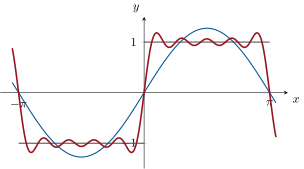
(i) Three convergences, three currencies: pointwise (Dirichlet: needs piecewise , pays the midpoint at each jump — never the one-sided value), uniform (needs a continuous limit; impossible across a jump, Gibbs is the visible symptom), and quadratic mean (Parseval: the most robust, blind to individual points). Always name which one you are claiming. (ii) No termwise differentiation by default: differentiating the sawtooth series of Example 14.12 term by term yields , whose terms do not even tend to — the transfer theorems of the function-sequences chapter need uniform convergence of the derived series, which the jump destroys. Smoothness first, differentiation second (Exercise 14.6 is the dictionary). (iii) Symmetric partial sums: Dirichlet’s theorem concerns ; rearranging or summing one side first can change divergence into convergence and back. (iv) Normalization drift: conventions differ across books ( or in front, period or ); the reliable invariants are the orthonormality relations — recompute in the convention at hand before trusting any formula.
Remark 14.17 (Where this is used)
Parseval is the germ of the theory of Fourier series: the Year 3 volume completes the picture (the exponentials are a Hilbert basis of , and the map is a bijective isometry). Within this volume, the weekend problem proves Fejér’s theorem — the Cesàro means of the Fourier series converge uniformly for every continuous periodic — which upgrades the admitted general Parseval to a theorem, yields the trigonometric Weierstrass theorem, and pays two spectacular dividends: Weyl’s equidistribution theorem and the isoperimetric inequality. Applied mathematics reads this chapter daily: spectra of signals, harmonics of vibrating systems, and the fast Fourier transform (the finite avatar was Exercise 13.10).
Remark 14.18 (Perspectives within this volume)
Three chapters converse with this one. Backward: the Hermitian chapter supplied the geometry (orthonormal families, projections, Bessel), and the function-sequences chapter the analysis (uniform convergence, transfer theorems, approximate identities — Fejér’s kernel is to Fourier series what Bernstein’s polynomials were to Weierstrass). Sideways: the power-series chapter’s boundary theory returns through Abel summation, realized here by the Poisson kernel (Exercise 14.12) — the disk’s radius playing the role of the summation parameter. Forward: the differential-equations chapter decomposes periodic forcing into harmonics and feeds each to the oscillator’s frequency response; resonance happens when a Fourier mode of the input matches a natural frequency, which is why its weekend problem and this chapter’s are two halves of one story.
14.3 Exercises
Exercise 14.1 ★
Compute the Fourier coefficients of the square wave ( on , on ), state Dirichlet’s conclusion at and at the jump , and recover Leibniz’s series.
Solution
Solution of Exercise 14.1.
Oddness kills the . For :
So . Dirichlet at (a continuity point, value ): , giving
At the jump : the series sums to , as Dirichlet prescribes (every term vanishes: consistent).
Exercise 14.2 ★
Expand (, -periodic) in Fourier series; justify normal convergence; evaluate at to obtain , and re-derive Basel from it.
Solution
Solution of Exercise 14.2.
Evenness kills the ; , and for :
(one integration by parts). Hence
with normal convergence () — as Theorem 14.10 (1) predicts for this continuous piecewise- function. At :
Splitting into odd and even parts: , so : Basel again.
Exercise 14.3 ★
Expand () and deduce
Solution
Solution of Exercise 14.3.
Evenness: ; ; two integrations by parts give (). Hence
normally convergent. At : , i.e. . Parseval:
so .
Exercise 14.4 ★★
Let be continuous -periodic with for all . Prove (Parseval — for which class is it proved here? justify that continuity plus piecewise can be dropped by admitting general Parseval, or give the density argument in outline).
Solution
Solution of Exercise 14.4.
If moreover is piecewise : Parseval (proved) gives , and strict positivity of the integral of the continuous forces .
For merely continuous , admit general Parseval: same one-line proof. (Outline of the density route: Fejér/Weierstrass-type trigonometric approximation shows trigonometric polynomials are -dense among continuous periodic functions; since all of them, for approximants , forcing .)
Exercise 14.5 ★★
For , expand () and deduce the partial-fraction expansion of the cotangent:
Solution
Solution of Exercise 14.5.
Evenness: ;
(product-to-sum, then integrate; ). Dirichlet at (a continuity point of the periodic extension, whose one-sided values agree by evenness):
using . Dividing by gives the cotangent expansion.
Exercise 14.6 ★★
Prove that if is -periodic and with piecewise continuous, then : smoothness of the signal decay of its spectrum.
Solution
Solution of Exercise 14.6.
Iterating ( times, integration by parts across the pieces with matching boundary values): . The coefficients of the piecewise continuous are bounded (indeed , Bessel):
Exercise 14.7 ★★★
(Wirtinger’s inequality) Let be , -periodic, with . Prove
with equality iff . (Parseval on both sides; compare and .)
Solution
Solution of Exercise 14.7.
Parseval for and for (both legitimate: is , piecewise continuous — indeed continuous):
Termwise, for : the inequality follows. Equality forces for all , i.e. for : (real form); conversely such give equality.
Exercise 14.8 ★★★
(The Gibbs constant) For the square wave of Exercise 14.1, evaluate the partial sum at : writing and , show that
a Riemann sum of on at midpoints. Conclude that the overshoot beyond the jump value does not vanish as .
Solution
Solution of Exercise 14.8.
From Exercise 14.1, . At , with :
since . The points are the midpoints of the subintervals of of length : the sum is a midpoint Riemann sum of the continuous , hence converges to
The partial sums near the jump overshoot the value by of the half-jump forever: Gibbs’s phenomenon, quantified.
Exercise 14.9 ★
Expand and in Fourier series (linearize; a trigonometric polynomial is its own Fourier series, by uniqueness of coefficients). What are , , for each?
Solution
Solution of Exercise 14.9.
From :
Each is a trigonometric polynomial, hence equal to its own Fourier series (uniqueness of coefficients: two expansions would differ by a trigonometric polynomial with all coefficients zero). For : , , all other and all zero; , . For : , ; , .
Exercise 14.10 ★★
Let and on , extended -periodically. Compute
apply Dirichlet’s theorem at the jump , and deduce the partial-fraction expansion of the hyperbolic cotangent:
Solution
Solution of Exercise 14.10.
Direct computation:
using . At the periodic extension jumps from to ; Dirichlet (symmetric partial sums) gives
the imaginary parts of the paired terms cancelling. Divide by :
the hyperbolic twin of Exercise 14.5.
Exercise 14.11 ★★
(Convolution) For continuous and -periodic define
Show that , that (to swap the two integrals of a continuous integrand, compare the two functions of the upper limit: both vanish at the left endpoint and have the same derivative, by continuity and differentiation under the integral sign), and that for the Dirichlet kernel. (The weekend problem’s Fejér means are likewise convolutions, .)
Solution
Solution of Exercise 14.11.
Commutativity: substitute and use periodicity of the integrand. For , the integrand is continuous; the two iterated integrals agree (both, as functions of the upper limit of the outer variable, vanish at the left endpoint and have the same derivative — continuity plus Theorem 9.10 justify differentiating the iterated integral). Hence
the inner integral being for every (substitution and periodicity). Finally Lemma 14.5 says ; the substitution and the evenness of turn this into .
Exercise 14.12 ★★★
(Poisson kernel: Abel means of Fourier series) For set .
Sum the two geometric series and show
- Show that for : as , uniformly.
- Deduce that for every continuous -periodic , the Abel means converge to uniformly as — the continuous-parameter sibling of Fejér’s theorem, and the Fourier incarnation of Abel summation from the power-series chapter.
Solution
Solution of Exercise 14.12.
With :
Mean : term-by-term integration of the normally convergent series keeps only .
- For : , so , whose denominator tends to while the numerator tends to : uniform convergence to off any neighborhood of .
Term-by-term integration (normal convergence in ) gives . The approximate-identity argument: with mean and positivity,
split at : at most (Heine) plus : uniform convergence as . This is Abel summation of the Fourier series — the Fourier twin of the power-series chapter’s boundary theory.
14.4 Problem: Fejér’s theorem and its dividends
Problem 14.1
Dirichlet’s theorem needs piecewise ; for merely continuous the partial sums can misbehave. Fejér’s discovery: their Cesàro means never do. The engine is the positivity of the Fejér kernel, and the harvest is immense: uniform trigonometric approximation (Weierstrass), uniqueness of Fourier coefficients, Parseval for every function of this chapter (removing the “admitted” in Theorem 14.10), Weyl’s equidistribution theorem, and — crowning a century of geometry — the isoperimetric inequality. Throughout, is -periodic and piecewise continuous, and
Part I — The Fejér kernel.
- Show that with , and that .
Prove the closed form, for :
(sum as the imaginary part of a geometric series).
Show the concentration estimate: for ,
is a positive approximate identity.
- (Fejér’s theorem) Prove: if is continuous and -periodic, then uniformly on (split the integral of at ; use Heine and questions 1–3).
- For piecewise continuous , show the pointwise version at every , and the uniform bound (positivity!).
Part II — Weierstrass, uniqueness, Parseval.
- (Trigonometric Weierstrass) Deduce: every continuous -periodic function is a uniform limit of trigonometric polynomials.
- (Uniqueness) Deduce: a continuous with for all is identically zero — two continuous periodic functions with the same Fourier coefficients coincide (Exercise 14.4, now with no admission).
(Parseval, continuous case) Using the projection property of (Proposition 14.2) and , prove
and conclude Parseval’s identity for every continuous -periodic .
- (Parseval, piecewise continuous case) Given piecewise continuous and , construct a continuous periodic with (replace by an affine interpolation on tiny intervals around the jumps), and deduce (use Bessel: ): Parseval holds in the full generality stated in Theorem 14.10 — the “admitted” is gone.
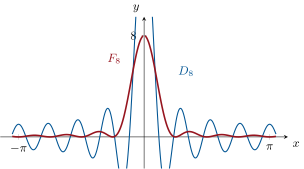
- (No Gibbs for Fejér) Contrast with Exercise 14.8: show that for the square wave , everywhere, for every — Cesàro averaging erases the overshoot that haunts . Explain in one sentence which property of is responsible.
Part III — Rates.
Prove the two kernel bounds, for :
(for the first, by induction; for the second, on ).
Deduce the first-moment estimate
for an explicit constant (split at ).
Conclude: if is -Lipschitz and -periodic, then
- (Saturation) Compute for and show : even for the smoothest functions, Fejér converges no faster than — the exact analogue of the Bernstein saturation in the function-sequences chapter’s weekend problem.
- (Localization) Show: if (piecewise continuous) vanishes on , then , however wild is elsewhere — convergence of the means at only sees near .
Part IV — Weyl’s equidistribution theorem. A sequence in is equidistributed when, for every interval ,
- Show that is equidistributed as soon as for every continuous -periodic (squeeze the indicator of between two continuous piecewise-affine functions whose integrals differ by ).
(Weyl’s criterion, sufficiency) Suppose
Show first for trigonometric polynomials, then for all continuous -periodic by question 6 (transported to period ): with question 16, is equidistributed.
Let be irrational and (fractional part). Bound the geometric sum
and conclude Weyl’s theorem: is equidistributed in .
- Deduce that is dense in for irrational , and explain in one sentence why equidistribution is strictly stronger than density.
- (Leading digits) Prove that the proportion of integers such that has leading (decimal) digit tends to (leading digit means ; show is irrational).
Part V — The isoperimetric inequality. Let be a closed simple curve of length enclosing a signed area , parametrized by scaled arc length: , -periodic, with constant; the enclosed area is
(taken here as the definition of the signed area; the chapter on multiple integrals proves it agrees with the intuitive one, via Green’s formula).
Expand (the series of a function, normally convergent) and prove, by Parseval applied to :
- Prove likewise (Parseval in its polarized form: , applied to , ).
(Hurwitz) Conclude:
with equality if and only if — a circle. The isoperimetric inequality: among closed curves of length , only the circle encloses area .
- Sanity checks: verify equality for the circle of radius and the strict inequality for the square of side ; explain why for every integer , including the negative ones, and where the parametrization’s constant speed was used.
- Synthesis. In one sentence each: (i) the single property of from which Parts I–III flow, and which lacks; (ii) how Cesàro summation here relates to the power-series chapter’s weekend problem (Frobenius); (iii) which dividend used only Weierstrass (question 6) and which needed full Parseval; (iv) one sentence on what the Year 3 volume adds ( completeness: Fourier series as a Hilbert basis).
Solution
Solution of Problem 14.1.
1. Averaging Lemma 14.5 over (linearity of the integral) gives ; each has mean , so has mean .
2. With :
Dividing by :
3. On : and : , uniformly there.
4. By the unit mean, . Given , Heine yields with for , uniformly in . Then, using and its unit mean,
for large , uniformly in : Fejér’s theorem.
5. is even with mean : each half , carries mean . Then
on each half, split at where the one-sided limit is -close, and let question 3 kill the far part: both integrals tend to . The bound: gives .
6. Each is a trigonometric polynomial (an average of the , ), and uniformly: the trigonometric Weierstrass theorem.
7. for all makes every , hence every ; by Fejér, . Applying this to a difference: continuous periodic functions are determined by their Fourier coefficients.
8. is the orthogonal projection of onto (Proposition 14.2), so it minimizes over ; since :
(the middle inequality because the mean of is at most the sup squared). Pythagoras then passes to the limit: Parseval for every continuous periodic .
9. Let be the jumps of in a period, . For small , define outside the intervals and by the affine chord across each such interval: is continuous, periodic, , and
for small. Bessel makes a contraction for , so
and question 8 gives for every : , and Pythagoras yields Parseval for every piecewise continuous : the “admitted” in Theorem 14.10 is now a theorem.
10. The square wave has , so question 5 gives everywhere and for every — no overshoot, ever — while Exercise 14.8 shows . The one responsible property: , so is a weighted average of values of and can never leave ; takes negative values, so can.
11. by induction (): with ,
Concavity of on gives for , so .
12. By evenness and the split at :
For : and , so the moment is .
13. For -Lipschitz :
uniformly in .
14. gives , while for : , so . Even for this entire, band-limited signal the rate is : Fejér saturates, exactly as Bernstein’s operator saturates at (Voronovskaya, in the function-sequences chapter’s weekend problem).
15. If vanishes on , then , of absolute value at most : the Cesàro means at only see near .
16. Given and , choose continuous -periodic piecewise-affine with and (trapezoids with slopes over intervals of total length ). Then
and symmetrically : the proportion tends to .
17. For with the hypothesis gives the limit ; for both sides are ; linearity handles every trigonometric polynomial. For continuous -periodic and , question 6 (transported by ) provides a trigonometric polynomial with :
With question 16: is equidistributed.
18. For and irrational , :
a bound independent of ; dividing by gives Weyl’s criterion, and question 17 concludes: is equidistributed.
19. Every subinterval receives asymptotic proportion equal to its length, in particular infinitely many points: is dense. Equidistribution is stronger: a sequence can be dense while spending nearly all its time in one corner (density says where the sequence goes, equidistribution says how often).
20. has leading digit iff for some , i.e. iff . Irrationality: would give , impossible for by unique factorization. Weyl’s theorem (question 18 with ; the half-open interval is squeezed between closed ones of nearby lengths) gives the proportion : the first digits of follow Benford’s law.
21. is , so its Fourier series converges normally with sum (Theorem 14.10 (1)), and . Since is constant,
and Parseval applied to the continuous gives , i.e. .
22. The polarized Parseval follows from Parseval applied to and (polarization identity), both continuous. With , :
23. Combining questions 21–22:
since for every integer. Equality forces for all : , a circle of center and radius (constant speed). Hurwitz’s proof of the isoperimetric inequality: , circle only.
24. Circle of radius : , : : equality. Square of side : (as ). For negative , is a product of two negative integers: positive — so backward-winding modes cost area twice. Constant speed entered in question 21, converting into ; for a non-constant speed, Cauchy–Schwarz gives , so the inequality survives, with the circle still the only equality case.
25. (i) Everything flows from (with unit mean and concentration); has unit mean and concentration of oscillation but not positivity, and Gibbs is the price. (ii) Cesàro summability of the Fourier series implies its Abel summability with the same sum (Frobenius, proved in the power-series chapter’s weekend problem) — the Poisson-kernel route of Exercise 14.12 is exactly Abel’s method. (iii) Weyl’s theorem needed only uniform approximation (question 6); the isoperimetric inequality needed Parseval itself (questions 8, 21–22). (iv) The Year 3 volume proves completeness: the exponentials form a Hilbert basis of , Parseval becomes an isometry of Hilbert spaces, and Fejér’s theorem becomes the statement that this isometry is computable by positive averages.