University Mathematics — Year 2 · Bachelor Year 2
17Affine Spaces
Vector spaces have a privileged point — the origin — that geometry does not want. An affine space is a vector space that has forgotten its origin: points and vectors become different species, related by translation. This short chapter builds the dictionary (points, barycenters, affine subspaces and maps), the affine view of convexity, and the classification tools used in the geometry chapters ahead.
17.1 Points and vectors
Definition 17.1
An affine space directed by a real vector space is a nonempty set with a map satisfying
One writes for the unique point with . The dimension of is . Every vector space is an affine space over itself (); every choice of origin identifies with via .
Example 17.2 (An affine space with no natural origin)
The solution plane is not a vector subspace (), but it is an affine space directed by : for the difference lands in (the sums cancel), Chasles is inherited from , and is bijective onto . No point of is distinguished — any choice of “origin” works equally well, and all the identifications differ by translations. This is the typical situation: solution sets of inhomogeneous linear problems (linear systems, linear differential equations in Chapter 16) are affine, never linear, and the slogan “particular solution plus kernel” is exactly the statement of the next definition.
Definition 17.3 (Barycenter)
Let be weighted points with . The barycenter is the unique point with
Barycenters are associative (subgroups of points may be replaced by their partial barycenter with the summed weight) and invariant under rescaling of all weights.
Proof of existence and the formulas. Fix and write . By Chasles,
which determines uniquely. Independence of : for another origin ,
the same point . Associativity: split the index set as with , and let be the barycenter of , so that . Then
is the barycenter of together with , as claimed. Rescaling: replacing each by () multiplies and the weighted sum by , leaving unchanged. ∎
Remark 17.4 (Common pitfalls)
Two traps surround the definition. First, if the weights sum to zero, there is no barycenter: the map is then independent of and defines a vector, not a point — for instance encodes . Keeping track of which of the two objects a computation produces is half of barycentric hygiene. Second, weights are only meaningful up to a common nonzero factor; formulas like “the coordinates of are ” presuppose a normalization (usually ), and forgetting to normalize is the standard source of wrong ratios on a figure.
Definition 17.5 (Affine subspaces; affine maps)
An affine subspace is a set with a vector subspace (its direction); equivalently, a nonempty set stable under barycenters. Affine subspaces of are exactly the solution sets of linear systems (Year 1: particular solution plus kernel). A map is affine when it preserves barycenters — equivalently when
for a (unique) linear map , the linear part. Affine maps of : . Compositions are affine with composed linear parts; is bijective iff is.
Proof of the equivalence for maps. If : for a barycenter of , expanding every point from , and : is the barycenter of the images. Conversely, fix and define . Homogeneity: for every real , so preservation of barycenters (with arbitrary real weights, as hypothesized) gives directly. Additivity: , so , using homogeneity. Hence is linear. ∎
Remark 17.6
The proof used barycenters with arbitrary real weights: the homogeneity step takes outside . If a map is only assumed to preserve barycenters with nonnegative weights — equivalently, midpoints and segments — linearity of the vector map no longer comes for free: one only gets -linearity, and a continuity hypothesis is needed to conclude, exactly as in Exercise 17.5. Distinguishing “preserves all barycenters” from “preserves convex combinations” is a small but real subtlety of the affine vocabulary.
Example 17.7 (Classical barycenter geometry)
The centroid of a triangle is the barycenter . Associativity with the midpoint shows
lies on the median at two-thirds of it — and likewise for the other two medians: the three medians are concurrent, in one line of barycentric calculus.
Example 17.8 (The bimedians of a quadrilateral)
Let be any quadrilateral (planar or not!) and consider its bimedians: the segments joining the midpoints of opposite sides, and . Introduce the barycenter of and group the weights two ways:
is the midpoint of both bimedians — so the two bimedians always bisect each other, and the quadrilateral of the four midpoints is a parallelogram (its diagonals are the bimedians). No case analysis, no coordinates, and the argument survives unchanged for a skew quadrilateral in , where a picture-based proof would already be delicate: associativity does not care about dimension.
Example 17.9 (Classifying an affine map, start to finish)
Let on . Its linear part is , whose spectrum avoids : by the fixed-point criterion proved below (Proposition 17.17), has exactly one fixed point, found by solving
Recentering at (set , ):
in the frame at , is its linear part, an anisotropic dilation stretching by horizontally and vertically from the center . The general lesson: an affine map is “linear map plus location data”, and the location data collapses to one well-chosen origin whenever is not an eigenvalue. Conversely, translating the origin badly creates the constant terms: affine geometry is the art of choosing where to put .
Remark 17.10 (Method: concurrency and alignment by barycenters)
Example 17.7 is an instance of a general recipe. To prove that three cevians of a triangle are concurrent, exhibit a single weighted system and use associativity three ways: grouping shows the barycenter lies on the cevian from , grouping on the cevian from , grouping on the third. For the medians, the system does all the work; for cevians cutting the sides in prescribed ratios, the weights are read off the ratios. To prove three points aligned, write one as a barycenter of the other two (Exercise 17.2), or use the determinant criterion of Exercise 17.11. Both recipes replace geometric ingenuity by weight bookkeeping — this is precisely what barycentric calculus is for.
17.2 Convexity, affinely
Definition 17.11
A subset of an affine space is convex when it contains every barycenter with nonnegative weights of its points — equivalently, every segment between its points. The convex hull is the set of all nonnegative-weight barycenters of points of — the smallest convex set containing .
Example 17.12 (Epigraphs are convex sets)
The region above the parabola is convex: for and , the convexity inequality of the square function gives
so the barycenter stays above the parabola. The computation is general: is convex exactly when is a convex function — convex sets and convex functions (Chapter 8) are two faces of one notion, epigraphs being the dictionary. This is the geometric reason support lines exist for convex functions, the fact that will prove Jensen’s inequality in Chapter 22.
Example 17.13 (Redundant generators of a convex hull)
Let . The fifth point is the barycenter
so it already lies in the hull of the other four: is the square with the four corners as vertices. In general, a point of that is a nonnegative-weight barycenter of the other points of can be deleted without changing the hull; the points that can never be deleted (here the four corners) are the extreme points of the hull. Determining them is a pure barycenter computation: , say, cannot be written as of the remaining points with nonnegative weights, because the first coordinate would force all weight onto points with , and the second coordinate then fails. Convexity questions reduce, again and again, to solving small weighted systems.
Theorem 17.14 (Carathéodory)
In an affine space of dimension , every point of is a barycenter of at most points of .
Proof. Let with , , and points. The vectors () are linked (): nontrivially; setting , we get weights with , (any ), not all zero. Then for every real the weights still sum to and, since ,
they produce the same point . Now slide from : some is positive (they sum to zero and are not all zero), so
is well defined and positive. At : for indices with , by minimality, with equality at a minimizing index; for indices with , . All weights remain nonnegative and at least one has died: is rewritten as a barycenter of fewer points. Iterate while more than points remain. ∎
Example 17.15
In the plane (): every point of the convex hull of a finite set lies in a triangle with vertices in the set — the geometric content of Carathéodory, used in optimization and probability (mixtures) alike.
Example 17.16 (Running Carathéodory’s algorithm)
Write the center of the square of Example 17.13 with its four corners , , , :
four points in dimension — one too many. The proof’s recipe asks for weights with and : here works (the two diagonals share their midpoint). Sliding keeps the barycenter fixed for every ; the extremal admissible value makes the weights , killing and simultaneously:
a representation by two points — even better than the three that the theorem guarantees, because the center happens to lie on a segment between generators. The algorithm is entirely mechanical: find a dependence, slide until a weight dies, repeat.
17.3 Affine classification tools
Proposition 17.17 (Fixed points of affine maps)
Let be an affine endomorphism of a finite-dimensional affine space with linear part . If , then has exactly one fixed point , and in the vectorialization at , is its linear part. (Translations, with and no fixed point, are the basic obstruction.)
Proof. Fix and write . The point is fixed iff , i.e.
In finite dimension, is invertible iff is not an eigenvalue of , iff — and in that case the displayed equation has exactly one solution , giving the unique fixed point . Recentering: for any vector ,
so in the frame with origin the map reads : purely linear. When , either no fixed point exists (the displayed equation may be unsolvable, as for a translation) or a whole affine subspace of them does (add any eigenvector of eigenvalue to a solution): uniqueness is exactly the spectral condition. ∎
Example 17.18 (Plane isometries, completed)
An affine isometry of the Euclidean plane has linear part in : a rotation or a reflection (Year 1 volume). If : , so the map is a rotation about a unique center (Proposition 17.17). If the linear part is a reflection: either a reflection in an axis (fixed points exist) or a glide reflection (reflection composed with a translation along the axis, no fixed point). With translations, this is the complete classification of plane isometries.
Remark 17.19 (The plane isometries, at a glance)
Collecting the cases: identity; translations (, no fixed point unless trivial); rotations (linear part , : one center); reflections (linear part a reflection, a line of fixed points); glide reflections (same linear part, no fixed point). Four families plus the identity, each recognized by two data only: the linear part and the fixed-point set — the pattern of Proposition 17.17 made exhaustive.
Example 17.20 (A glide reflection, caught in the act)
Let . The linear part is the reflection in the diagonal , so and Proposition 17.17 is silent. Fixed points would need and simultaneously: impossible — none exist, so is not a reflection. Squaring settles the classification:
the translation by : is the glide reflection with axis the line (shifted appropriately: the midpoint of and always lies on constant, here , as one checks on ) and glide vector , half of . Compare with Exercise 17.6, where the same linear part but a different constant produced an honest reflection: with eigenvalue present, the constant term decides everything.
Example 17.21 (Affine recursions are affine dynamics)
The classical recursion () iterates the affine map of the line, whose linear part avoids the eigenvalue : there is a unique fixed point , and recentering there (the one-dimensional case of the proposition above) turns into multiplication by :
For : and . The recipe taught for such recursions in Chapter 7 — “subtract the fixed point” — is exactly the vectorialization of an affine map at its fixed point; convergence for is the contraction phenomenon that Chapter 4 turned into the Banach fixed-point theorem. One idea, three chapters.
Example 17.22 (Finding the center of a rotation)
Let . The linear part is : the rotation of angle , whose spectrum avoids . By Proposition 17.17 there is exactly one fixed point: and give , , so , and is the rotation of center and angle . The general lesson: when , classifying costs one linear system — the geometry is entirely in the linear part, the arithmetic entirely in locating the center.
Remark 17.23 (Where affine language is used next)
Barycenters and affine maps are the grammar of the geometry chapters ahead: tangent lines and planes are affine objects (Chapters 18 and 19), an affine change of variables multiplies areas and volumes by (Chapter 20), and expectation is a barycenter with weights given by a probability law, which is why convexity governs Jensen’s inequality (Chapter 22). In the Year 3 volume the same convexity vocabulary carries the study of norms and of integral inequalities.
Remark 17.24 (Perspectives within this volume)
Two threads leave this chapter. The affine thread: tangent lines (Chapter 18) and tangent planes (Chapter 19) are affine subspaces attached to nonlinear objects, and the classification of quadrics in the surfaces chapter runs on this chapter’s center equation . The convex thread is longer: convexity of half-planes and disks powers the Helly theory of the weekend problem; convexity of functions gives Jensen’s inequality (Chapter 22); and the final theorem of the book — the extinction criterion for branching processes (Chapter 23) — is decided by the position of a convex curve relative to the diagonal, a picture that belongs to this chapter as much as to probability. Barycenters return there too: an expectation is a barycenter with probability weights.
17.4 Exercises
Exercise 17.1 ★
In , are the following affine subspaces? Give directions and dimensions. ; ; ; the solution set of for a given compatible system.
Solution
Solution of Exercise 17.1.
: affine plane, direction the vector plane , dimension . Adding : an affine line (two independent equations), direction , dimension . : a cylinder — not stable under barycenters (the midpoint of and is the origin, off the cylinder): not affine. A compatible system : affine subspace of dimension , as recalled in Definition 17.5.
Exercise 17.2 ★
Prove that three distinct points of an affine space are aligned iff is a barycenter of and , iff the vectors are linked. Deduce Menelaus-style weight bookkeeping: if , locate for , , .
Solution
Solution of Exercise 17.2.
means : existence of such is exactly linkage of with , i.e. alignment. Positions: : midpoint; : beyond , at ’s distance from it (); : the reflection of through .
Exercise 17.3 ★
Let be the affine map of given by with and . Determine the image of , its fixed points (if any), and .
Solution
Solution of Exercise 17.3.
is the projection matrix onto along (check ). Image of : : the affine line through directed by . Fixed points: , i.e. ; but and ; is in it? forces and : no. No fixed points. And
is followed by a translation along the image line — is a “glide projection”: projection onto the line composed with a slide.
Exercise 17.4 ★★
(Associativity in action) In a triangle , let divide , , in ratios , , . Express as barycenters and compute the barycenter of : what do you find, and why was it predictable?
Solution
Solution of Exercise 17.4.
(since places closer to : weights on , on — check: ). Similarly , . Summing the three weighted systems, the barycenter of (each of total weight , so replace by its system, etc.) is
the centroid of : the triangle has the same centroid — predictable, because the construction treats cyclically and the centroid is the unique fixed point of the cyclic symmetry of weights.
Exercise 17.5 ★★
Prove that a map preserving midpoints () and continuous is affine. (Show the vector map is additive via midpoints, then -homogeneous, then -homogeneous by continuity — the same density strategy used for Cauchy’s functional equation in the Year 1 volume; re-derive the needed steps here.)
Solution
Solution of Exercise 17.5.
Set (working in vectorialized at ), .
Additivity: , so midpoint preservation gives ; with : ; combining, .
-homogeneity: additivity gives (, induction), then (add), then (apply , use injectivity of scaling).
-homogeneity: for , take rationals : , and continuity of (inherited from ) passes to the limit: . Hence is linear and : affine.
Exercise 17.6 ★★
Classify the affine map of the Euclidean plane: linear part, fixed points, geometric nature (reflection? glide?). Compute and conclude.
Solution
Solution of Exercise 17.6.
Linear part : the reflection in the diagonal (orthogonal, determinant ). Fixed points: amounts to the single equation (the two components are equivalent): every point of the line is fixed. So fixes that line pointwise: is the reflection in that axis (an isometry with a line of fixed points and linear part a reflection). Consistently, : an involution, as a reflection must be.
Exercise 17.7 ★★★
(Radon) Let be points of an affine space of dimension . Prove that they can be split into two disjoint groups whose convex hulls intersect. (As in Carathéodory’s proof, find weights , not all zero, with and ; separate positive and negative weights and normalize both sides.)
Solution
Solution of Exercise 17.7.
The vectors () are linked in dimension : there are , not all zero, with ; set , so and for every , with not all zero. Split indices: , , both nonempty (the sum to zero and are not all zero). With :
(both sides equal the point with , by the relation): a common point of the two convex hulls, with disjoint index groups.
Exercise 17.8 ★★★
Let be an affine endomorphism of with . Prove that is the affine projection onto the affine subspace along the direction , and that conversely all such projections are idempotent. (Show first that consists of fixed points.)
Solution
Solution of Exercise 17.8.
Image = fixed points: for , : every image point is fixed; conversely fixed points are images. So is nonempty, and it is an affine subspace (image of an affine map), with direction .
Projection structure: is idempotent (), so (Example 3.18). For any point , consider the vector ; applying :
so . Hence displays as a point of translated by a vector of : is exactly the projection onto along . Conversely such projections clearly satisfy .
Exercise 17.9 ★
Let in a triangle . Using associativity, show that the line meets at , and locate on the segment ; locate likewise the intersection of with .
Solution
Solution of Exercise 17.9.
Let , of total weight . Associativity gives , so : lies on the segment at five-sixths of it from . Since , the line meets at the single point , with . Likewise, with (total weight , ), associativity gives : the line meets at , and .
Exercise 17.10 ★★
For , the homothety is the affine map fixing with linear part . Prove that the composition is a homothety of ratio when , and a translation when ; in the case (two point reflections), compute the translation vector.
Solution
Solution of Exercise 17.10.
Vectorialize at an origin and write points as vectors: with . The composition is affine with linear part . If : , so Proposition 17.17 yields a unique fixed point and, vectorialized there, : the homothety . If the linear part is the identity, so is a translation; expanding,
For (point reflections) the vector is : the composition of the point reflections in then is the translation by .
Exercise 17.11 ★★
(Menelaus) In a triangle , let , , , all distinct from the vertices, and define by , , . Prove that are aligned if and only if . (Write each point as a barycenter of two vertices; show that three points are aligned iff their barycentric coordinate rows with respect to form a singular matrix.)
Solution
Solution of Exercise 17.11.
says exactly , i.e. (total weight since ); likewise and .
The alignment criterion. Give each point its normalized barycentric row , , with respect to . If with for three points , then summing the entries gives , and : the are affinely dependent, i.e. aligned. Conversely an affine dependence gives with entries summing to and ; expanding from , , so by affine independence of : the rows are linearly dependent. So alignment amounts to a vanishing determinant, and scaling rows by the nonzero factors , , changes nothing:
Hence are aligned iff : Menelaus’ theorem.
Exercise 17.12 ★★★
Prove that the convex hull of a compact subset of is compact. (By Theorem 17.14, is the image of a compact set under a continuous map.) Show by an example in that the convex hull of a closed set need not be closed.
Solution
Solution of Exercise 17.12.
Let : closed and bounded in , hence compact, and is compact as a finite product. The map
is continuous, and Theorem 17.14 says precisely that : a continuous image of a compact set (Theorem 4.16), hence compact.
For a closed set: take , closed in . A convex combination putting weight on and on axis points has second coordinate , so
(for , ). The point is adherent but not in the hull: not closed.
17.5 Problem: from Radon to Helly, centerpoints and Jung’s theorem
Problem 17.1
Weekend problem — Helly’s theorem and two of its dividends
Radon’s lemma (Exercise 17.7) says that points of an -dimensional affine space always split into two groups with intersecting convex hulls. This problem turns that one linear-algebra fact into a chain of theorems of combinatorial geometry: Helly’s intersection theorem, the centerpoint theorem (a two-dimensional median), and Jung’s covering theorem. Throughout, the plane is with its usual Euclidean structure, and is the determinant in the canonical basis.
Part I — Barycentric coordinates. Points are affinely independent when the vectors are linearly independent.
- Show that affine independence does not depend on the choice of the base point , and that it is equivalent to: whenever two families of weights, each summing to , define the same barycenter of , the weights coincide.
- Let be affinely independent in the plane. Show that every point admits a unique triple with and — its barycentric coordinates.
Prove the determinant formulas
barycentric coordinates are ratios of signed areas.
- The lines , , are the coordinate lines , , . Show that lies in the closed triangle iff , and that the three lines cut the plane into exactly seven regions, classified by the signs of (the sign pattern being impossible).
- Let be an affine map (an affine form). Show , that the level sets of a nonconstant affine form are lines, that every line arises this way, and that the closed half-planes are convex.
Part II — Radon partitions, refined. A family of points of is in general position when every of them are affinely independent. An affine dependence of is a family with and for one (hence every) origin .
- Compute a nonzero affine dependence of the four points , , , ; give the Radon partition and the Radon point.
- Show that for points in general position the vector space of affine dependences has dimension exactly , and that a nonzero dependence has no vanishing coefficient.
- Deduce that the Radon partition of points in general position is unique (up to swapping the two blocks), each block being the set of indices where has one fixed sign.
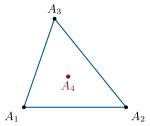
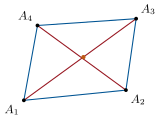
- For four points of the plane in general position, show the dichotomy: either the partition has type — one point interior to the triangle of the other three — or type : the four points are in convex position and the segments joining the two pairs (the diagonals) intersect, at the Radon point.
- Carry out question 6 for the unit square , , , : dependence, partition, Radon point.
Part III — Helly’s theorem in the plane.
- Let be convex subsets of , any three of which have a common point. Pick and apply Radon’s lemma to : show that the Radon point belongs to all four sets. (For each , the block not containing consists of points of .)
- (Helly) Let () be convex subsets of , any three of which intersect. Prove , by induction on : replace and by and check the hypothesis for the new family using question 11.
- Three counterexamples, one per hypothesis: (a) the three closed edges of a triangle pairwise intersect but have no common point ( cannot be lowered to ); (b) the four sets , for four points in general position, satisfy the triple-intersection hypothesis but not the conclusion (convexity matters); (c) the closed half-planes , , pairwise and triple-wise intersect but (infinite families need compactness).
- (Compact Helly) Let be an arbitrary family of compact convex subsets of , any three of which intersect. Using question 12 and the Borel–Lebesgue property (Theorem 4.20), show .
- (First dividend) Let be a finite set of points of the plane and . Show: if every three points of lie in some closed disk of radius , then lies in one closed disk of radius . (Apply Helly to the disks , .)
Part IV — The centerpoint theorem. A centerpoint of a finite set of points of the plane is a point (not necessarily in ) such that every closed half-plane containing contains at least points of .
- (Dimension ) For reals , show that the median satisfies: every closed half-line containing contains at least of the .
- (Counting lemma) If are subsets of with , show .
- Let and let be the (finite) family of the convex hulls , , . Show that any three members of have a common point, and deduce from Helly a point common to all of them.
- Prove that this is a centerpoint of : the centerpoint theorem. (If a closed half-plane through contained fewer than points, its open complement would contain a set of points, and would avoid .)
- Sharpness: let and place points in each of three disks of small radius centered at the vertices of a large triangle. Show that for every point of the plane some closed half-plane containing contains at most points of , so the constant cannot be improved. (Among the three directions from to the disk centers, two make an angle at most .)
Part V — Jung’s theorem and synthesis.
- (Triangle lemma) Let be three points with pairwise distances . Show they lie in a closed disk of radius . (If some angle is , take the disk on the longest side as diameter, using the median formula ; if the triangle is acute, bound the circumradius using its largest angle, which lies in .)
- (Jung) Deduce: every compact subset of the plane of diameter is contained in a closed disk of radius .
- Sharpness: for the equilateral triangle of side with centroid , prove the Leibniz identity for every point , and conclude that any disk containing the three vertices has radius , with equality only for the circumdisk.
- (Helly in ) State and prove Helly’s theorem in : if finitely many convex sets are such that any of them intersect, then all of them intersect. (Radon’s lemma Exercise 17.7 handles sets; then induct as in question 12.)
Synthesis. Assemble the chain
indicating in one sentence each: where linear algebra enters, where the signs of the weights enter, where convexity enters, and which single step used the dimension of the plane. What do the constants (in Helly), (centerpoint) and (Jung) become in ? (State without proof.)
Solution
Solution of Problem 17.1.
1. Rebase at : for , . If , expanding gives ; independence of the forces for , then : independence at . For the equivalence: two weight families , summing to with the same barycenter give, with : and (origin ) , so under independence. Conversely a nontrivial relation , completed by , lets one add to any weight family without moving the barycenter: non-uniqueness.
2. is a basis of : write (unique) and set ; the barycenter condition at origin reads exactly . Uniqueness is question 1.
3. From and Chasles, . With :
using bilinearity and , . The other two formulas follow by the same computation with the roles permuted cyclically.
4. By definition is the set of barycenters with nonnegative weights; normalizing the weights to sum and invoking uniqueness (question 2), iff . Each coordinate is an affine function of (question 3: a determinant with one column affine in ), so each open sign condition defines an open half-plane. The pattern contradicts ; each of the remaining seven patterns is realized: scale a sign-respecting triple with at least one entry so that the (positive) sum is — e.g. , , , and permutations.
5. An affine map preserves barycenters (Definition 17.5), so . Writing with : is a line, and every line is such a level set. If and , then : half-planes are convex.
6. The conditions , , give (taking ) the dependence . Signs split as , and normalizing each side by :
the centroid of the triangle: the Radon point is itself, which indeed lies inside the triangle .
7. The linear map , , has rank , so . If two independent dependences existed, a suitable combination (or itself if both last coefficients vanish) would be a nonzero dependence with ; restricting to and rebasing at , some with (a single nonzero weight cannot sum to zero), giving a nontrivial relation : the points would be affinely dependent, against general position. So . The same restriction argument shows a nonzero dependence has no vanishing coefficient.
8. Let be a dependence, and : both nonempty (, ) and exhaustive (no zero coefficient). Radon’s construction (Exercise 17.7) produces the common hull point from exactly this partition. Since the dependence is unique up to a nonzero scalar (question 7), the unordered pair — hence the Radon partition — is unique.
9. Blocks are nonempty, so the type is or . Type , block : the Radon point lies in , so of the other three; it cannot lie on an edge (three of the points would be aligned, against general position), so is interior to the triangle. Type , blocks : the Radon point lies on , and is not an endpoint (that would align three points): the two segments cross at an interior point. Moreover no point lies in the hull of the others: such a containment with is an affine dependence with sign pattern , which by uniqueness (question 8) would make the partition . So in the case the four points are in convex position and the crossing segments are the diagonals.
10. The equations , , give the dependence : partition , and
the Radon point is the center of the square, where the two diagonals cross — type , as the picture predicts.
11. Radon applied to gives blocks and a point . Fix , say . Every satisfies , so by the choice ; since is convex, . As was arbitrary, .
12. Induction on . For the hypothesis is the conclusion; is question 11. Let , assume the statement for sets, and take with the triple-intersection property. Set , convex. The family has members; a triple avoiding intersects by hypothesis, and a triple has intersection , nonempty by question 11 applied to (any three of these meet, by hypothesis). The induction hypothesis now yields a common point of the new family, i.e. of all sets.
13. (a) The closed edges , , of a nondegenerate triangle: any two share a vertex, but a common point of all three would lie in and in , which excludes . (b) Any three of the sets omit three of the four points, leaving exactly one common point; the total intersection omits every point. The are finite, not convex: convexity is essential. (c) Finitely many intersect in , yet no point has for all : for infinite families, compactness is essential.
14. Suppose and fix . Every misses some , so , a cover by open sets ( is compact, hence closed). By Borel–Lebesgue (Theorem 4.20) finitely many suffice: . But any three members of this finite family of convex sets intersect, so question 12 makes the intersection nonempty: contradiction.
15. Set for : compact convex sets. For , the hypothesis gives a closed disk containing ; then , i.e. . By Helly (question 12; the family is finite) there is : every satisfies , so .
16. Let . A closed half-line containing is with or with . The first contains : at least points. The second contains : exactly points.
17. , then
18. Note . For of cardinality , question 17 provides a point ; then for each : any three members of meet. The family is finite (finitely many subsets of ) and consists of convex sets, so Helly (question 12) gives .
19. Suppose some closed half-plane contains fewer than points of . Its complement is an open half-plane, convex, with , hence ; choose with . Then by convexity of , so : contradiction with . Hence every closed half-plane containing contains at least points: is a centerpoint.
20. Take the triangle equilateral of side and . Let be any point; we exhibit a closed half-plane containing and at most points.
Case 1: is within of a vertex, say . Directions from to and to deviate from the directions , by at most , so they make an angle . Case 2: is at distance from all vertices. If is in the triangle, the three angular gaps between the directions from to the vertices sum to , so some gap is ; if is outside, the three directions lie in an open half-plane of directions and two of them make an angle . In every case two directions, say toward and , make an angle ; let be their unit bisector, so . For any point of the disk around :
since (and likewise for ): the open half-plane swallows both clusters. Its closed complement contains and at most the points of the third cluster. So no point of the plane beats : with question 19, the centerpoint constant is exactly .
21. Order the angles; the largest, , satisfies (the three sum to ). If , say at , let be the midpoint of the opposite side . The median formula (, expand and eliminate with the law of cosines) gives
using (the inner product is ). So the disk of diameter , of radius , contains all three points (degenerate aligned triples fall under ). If the triangle is acute; by the law of sines the circumradius is with the side opposite , and gives , so : the circumdisk does the job.
22. For let : compact convex. Any three points of are pairwise at distance , so question 21 gives a disk of radius containing them: its center lies in . By compact Helly (question 14, arbitrary families allowed) there is : every is within of , i.e. . This is Jung’s theorem in the plane.
23. With the centroid, , so
and the middle term vanishes: the Leibniz identity. For the equilateral triangle of side , (two thirds of the height ), so . If contains the vertices, then : , with equality forcing and all three distances equal to — the circumdisk. Jung’s constant is sharp.
24. Helly in : if () are convex subsets of and any of them intersect, then all of them do. Base case : pick ; Radon’s lemma (Exercise 17.7) splits into blocks with a common hull point , and for each , the block not containing consists of points of , so by convexity, exactly as in question 11. Induction step for : replace by ; an -tuple of the new family containing the intersected member amounts to of the old sets, handled by the base case, and the other tuples are covered by hypothesis. Conclude by the induction hypothesis.
25. Linear algebra enters once: vectors in the -dimensional space of pairs (total weight, weighted position) must be dependent — that is the affine dependence. The signs of its coefficients split the points into the two Radon blocks and turn one linear relation into an equality of two nonnegative barycenters. Convexity is used exactly twice: in Helly’s step (the hull of points of stays in ) and in the applications (half-planes and disks are convex). The dimension of the plane entered only through the number of points fed to Radon, i.e. the “” in Helly’s hypothesis; everything else was dimension-free, as question 24 confirms. In the constants become: Helly number ; centerpoint constant (every finite set has a point every closed half-space through which contains a fraction of it); Jung radius for sets of diameter — equal to when .