
সব বই

পেশাদার

1 Markets I: The Ecosystem and Exchange-Traded Marketsবাজার অনলাইন 2 Markets II: Rates, FX and Creditবাজার অনলাইন 3 Markets III: Commodities, Energy and Cryptoবাজার অনলাইন 4 Quantitative Methodsপদ্ধতি অনলাইন 5 Derivatives and Volatilityডেরিভেটিভস অনলাইন 6 Rates, Credit, XVA and Riskসুদহার, ঋণ ও ঝুঁকি অনলাইন 7 Research Craft: Predictors, Backtests, Measurement, Portfoliosগবেষণা অনলাইন 8 Strategies I: Equities and Futuresকৌশল অনলাইন 9 Strategies II: Volatility, Relative Value, Macro and the Bank Desksকৌশল অনলাইন 10 Microstructure and Executionএক্সিকিউশন অনলাইন 11 Market Making and High-Frequency Tradingমার্কেট মেকিং অনলাইন 12 Machine Learning for Marketsমেশিন লার্নিং অনলাইন 13 Low-Latency Softwareপ্রযুক্তি অনলাইন 14 Networks, Hardware and Trading Infrastructureপ্রযুক্তি অনলাইন 15 Research, Data and Risk Platformsপ্রযুক্তি অনলাইন 16 The Desk and the Firmপ্রতিষ্ঠান অনলাইন 17 The Industry: Firms, Roles and Careersক্যারিয়ার অনলাইন 18 Interviews I: Maths, Probability and Speedক্যারিয়ার অনলাইন 19 Interviews II: Markets, Trading Games and the Final Roundক্যারিয়ার অনলাইন 20 Interviews III: Codeক্যারিয়ার অনলাইন
অ্যাপ পরিচিতি Coach সাইন ইন পড়া শুরু করো

বইগুলো এখনো বাংলা ভাষায় পাওয়া যায় না — ইংরেজি সংস্করণ দেখানো হচ্ছে।

Biology · পরিভাষা

Anatomy of a gene কী?

Definition 17.7 University Biology — Year 1 · অধ্যায় 17 — Genomes of Cells and Viruses

A gene is a stretch of DNA transcribed into a functional RNA — usually a messenger for one protein. A eukaryotic protein-coding gene comprises a promoter, the sequence upstream where transcription begins and is controlled; exons, the parts kept in the mature message; introns, the parts transcribed and then cut out (Chapter 19); the untranslated regions at each end of the message; and a terminator. A human gene averages 27 kb27\,\mathrm{kb} with eight exons totalling 1.5 kb1.5\,\mathrm{kb}: nineteen twentieths of a typical gene is intron. Bacterial genes have no introns.
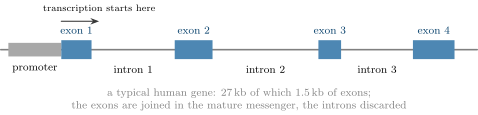
A eukaryotic gene: a promoter, exons (kept) alternating with introns (removed after transcription). Drawn to a compressed scale — in a real gene the introns would be twenty times longer than the exons.

উদাহরণ

Example 17.9 (Reading a genome’s size)

A genome of 4.6 Mb4.6\,\mathrm{Mb} with no introns and few repeats holds 43004300 genes; one of 3200 Mb3200\,\mathrm{Mb} with long introns and half its length in repeats holds 20 00020\,000; one of 130 000 Mb130\,000\,\mathrm{Mb} holds the same twenty thousand. The size measures how much has accumulated in a lineage’s non-coding DNA, and how efficiently it has been removed, not how much the organism does.

Example 17.3 (A dense genome)

Of the E. coli chromosome’s 4.6 Mb4.6\,\mathrm{Mb}, 88 %88\,\% codes for protein: some 43004300 genes of about 10001000 pairs each, packed head to tail with a hundred pairs between them, many grouped into operons transcribed together (Chapter 20). A plasmid of 5 kb5\,\mathrm{kb} may carry three genes and exist in fifty copies; the resistance gene it carries can spread through a hospital ward’s bacteria in weeks, by conjugation, faster than any mutation could arise.

প্রসঙ্গসহ পড়ো →