Biology · Glossary

What is Buffer?

Definition 8.9 University Biology — Year 1 · Chapter 8 — Water and Small Biomolecules

A buffer is a solution containing a weak acid and its conjugate base in comparable amounts; it resists a change of pH, because added H+\mathrm{H^+} is taken up by A\mathrm{A^-} and added OH\mathrm{OH^-} by HA\mathrm{HA}. It works best within one unit of the pKaK_a, and its capacity grows with the total concentration of the pair. The cell’s buffers: phosphate (H2PO4/HPO42\mathrm{H_2PO_4^-}/\mathrm{HPO_4^{2-}}, pKaK_a 6.8) and the side chains of proteins inside cells; bicarbonate (CO2/HCO3\mathrm{CO_2}/\mathrm{HCO_3^-}, effective pKaK_a 6.1) in the blood, whose acid partner is a gas that the lungs can remove.
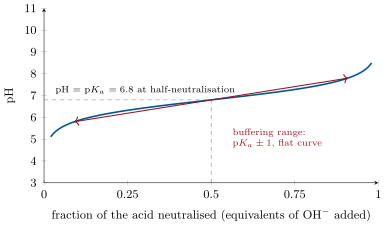
Titration of a weak acid (phosphate, pK_a 6.8) by a base. The curve is flat around the pK_a: there, adding base changes the ratio of base to acid but barely the pH. Outside the range the pH swings freely.
Titration of a weak acid (phosphate, pKaK_a 6.8) by a base. The curve is flat around the pKaK_a: there, adding base changes the ratio of base to acid but barely the pH. Outside the range the pH swings freely.
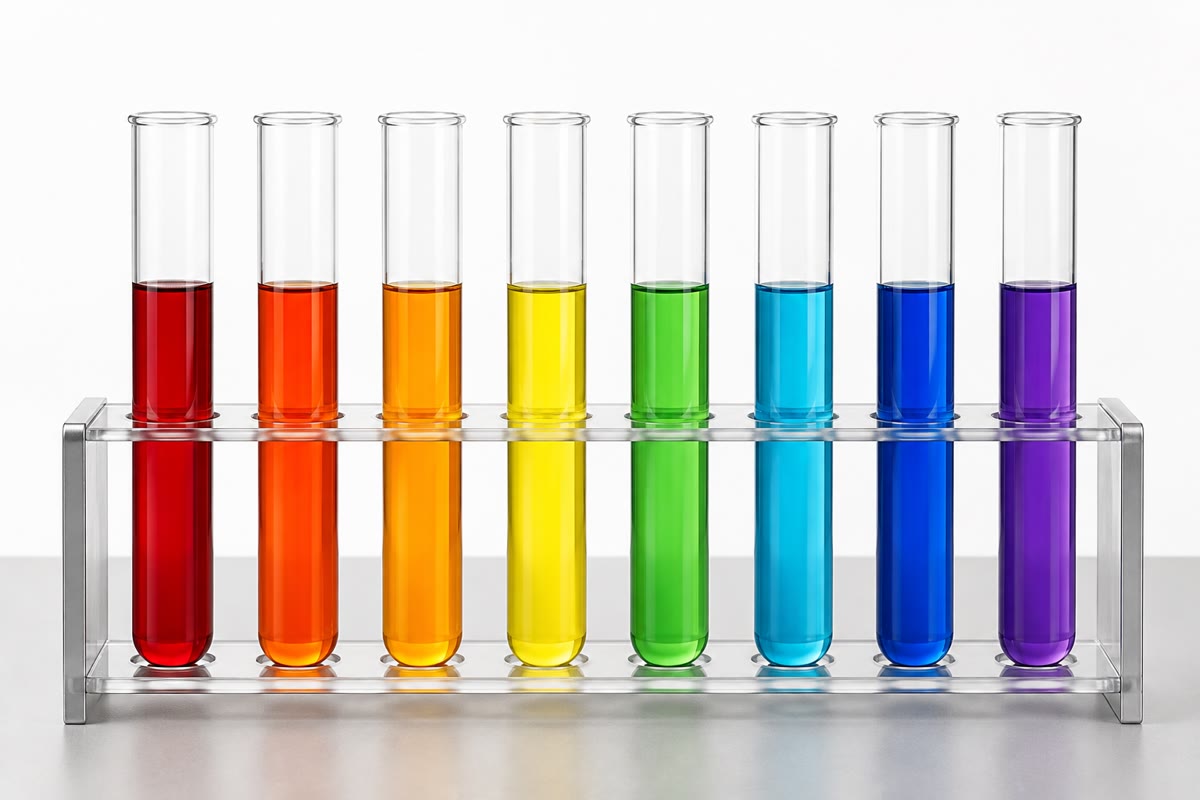
The pH scale made visible with a universal indicator: from red at pH 2 to violet at pH 12. Gastric juice is at 1–2, urine 5–8, blood 7.4, the small intestine 8, the cytosol 7.2, the lysosome 5, the thylakoid lumen in the light 5, the stroma 8.
Read in context →