
Biology · Glossary

What is Fluidity, phase transition?

Also known as: phase transition temperature · membrane fluidity

Definition 9.10 University Biology — Year 1 · Chapter 9 — Lipids

A lipid bilayer has a phase transition temperature TmT_m: below it the chains are packed in an ordered, gel-like state in which lipids barely move; above it they are disordered and the bilayer is a two-dimensional fluid in which a lipid changes places with its neighbour a million times a second and crosses the membrane’s plane at 1µm/s1\,\text{µ}\mathrm{m}/\mathrm{s}. Cells keep their membranes above TmT_m: the fluidity lets proteins diffuse and rotate, vesicles bud and fuse, and the bilayer reseal.
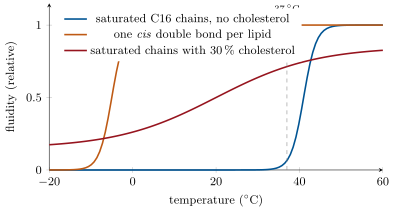
Fluidity against temperature for three bilayers. Saturated chains freeze sharply near 40\, C; one double bond per lipid lowers the transition below zero; cholesterol smooths the transition into a gentle slope, keeping the membrane neither solid nor too fluid across the physiological range.
Fluidity against temperature for three bilayers. Saturated chains freeze sharply near 40C40\,{}^{\circ}\mathrm{C}; one double bond per lipid lowers the transition below zero; cholesterol smooths the transition into a gentle slope, keeping the membrane neither solid nor too fluid across the physiological range.

Examples

Example 9.13 (Butter, olive oil, fish oil)

Butter (65%65\,\% saturated) is solid in the refrigerator and soft at room temperature; olive oil (75%75\,\% oleic acid) is liquid at room temperature and clouds in the refrigerator; fish oil, rich in omega-3 acids with five and six double bonds, stays liquid at 20C-20\,{}^{\circ}\mathrm{C}, which is what a cod’s membranes need in the North Atlantic.

Read in context →