 Coach
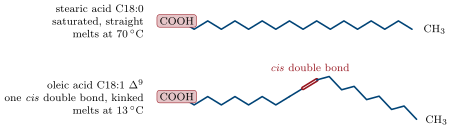
CoachLipids are the biological molecules defined not by a common structure but by a common property: they are insoluble in water and soluble in non-polar solvents. Most are built on fatty acids: carboxylic acids with an unbranched hydrocarbon chain of carbons, almost always an even number (they are assembled two carbons at a time, Chapter 16). A saturated fatty acid has only single bonds and a straight, flexible chain; an unsaturated one has one or more double bonds, in the cis configuration, each putting a rigid kink of about in the chain. Notation: C18:1 is an 18-carbon acid with one double bond after carbon 9 (oleic acid); an omega-3 acid has its last double bond three carbons from the methyl end.
Examples
Example 9.9 (Bile salts)
Dietary fat arrives in the intestine as oil; the lipase that digests it works only at the oil–water interface. Bile salts, amphiphilic derivatives of cholesterol, coat the fat into droplets a micrometre across, multiplying the interface a thousandfold, and then carry the fatty acids released, in micelles, to the absorbing cells (Chapter 22). The same trick is used by soap.