
সব বই

পেশাদার

1 Markets I: The Ecosystem and Exchange-Traded Marketsবাজার অনলাইন 2 Markets II: Rates, FX and Creditবাজার অনলাইন 3 Markets III: Commodities, Energy and Cryptoবাজার অনলাইন 4 Quantitative Methodsপদ্ধতি অনলাইন 5 Derivatives and Volatilityডেরিভেটিভস অনলাইন 6 Rates, Credit, XVA and Riskসুদহার, ঋণ ও ঝুঁকি অনলাইন 7 Research Craft: Predictors, Backtests, Measurement, Portfoliosগবেষণা অনলাইন 8 Strategies I: Equities and Futuresকৌশল অনলাইন 9 Strategies II: Volatility, Relative Value, Macro and the Bank Desksকৌশল অনলাইন 10 Microstructure and Executionএক্সিকিউশন অনলাইন 11 Market Making and High-Frequency Tradingমার্কেট মেকিং অনলাইন 12 Machine Learning for Marketsমেশিন লার্নিং অনলাইন 13 Low-Latency Softwareপ্রযুক্তি অনলাইন 14 Networks, Hardware and Trading Infrastructureপ্রযুক্তি অনলাইন 15 Research, Data and Risk Platformsপ্রযুক্তি অনলাইন 16 The Desk and the Firmপ্রতিষ্ঠান অনলাইন 17 The Industry: Firms, Roles and Careersক্যারিয়ার অনলাইন 18 Interviews I: Maths, Probability and Speedক্যারিয়ার অনলাইন 19 Interviews II: Markets, Trading Games and the Final Roundক্যারিয়ার অনলাইন 20 Interviews III: Codeক্যারিয়ার অনলাইন
অ্যাপ পরিচিতি Coach সাইন ইন পড়া শুরু করো

বইগুলো এখনো বাংলা ভাষায় পাওয়া যায় না — ইংরেজি সংস্করণ দেখানো হচ্ছে।

Biology · পরিভাষা

Hormone কী?

Definition 21.1 University Biology — Year 3 · অধ্যায় 21 — Endocrinology and Homeostasis

A hormone is a substance released by a cell into the blood that acts on distant cells carrying its receptor; a paracrine signal acts on neighbours, an autocrine one on the cell that made it, and a neurohormone is released by a neuron into the blood. The classical endocrine glands — pituitary, thyroid, parathyroids, adrenals, pancreatic islets, gonads — have been joined by the heart (natriuretic peptide), the kidney (erythropoietin), fat (leptin), the gut (a dozen peptides) and bone. Chemically hormones are of three kinds, and the chemistry fixes the mechanism. Peptide and protein hormones (insulin, growth hormone, the pituitary hormones) are made on ribosomes, stored in granules, released by exocytosis, travel free in plasma, cannot cross membranes, and act on receptors at the cell surface — G-protein-coupled or kinase-linked — through second messengers, within seconds to minutes; their half-lives are minutes. Steroids (cortisol, aldosterone, oestrogens, testosterone, and the secosteroid vitamin D) are made from cholesterol as needed, not stored, travel bound to carrier proteins, cross membranes, and bind nuclear receptors that are themselves transcription factors: their effects take hours and last days. Amines straddle the two: adrenaline acts at the surface within a second; the thyroid hormones, though amino-acid derivatives, act on nuclear receptors like steroids. A hormone means nothing in itself: the same adrenaline dilates one vessel and constricts another because their smooth muscles carry different receptor subtypes, and the same cortisol raises blood glucose in the liver and suppresses a lymphocyte because the two cells’ chromatin offers its receptor different genes.
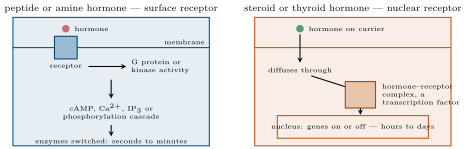
Two ways to hear a hormone. Water-soluble hormones stop at the surface and act through second messengers, fast and brief; lipid-soluble ones enter, bind a receptor that is a transcription factor, and change what the cell makes, slowly and for long.
প্রসঙ্গসহ পড়ো →