 Coach
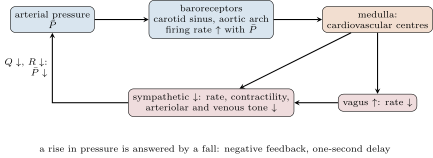
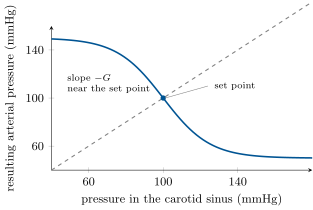
CoachStretch receptors in the walls of the carotid sinuses (at the fork of each carotid artery, below the jaw) and of the aortic arch — the baroreceptors — fire at a rate that rises with the pressure that distends them, faster for a rising pressure. Their nerves reach the cardiovascular centres of the medulla, which control the two branches of the autonomic outflow: the vagus, whose acetylcholine slows the sinoatrial node, and the sympathetic nerves, whose noradrenaline speeds the node, strengthens the ventricle, constricts the arterioles (raising ) and constricts the veins (squeezing stored blood toward the heart and raising the filling). A rise in pressure increases baroreceptor firing, which excites the vagus and inhibits the sympathetic outflow: the rate falls, the arterioles relax, the pressure comes down. A fall does the reverse. The loop is a negative feedback with a set point near , a delay of about a second, and a gain such that a disturbance is corrected to within a fifth of its size: it is the reason you do not faint on standing.
Examples
Example 18.6 (A haemorrhage)
A donor gives , a tenth of the blood. Within seconds the baroreflex constricts the arterioles and veins and quickens the heart: the pressure barely moves, the skin goes pale and cool (its arterioles closed), the pulse is faster. Within minutes the lowered capillary pressure lets interstitial fluid move into the vessels (the Starling balance of Chapter 16), restoring half the volume by the next hour; renin, angiotensin and antidiuretic hormone reduce the urine to a trickle, and thirst follows; over days the kidney retains salt and water and the plasma volume is back, and over weeks the marrow replaces the red cells. A loss of outruns all of this: the reflex is saturated, the pressure collapses, the underperfused tissues release lactate and the capillaries leak — shock, from which only transfusion returns the patient.
Example 18.9 (Standing up, fainting, and the astronaut)
On standing, of blood shifts into the leg veins, the venous return and the stroke volume fall by a third, and the pressure at the carotid sinus drops — the baroreflex answers within a beat with a faster heart and tighter vessels, and the pressure at the head is back within ten seconds. A soldier standing motionless on a hot parade ground loses the muscle pump, pools blood in dilated skin veins, and faints: lying flat cures him at once. An astronaut after months without gravity has lost a litre of blood volume (the kidney excreted what it read as excess when the blood pooled in the chest), and on landing the reflex, unpractised, cannot keep him upright. And the giraffe, whose head is two metres above its heart, runs a mean pressure of and wears compression stockings of skin — the hydrostatics of Chapter 16 set the requirements, and the reflexes of this chapter meet them.