
Biology · Glossary

What is The cell cycle?

Definition 18.6 University Biology — Year 1 · Chapter 18 — DNA Replication and Mitosis

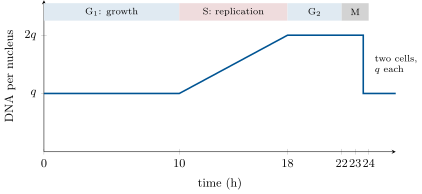
The cell cycle of a eukaryotic cell has four phases. G1_1 (gap 1): the cell grows and makes the enzymes of replication; S (synthesis): it replicates its DNA, so that each chromosome becomes two identical sister chromatids joined at the centromere; G2_2: it grows further and checks the copies; M: mitosis, the division of the nucleus, followed by cytokinesis, the division of the cytoplasm. G1_1, S and G2_2 together are interphase, in which the chromosomes are extended and active; a cell that stops dividing leaves the cycle from G1_1 into a resting state, G0_0. A dividing human cell takes about 24h24\,\mathrm{h}: G1_1 10h10\,\mathrm{h}, S 8h8\,\mathrm{h}, G2_2 4h4\,\mathrm{h}, M 1h1\,\mathrm{h}; a yeast, 90min90\,\mathrm{min}; an early frog embryo, thirty minutes with no gaps at all.
The DNA content of a nucleus through one cell cycle of 24\, h. It doubles during S phase, from q (2n chromosomes of one chromatid) to 2q (2n chromosomes of two chromatids), and returns to q in each daughter at the end of mitosis; the number of chromosomes never changes.
The DNA content of a nucleus through one cell cycle of 24h24\,\mathrm{h}. It doubles during S phase, from qq (2n chromosomes of one chromatid) to 2q2q (2n chromosomes of two chromatids), and returns to qq in each daughter at the end of mitosis; the number of chromosomes never changes.
Read in context →