 Coach
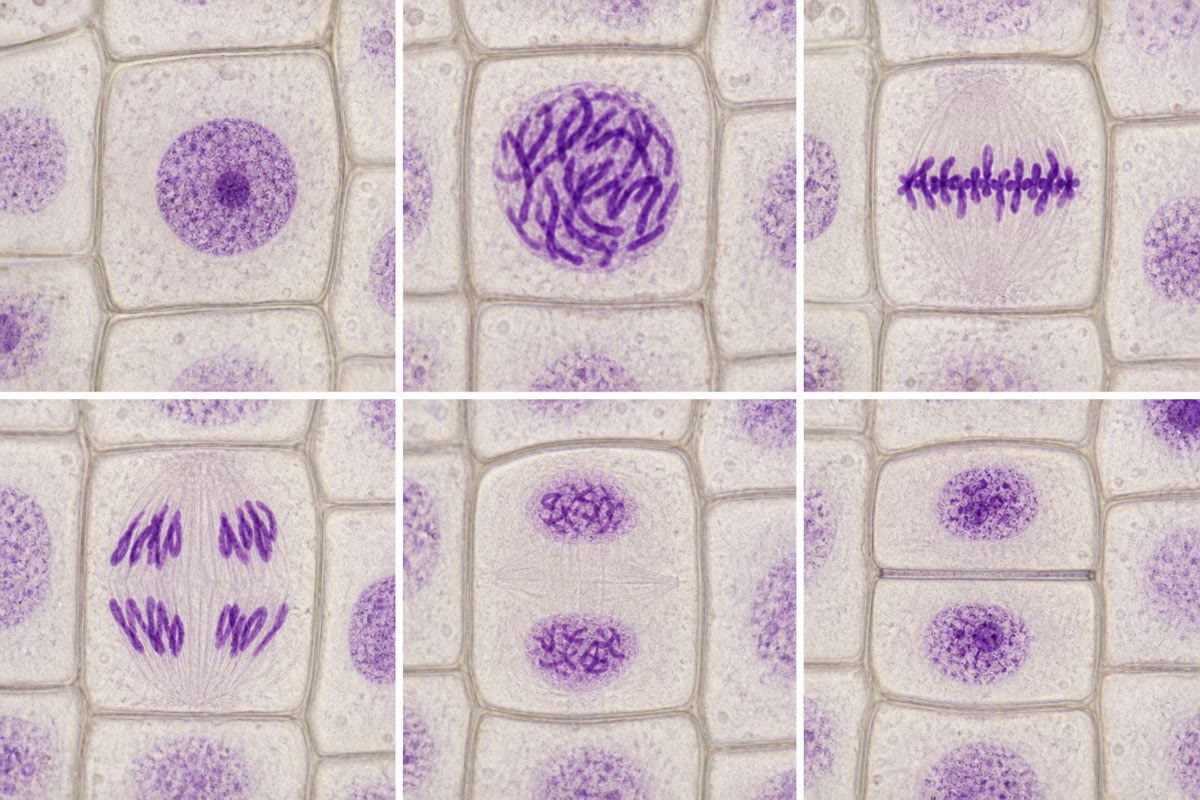
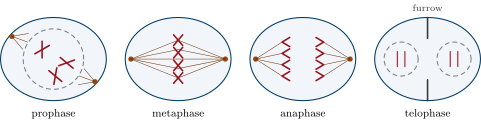
CoachMitosis distributes the replicated chromosomes so that each daughter nucleus receives one chromatid of every chromosome — the same number and the same genes as the parent. Its stages:
- prophase: the chromosomes condense into visible rods, each of two sister chromatids held together along their length by cohesin proteins; the two centrosomes move apart and the mitotic spindle of microtubules grows between them;
- prometaphase: the nuclear envelope breaks down; spindle microtubules attach to each chromatid’s kinetochore, a protein structure at the centromere, from opposite poles;
- metaphase: the chromosomes are aligned at the equator of the spindle, each under tension from both poles;
- anaphase: the cohesin is cut, the sister chromatids separate and are pulled to opposite poles as the microtubules shorten (anaphase A) and the poles move apart (anaphase B);
- telophase: the chromosomes decondense, and a nuclear envelope re-forms around each set.
Cytokinesis then divides the cytoplasm: in animal cells a contractile ring of actin and myosin pinches the cell in two; in plant cells vesicles from the Golgi fuse at the equator into a cell plate that grows outward into a new wall.
Examples
Example 18.11 (Turnover)
The epithelium of the small intestine is renewed every four days, the skin every month, the red cells every four months from the marrow, which produces two million a second; a liver cell divides once a year or so and a neuron never. A tumour’s cells have lost the checkpoints: they divide when they should not, tolerate mis-segregated chromosomes, and accumulate the mutations that let them divide faster still. Chemotherapy exploits the difference: drugs that poison the spindle or the polymerase kill the cells that divide most.