Coach
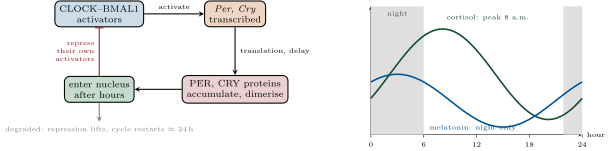
CoachNearly every cell carries a circadian clock: a transcription–translation loop in which the proteins CLOCK and BMAL1 switch on the genes Per and Cry, whose proteins accumulate, enter the nucleus after a delay of hours and repress their own transcription, then are degraded, releasing the repression — one cycle in about twenty-four hours, set by the rates of the delay and degradation. The clocks of the body are synchronised by a master clock of twenty thousand neurons in the suprachiasmatic nucleus of the hypothalamus, which is itself set by light through a dedicated class of retinal ganglion cells (containing melanopsin, not the rods’ or cones’ pigments), and which signals night to the body through the pineal’s melatonin, secreted only in darkness. The clock schedules cortisol before waking, body temperature lowest at 4 a.m., growth hormone in the first sleep, insulin sensitivity higher in the morning; food, exercise and temperature are secondary zeitgebers that can pull the peripheral clocks away from the central one, which is the malaise of the shift worker and of jet lag — a liver clock on one time and a brain on another.