
সব বই

পেশাদার

1 Markets I: The Ecosystem and Exchange-Traded Marketsবাজার অনলাইন 2 Markets II: Rates, FX and Creditবাজার অনলাইন 3 Markets III: Commodities, Energy and Cryptoবাজার অনলাইন 4 Quantitative Methodsপদ্ধতি অনলাইন 5 Derivatives and Volatilityডেরিভেটিভস অনলাইন 6 Rates, Credit, XVA and Riskসুদহার, ঋণ ও ঝুঁকি অনলাইন 7 Research Craft: Predictors, Backtests, Measurement, Portfoliosগবেষণা অনলাইন 8 Strategies I: Equities and Futuresকৌশল অনলাইন 9 Strategies II: Volatility, Relative Value, Macro and the Bank Desksকৌশল অনলাইন 10 Microstructure and Executionএক্সিকিউশন অনলাইন 11 Market Making and High-Frequency Tradingমার্কেট মেকিং অনলাইন 12 Machine Learning for Marketsমেশিন লার্নিং অনলাইন 13 Low-Latency Softwareপ্রযুক্তি অনলাইন 14 Networks, Hardware and Trading Infrastructureপ্রযুক্তি অনলাইন 15 Research, Data and Risk Platformsপ্রযুক্তি অনলাইন 16 The Desk and the Firmপ্রতিষ্ঠান অনলাইন 17 The Industry: Firms, Roles and Careersক্যারিয়ার অনলাইন 18 Interviews I: Maths, Probability and Speedক্যারিয়ার অনলাইন 19 Interviews II: Markets, Trading Games and the Final Roundক্যারিয়ার অনলাইন 20 Interviews III: Codeক্যারিয়ার অনলাইন
অ্যাপ পরিচিতি Coach সাইন ইন পড়া শুরু করো

বইগুলো এখনো বাংলা ভাষায় পাওয়া যায় না — ইংরেজি সংস্করণ দেখানো হচ্ছে।

Biology · পরিভাষা

The Krebs cycle কী?

Definition 15.6 University Biology — Year 1 · অধ্যায় 15 — Cellular Respiration and Fermentation

The Krebs cycle (citric acid cycle) in the mitochondrial matrix condenses acetyl-CoA (C2) with oxaloacetate (C4) into citrate (C6) and, in eight steps, oxidises the two carbons to CO2\mathrm{CO_2} while regenerating oxaloacetate. Per acetyl group: 3 NADH, 1 FADH2\mathrm{FADH_2}, 1 GTP (by substrate-level phosphorylation) and 2 CO2\mathrm{CO_2}. Per glucose (two acetyls): 6 NADH, 2 FADH2\mathrm{FADH_2}, 2 GTP, 4 CO2\mathrm{CO_2} — which with the 2 CO2\mathrm{CO_2} of pyruvate dehydrogenase makes the six of the overall equation. No oxygen is consumed in the cycle itself; it runs only as long as the respiratory chain re-oxidises its NADH. It is also amphibolic: its intermediates are drawn off for biosynthesis (Chapter 16) and replenished from amino acids and pyruvate.
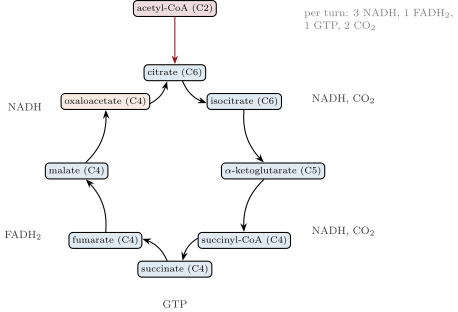
The Krebs cycle. An acetyl group enters by condensing with oxaloacetate; two carbons leave as CO_2 at the two decarboxylations; the four oxidations load three NADH and one FADH_2; oxaloacetate is regenerated for the next turn.
The Krebs cycle. An acetyl group enters by condensing with oxaloacetate; two carbons leave as CO2\mathrm{CO_2} at the two decarboxylations; the four oxidations load three NADH and one FADH2\mathrm{FADH_2}; oxaloacetate is regenerated for the next turn.
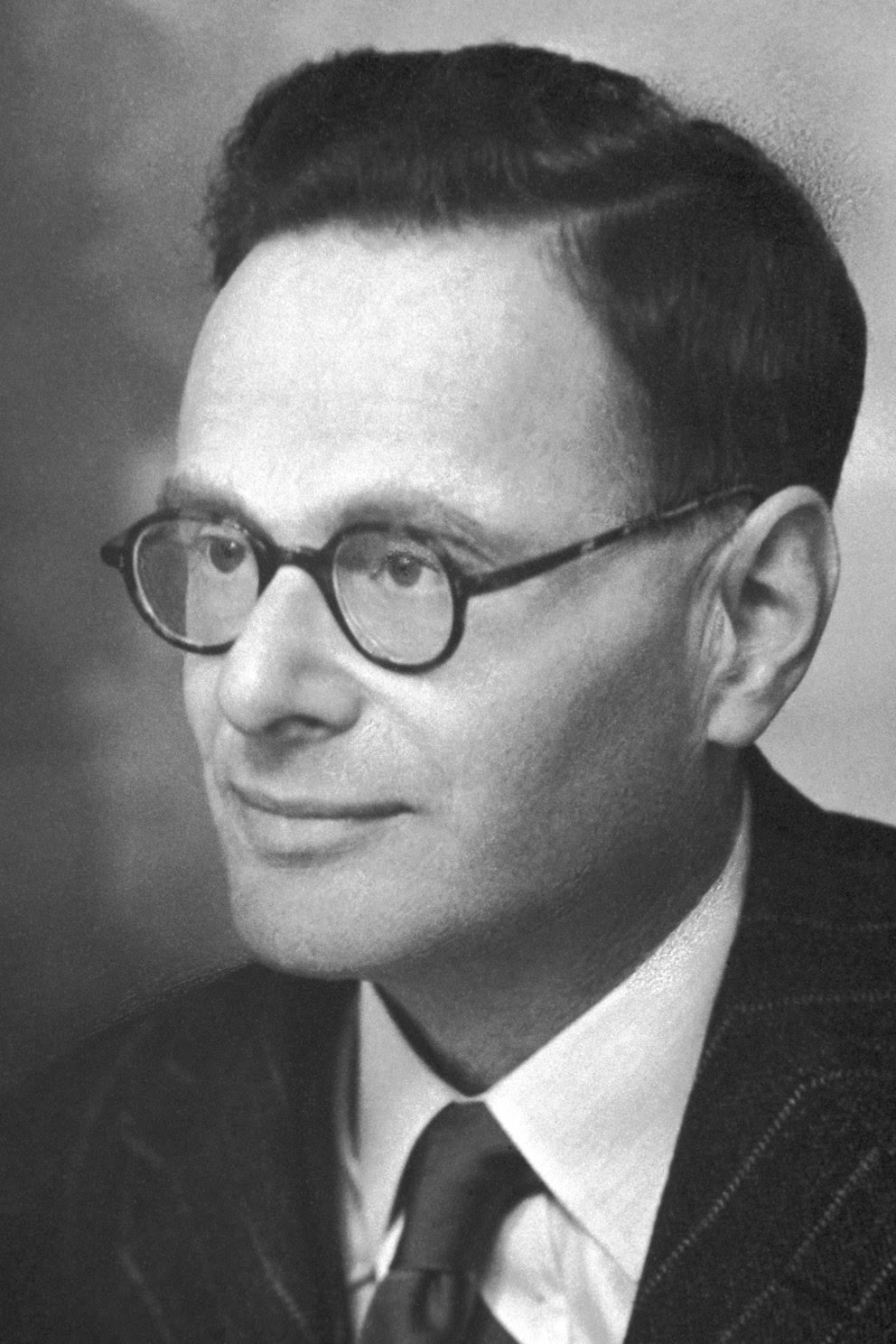
Hans Krebs (1900–1981), who worked out the cycle in 1937 from the rates at which minced pigeon muscle oxidised its acids. Photograph: Nobel Foundation, public domain.

উদাহরণ

Example 15.7 (Following the carbons)

Feed a cell glucose labelled with 14C\mathrm{^{14}C} on carbon 1: the label appears in the methyl carbon of pyruvate, then of acetyl-CoA, enters citrate, and leaves as CO2\mathrm{CO_2} only on the second or third turn of the cycle — the two carbons released in a given turn belong to the oxaloacetate of the previous one. Krebs (1937) deduced the cycle from the observation that catalytic amounts of any of its acids stimulated the oxidation of far more pyruvate than they could account for themselves: they were being regenerated.

প্রসঙ্গসহ পড়ো →