
সব বই

পেশাদার

1 Markets I: The Ecosystem and Exchange-Traded Marketsবাজার অনলাইন 2 Markets II: Rates, FX and Creditবাজার অনলাইন 3 Markets III: Commodities, Energy and Cryptoবাজার অনলাইন 4 Quantitative Methodsপদ্ধতি অনলাইন 5 Derivatives and Volatilityডেরিভেটিভস অনলাইন 6 Rates, Credit, XVA and Riskসুদহার, ঋণ ও ঝুঁকি অনলাইন 7 Research Craft: Predictors, Backtests, Measurement, Portfoliosগবেষণা অনলাইন 8 Strategies I: Equities and Futuresকৌশল অনলাইন 9 Strategies II: Volatility, Relative Value, Macro and the Bank Desksকৌশল অনলাইন 10 Microstructure and Executionএক্সিকিউশন অনলাইন 11 Market Making and High-Frequency Tradingমার্কেট মেকিং অনলাইন 12 Machine Learning for Marketsমেশিন লার্নিং অনলাইন 13 Low-Latency Softwareপ্রযুক্তি অনলাইন 14 Networks, Hardware and Trading Infrastructureপ্রযুক্তি অনলাইন 15 Research, Data and Risk Platformsপ্রযুক্তি অনলাইন 16 The Desk and the Firmপ্রতিষ্ঠান অনলাইন 17 The Industry: Firms, Roles and Careersক্যারিয়ার অনলাইন 18 Interviews I: Maths, Probability and Speedক্যারিয়ার অনলাইন 19 Interviews II: Markets, Trading Games and the Final Roundক্যারিয়ার অনলাইন 20 Interviews III: Codeক্যারিয়ার অনলাইন
অ্যাপ পরিচিতি Coach সাইন ইন পড়া শুরু করো

বইগুলো এখনো বাংলা ভাষায় পাওয়া যায় না — ইংরেজি সংস্করণ দেখানো হচ্ছে।

Chemistry · পরিভাষা

Functional-group interconversion কী?

Definition 28.3 University Chemistry — Year 2 · অধ্যায় 28 — Retrosynthesis and Multistep Strategy

A functional-group interconversion (FGI) is a retrosynthetic step that changes a functional group without changing the carbon skeleton: an alcohol from a ketone (by reduction), an alkane chain from an alkene (by hydrogenation), an amine from an amide.
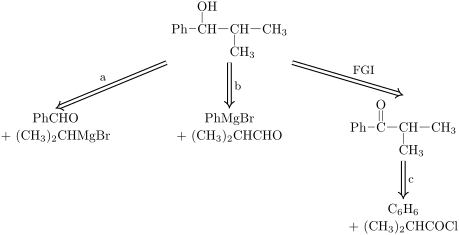
A retrosynthetic tree for 2-methyl-1-phenylpropan-1-ol. (a) and (b): the two disconnections of the C-C bond next to the alcohol carbon, each an aldehyde and a Grignard reagent. FGI: the alcohol from a ketone, by reduction; (c) the ketone by Friedel–Crafts acylation of benzene. Every arrow reads “is made from”.
A retrosynthetic tree for 2-methyl-1-phenylpropan-1-ol. (a) and (b): the two disconnections of the C−C\ce{C-C} bond next to the alcohol carbon, each an aldehyde and a Grignard reagent. FGI: the alcohol from a ketone, by reduction; (c) the ketone by Friedel–Crafts acylation of benzene. Every arrow reads “is made from”.
SynthonKindSynthetic equivalent
RX−\ce{R-} (alkyl, aryl)donorRMgBr\ce{RMgBr}, RLi\ce{RLi}, RX2CuLi\ce{R2CuLi} (conjugate)
−CH2COR\mathrm{^-CH_2COR}donorthe enolate of CHX3COR\ce{CH3COR}, or ethyl 3-oxobutanoate
−C≡N\mathrm{^-C{\equiv}N}donorNaCN\ce{NaCN}
RC+H−OH\mathrm{R\overset{+}{C}H{-}OH}acceptorthe aldehyde RCHO\ce{RCHO}
RC+=O\mathrm{R\overset{+}{C}{=}O}acceptorthe acyl chloride RCOCl\ce{RCOCl}, an ester
RX+\ce{R+} (primary)acceptorthe halide RBr\ce{RBr} (bimolecular substitution)
+CH2CH2COR\mathrm{^+CH_2CH_2COR}acceptorthe enone CHX2=CHCOR\ce{CH2=CHCOR} (conjugate addition)
Common synthons and their synthetic equivalents. The donor synthons are carbanions, the acceptor synthons carbocations; the real reagents carry the same polarity without the full charge.
প্রসঙ্গসহ পড়ো →