University Chemistry — Year 2 · Bachelor Year 2
28Retrosynthesis and Multistep Strategy
A molecule is drawn on the board, and nobody yet knows how to make it. Trying reactions forwards, from whatever is on the shelf, leads nowhere: there are too many. The chemist works the other way, from the target back towards the shelf, cutting one bond at a time on paper, each cut undoing a reaction that is known to work, until the pieces are compounds that can be bought. This chapter turns the reactions of the previous chapters into that backwards reasoning, and then asks how to judge the route it produces.
You already know
Chapter 21 to Chapter 27: the reactions to be undone. The Year 1 volume: protecting groups and acetals, Grignard reagents and polarity inversion, the Williamson synthesis, chemoselectivity, the oxidation of alcohols. The school volume: atom economy.
28.1 Thinking backwards
Definition 28.1 (Retrosynthetic analysis)
The molecule to be made is the target molecule. Retrosynthetic analysis works from the target back to available starting materials, by steps each of which is the reverse of a known reaction; a retrosynthetic step is written with the double arrow , read “is made from”.
Definition 28.2 (Disconnection and synthons)
A disconnection is the imaginary cutting of a bond of the target, the reverse of a bond-forming reaction. Cutting a bond heterolytically gives two synthons, idealised charged fragments, one a donor (nucleophilic, often negative), the other an acceptor (electrophilic, often positive). A synthetic equivalent is a real reagent that behaves as a synthon: a Grignard reagent for the carbanion , an aldehyde for the cation .
Definition 28.3 (Functional-group interconversion)
A functional-group interconversion (FGI) is a retrosynthetic step that changes a functional group without changing the carbon skeleton: an alcohol from a ketone (by reduction), an alkane chain from an alkene (by hydrogenation), an amine from an amide.
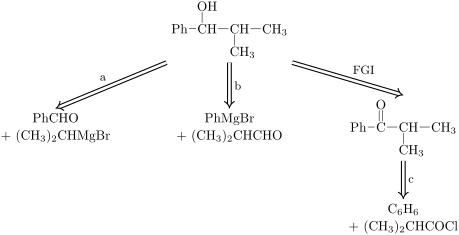
The tree shows the habits of the method. A disconnection is chosen at a bond next to a functional group, because that is where reactions make bonds. Each cut is checked by writing the synthons and finding real reagents for them. And there is rarely one answer: the tree branches, and the branches are judged at the end (Section 28.5).
| Synthon | Kind | Synthetic equivalent |
|---|---|---|
| (alkyl, aryl) | donor | , , (conjugate) |
| donor | the enolate of , or ethyl 3-oxobutanoate | |
| donor | ||
| acceptor | the aldehyde | |
| acceptor | the acyl chloride , an ester | |
| (primary) | acceptor | the halide (bimolecular substitution) |
| acceptor | the enone (conjugate addition) |
28.2 One-group disconnections
A one-group disconnection cuts a bond next to a single functional group. For a or bond of an ether, ester or amine, the cut goes between carbon and the heteroatom: the heteroatom is the donor, the carbon the acceptor (a Williamson synthesis, an esterification, an amide formation). For a bond, the functional group fixes the polarity of the synthons: next to an alcohol carbon, the alcohol carbon is the acceptor (an aldehyde or ketone) and the other carbon the donor (an organometallic); next to a carbonyl, the carbon is the donor (an enolate).
Most of these reactions need the right oxidation level at the right place, so FGIs between oxidation levels are the commonest steps of a route: alkene, alcohol, aldehyde or ketone, acid. One of them was left open in the Year 1 volume: stopping the oxidation of a primary alcohol at the aldehyde.
Proposition 28.4 (Mild oxidations)
A primary alcohol is oxidised to the aldehyde, without going on to the acid, by an oxidant used in an anhydrous organic solvent: pyridinium chlorochromate in dichloromethane, the Swern oxidation (dimethyl sulfoxide activated by oxalyl chloride, then triethylamine, at low temperature) or the Dess–Martin periodinane. In water, chromium(VI) or permanganate oxidise it to the carboxylic acid.
Argument. These oxidants remove the hydrogen of the bond on the carbon bearing an . The aldehyde formed has no such group. In water, however, an aldehyde is in equilibrium with its hydrate , which again has an on a carbon carrying a hydrogen: the hydrate is oxidised like an alcohol, to the acid. Without water no hydrate forms, and the oxidation stops at the aldehyde. ∎
28.3 Two-group disconnections
When the target has two functional groups, the best disconnection usually uses both: the bond is cut so that one group directs the donor and the other the acceptor. The distance between the groups, counted in carbons from one functionalised carbon to the other inclusive, tells which reaction to use.
Proposition 28.5 (Patterns and their reactions)
The relationships between two groups map onto the reactions of the previous chapters as follows. The odd relationships (1,3 and 1,5) match the natural polarities of carbonyl chemistry; the even ones (1,4 and 1,6) do not, and need polarity inversion or the cleavage of a ring.
Argument. In carbonyl chemistry the carbonyl carbon is an acceptor and the carbon a donor, and an enone adds an acceptor at its carbon. An enolate (donor at ) on a carbonyl (acceptor at the carbonyl carbon) joins carbons 1 and 2 of a 1,3 pattern: aldol and Claisen. An enolate on the carbon of an enone builds a 1,5 pattern: Michael, then Robinson. For a 1,4 pattern, the cut leaves an carbon as acceptor; no ordinary carbonyl reagent offers that polarity, but an -bromo ketone does, since bromide is a leaving group at that carbon. A 1,6 dicarbonyl is a cyclohexene opened by ozonolysis (Proposition 21.12), and the cyclohexene is made by a Diels–Alder reaction (Definition 17.10). ∎
| Pattern in the target | Disconnection | Reaction |
|---|---|---|
| -hydroxy carbonyl (1,3) | – bond | aldol addition |
| -unsaturated carbonyl | aldol condensation | |
| 1,3-dicarbonyl | C(O)–C | Claisen condensation |
| 1,5-dicarbonyl | C–C of the acceptor | Michael addition |
| cyclohex-2-en-1-one | ring , then Michael bond | Robinson annulation |
| cyclohexene | two ring bonds | Diels–Alder reaction |
| alkene at a defined place | Wittig or HWE reaction | |
| 1,4-dicarbonyl | central | enolate + -halo ketone |
| 1,6-dicarbonyl | reconnect the ends | oxidative cleavage of a cyclohexene |
Method 28.6 (A retrosynthetic analysis)
- List the functional groups of the target and their relationships (1,2; 1,3; …).
- Consider FGIs that would give a pattern with a good disconnection (an alcohol from a ketone, an alkane chain from an alkene).
- Choose strategic bonds: next to a functional group, near the middle of the molecule, at a branch point or joining a ring to a chain, so that the pieces are of similar size.
- Write the synthons, then their synthetic equivalents; reject a cut with no real reagent.
- Check chemoselectivity: which other group would react with each reagent? Plan a protection or change the order of the steps.
- Repeat on each piece until all are available; then write the route forwards, with reagents and conditions.
28.4 Protecting groups in a route
A route often needs a reagent that would attack a second group of the molecule. The Year 1 volume protected aldehydes and ketones as acetals. A route chooses among several protecting groups, each removed by its own conditions: acetals (removed by aqueous acid), silyl ethers of alcohols (removed by fluoride ion), benzyl ethers (removed by hydrogenolysis over palladium), carbamates of amines such as the tert-butoxycarbonyl group (removed by acid), and esters (removed by base).
Definition 28.7 (Orthogonal protection)
A set of orthogonal protecting groups is a set of protecting groups each removable by conditions that leave all the others intact, so that the functions they mask can be released one at a time, in any order.
Method 28.8 (Protecting in a route)
- For each step, list the groups the reagent would attack besides the intended one.
- First try to avoid protection: change the order of the steps, or use a more selective reagent (a borohydride instead of a hydride for a ketone beside an ester).
- Otherwise choose a group stable in every step until its removal, and removable in conditions the molecule tolerates.
- With several groups to release separately, choose an orthogonal set.
- Look for a step that removes a group for free: a hydrogenation planned anyway also removes a benzyl ether.
- Count: each protection costs two steps and their yields.
28.5 Judging a route
Proposition 28.9 (Overall yield)
The overall yield of a linear sequence of steps is the product of the step yields: . With steps of equal yield , .
Proof. Step converts the amount of its starting material into of product (yields taken on amounts of the intermediate, all other reagents in sufficient quantity). By induction, , and the overall yield is the product. ∎
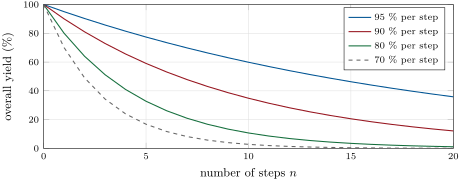
The product rule is why short routes win, why a protection (two extra steps) is never free, and why chemists prefer to build two halves separately and join them late: the long route then runs in two shorter branches, and the losses of one branch do not multiply those of the other. Besides yield and length, a route is judged on selectivity (each step should give one product), on the cost and hazard of its reagents, on the waste it produces (the atom economy of each step and the solvents of the purifications), and on how easily each step scales up.
History — Working backwards, made explicit
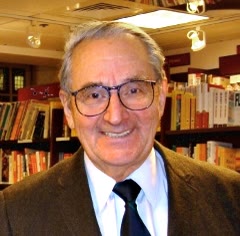
Chemists had always reasoned backwards from their targets, but Elias James Corey, from the 1960s, turned the habit into explicit rules: the disconnection, the synthon, the retrosynthetic arrow, and even computer programs that applied them. He received the 1990 Nobel Prize in Chemistry for the theory and methodology of organic synthesis. (Photograph: by Trvthchem, CC0, Wikimedia Commons.)
Safety


Oxalyl chloride is corrosive, toxic and reacts with water, releasing hydrogen chloride; the Swern oxidation releases carbon monoxide and foul-smelling dimethyl sulfide, so it is run in a fume hood. The Dess–Martin periodinane is an oxidiser and must not be heated. Chromium(VI) reagents are now avoided where an alternative exists.
28.6 Exercises
Exercise 28.1 ★
Disconnect each alcohol into a carbonyl compound and a Grignard reagent (give every possibility): 2-phenylpropan-2-ol, pentan-3-ol, 1-cyclohexylethanol, 2-methylbutan-2-ol, 1-phenylethanol.
Solution
Solution of Exercise 28.1.
- 2-Phenylpropan-2-ol: propanone + , or acetophenone + .
- Pentan-3-ol: propanal + .
- 1-Cyclohexylethanol: ethanal + cyclohexylmagnesium bromide, or cyclohexanecarbaldehyde + .
- 2-Methylbutan-2-ol: propanone + , or butanone + .
- 1-Phenylethanol: benzaldehyde + , or ethanal + .
Exercise 28.2 ★
For the disconnection of 1-phenylethanol at the bond, name the two synthons, say which is the donor, and give a synthetic equivalent for each.
Exercise 28.3 ★
A five-step route has step yields of 90, 85, 80, 95 and 70 %. Compute its overall yield.
Solution
Solution of Exercise 28.3.
: about 41 %.
Exercise 28.4 ★
Ethyl 4-oxopentanoate must be turned into 5-hydroxypentan-2-one. Plan the route with a protecting group, and say why it is needed.
Solution
Solution of Exercise 28.4.
, needed to reduce the ester to the alcohol, would also reduce the ketone. Protect the ketone as its cyclic acetal (ethane-1,2-diol, acid catalyst, water removed); reduce the ester with ; remove the acetal with dilute aqueous acid: 5-hydroxypentan-2-one.
Exercise 28.5 ★★
Propose a retrosynthesis of butane-1,3-diol from compounds with at most two carbons, with an FGI and a two-group disconnection.
Solution
Solution of Exercise 28.5.
FGI: butane-1,3-diol 3-hydroxybutanal (reduction of the aldehyde, ). Two-group disconnection of this -hydroxy aldehyde at the – bond: two molecules of ethanal (aldol). Forward: ethanal, dilute base, cold; then .
Exercise 28.6 ★★
Disconnect 1-(cyclohex-3-en-1-yl)ethan-1-one by a Diels–Alder reaction.
Solution
Solution of Exercise 28.6.
The cyclohexene ring is cut at the two bonds made in a Diels–Alder reaction, those allylic to the ring double bond on the side of the substituent: buta-1,3-diene and but-3-en-2-one, the acetyl group on the dienophile.
Exercise 28.7 ★★
Disconnect 4,4-dimethylcyclohex-2-en-1-one by a Robinson annulation.
Solution
Solution of Exercise 28.7.
Numbering C1 (), C2=C3, then C4 with the two methyls (Method 26.11): the aldol cut C2–C3 leaves an aldehyde at C3 and a methyl ketone; the Michael cut C4–C5 leaves 2-methylpropanal (C3 its carbonyl, C4 its carbon) and but-3-en-2-one.
Exercise 28.8 ★★
1-Phenylbutan-1-one can be made in one step by a Friedel–Crafts acylation, or in two from benzaldehyde. Write both routes and compare them.
Solution
Solution of Exercise 28.8.
One step: benzene with butanoyl chloride and (Friedel–Crafts acylation, no rearrangement, single acylation). Two steps: benzaldehyde with propylmagnesium bromide, then oxidation of the secondary alcohol. The Friedel–Crafts route is shorter and its reagents cheaper, but uses a full equivalent of aluminium chloride, which ends in the aqueous waste.
Exercise 28.9 ★★
Hexanal is wanted from hexan-1-ol. Which reagents give it, and which one would give hexanoic acid instead? Explain.
Solution
Solution of Exercise 28.9.
Pyridinium chlorochromate in dichloromethane, the Swern oxidation or the Dess–Martin periodinane give hexanal; acidified aqueous dichromate or permanganate give hexanoic acid, because in water the aldehyde forms its hydrate, which is oxidised again (Proposition 28.4).
Exercise 28.10 ★★★
In 4-aminobutan-1-ol, the amine must react first with an acyl chloride in one step, and the alcohol later with another. Propose an orthogonal pair of protecting groups and the sequence.
Solution
Solution of Exercise 28.10.
The amine reacts first, unprotected, if the alcohol is protected: protect the alcohol as a silyl ether (it survives the acylation); acylate the amine; remove the silyl group with fluoride; acylate the alcohol. If the amine had to be kept free while the alcohol reacts, it would be protected as a tert-butoxycarbonyl carbamate (removed by acid), orthogonal to the silyl ether (removed by fluoride): either can be released without touching the other.
Exercise 28.11 ★★★
Propose a synthesis of hexane-2,5-dione, a 1,4-dicarbonyl compound, from ethyl 3-oxobutanoate.
Solution
Solution of Exercise 28.11.
is a 1,4-dicarbonyl: cut the central bond. The donor is the enolate of ethyl 3-oxobutanoate (sodium ethoxide); the acceptor, an carbon of a ketone, is provided by 1-bromopropan-2-one, (bimolecular substitution of bromide). Then aqueous hydrolysis of the ester and heating remove : hexane-2,5-dione.
Exercise 28.12 ★★★
6-Methylhept-5-en-2-one, , is a fragrance intermediate. Propose a full plan from ethyl 3-oxobutanoate and a halide: retrosynthesis, forward route, and the step that removes the ester.
Solution
Solution of Exercise 28.12.
Retrosynthesis: the methyl ketone with a next to it is the product of the acetoacetic ester synthesis; cut the bond between C3 and C4: the enolate of ethyl 3-oxobutanoate and the allylic halide 1-bromo-3-methylbut-2-ene, . Forward: sodium ethoxide in ethanol, then the halide; then aqueous base, acidification and heating, which hydrolyse the ester and remove (Proposition 25.8): 6-methylhept-5-en-2-one.
28.7 Problem: Raspberry Ketone
Problem 28.1
Weekend problem — the retrosynthesis of a flavour compound, the phenol and whether to protect it, a palladium alternative, and the judgement of the routes
Raspberry ketone, 4-(4-hydroxyphenyl)butan-2-one, is found in raspberries and other fruits and is used as a flavouring and in perfumery. Exercise data: step yields of the aldol route, 85 % (condensation) and 92 % (hydrogenation). Molar masses (): C 12.011, H 1.008, O 15.999, N 14.007, I 126.90. The of phenol is 9.99.
Part I — Retrosynthesis.
- Draw the target and name its functional groups.
- Which FGI turns the unit into a pattern with a known disconnection?
- Write the unsaturated ketone obtained, with its geometry.
- Which two-group pattern does it contain, and which reaction makes it?
- Name the two starting materials.
- Why does this crossed aldol give one main product?
- Write the forward route in two steps, with conditions.
Part II — The phenol.
- In aqueous sodium hydroxide, in which form is 4-hydroxybenzaldehyde present? Use the .
- How does that form change the electrophilicity of the aldehyde?
- If the phenol were protected, which group would the second step remove for free? Explain.
- Count the steps of the route with that protection.
- Is the benzene ring at risk in the hydrogenation?
- Protect or not? Conclude.
Part III — A palladium alternative.
- Disconnect the unsaturated ketone at the bond between the ring and the chain: which Heck partners?
- Write the Heck reaction with triethylamine as base.
- At which carbon of but-3-en-2-one does the aryl group end up, and why?
- Name the steps of the catalytic cycle.
- Compute the atom economy of the Heck step, counting triethylamine.
- Compute the atom economy of the aldol condensation.
Part IV — Judging the routes.
- What is the atom economy of the hydrogenation?
- Compute the overall atom economy of the aldol route.
- Which double bond does the hydrogenation reduce, and why does the ketone survive?
- Compare the reagents of the two routes for cost and hazard.
- Which route would you choose?
- What would a third step at 90 % do to the overall yield?
- State the overall yield of the two-step aldol route.
Solution
Solution of Problem 28.1.
1. , the para to the chain: a phenol and a ketone. 2. Hydrogenation of a : , an -unsaturated ketone. 3. (E)-4-(4-hydroxyphenyl)but-3-en-2-one, . 4. An -unsaturated carbonyl: an aldol condensation, cut at the . 5. 4-Hydroxybenzaldehyde and propanone. 6. The aldehyde has no hydrogen and can only be the electrophile; propanone, in excess, is the only enolate source and reacts with the more reactive aldehyde rather than with itself. 7. (1) 4-hydroxybenzaldehyde, excess propanone, aqueous sodium hydroxide; acidification. (2) over palladium on carbon, at room temperature, until one equivalent is taken up. 8. The group stabilises the phenoxide, so the phenol is at least as acidic as phenol ( 9.99). At , : the phenoxide. 9. The pushes electron density through the ring onto the carbonyl carbon (a resonance donor para to it): the aldehyde is less electrophilic, and the condensation slower. 10. A benzyl ether: the hydrogenation over palladium that reduces the also cleaves the benzyl ether (hydrogenolysis), releasing the phenol in the same step. 11. Three: benzylation, aldol condensation, hydrogenation with deprotection. 12. No: under mild conditions (room temperature, palladium) the aromatic ring is not reduced. 13. Not protecting: the phenoxide only slows the condensation, which a longer time or warming compensate; one step saved is worth more than the gain in rate. 14. 4-Iodophenol and but-3-en-2-one. 15. , palladium catalyst. 16. At the terminal , the carbon: the aryl group inserts at the less hindered end, and -hydride elimination then gives the conjugated (E)-enone. 17. Oxidative addition of the aryl iodide to , coordination and insertion of the alkene, -hydride elimination, and regeneration of by the base, which takes (Chapter 20). 18. . 19. : . 20. 100 %: every atom of and of the enone ends in the product. 21. . 22. The : conjugated and unhindered, it binds and is hydrogenated on palladium far faster than the ketone ; stopping after one equivalent of hydrogen keeps the ketone. 23. Aldol route: cheap aldehyde, propanone and sodium hydroxide, water as by-product. Heck route: an aryl iodide, a palladium catalyst, and but-3-en-2-one, very toxic. 24. The aldol route: two steps, cheap and safer reagents, atom economy above 90 %. 25. It multiplies it by 0.90: . 26. overall.