 Coach
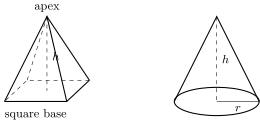
Coach- A pyramid has a polygon as its base and a point, the apex, joined to every vertex of the base by triangular faces. Its height is the distance from the apex to the plane of the base.
- A cone is the same construction over a disk: a base disk, an apex, and a curved lateral surface.
A pyramid is regular when its base is a regular polygon (square, equilateral triangle, …) and its apex sits vertically above the center of the base.
Examples
Example 62.2 (Counting faces, edges, vertices)
A pyramid with a square base has faces ( square triangles), edges and vertices. With an -sided base: faces, edges, vertices. Check Euler’s little pattern: faces vertices edges .
Example 62.5
A pyramid has a square base of side cm and height cm:
An ice-cream cone of radius cm and height cm:
Example 62.6 (Careful with the height)
For a cone, do not confuse the height (apex to center of the base, perpendicular) with the slant height (apex to the rim). They are related by Pythagoras (Theorem 58.1) in the right triangle apex–center–rim: